Start here: the trail map signpost
Meet Nora. Nora runs a website for hikers. Her inbox fills up each week with questions. Many clients ask the exact same thing. Hikers ask if trail maps work offline. When they lose cell signals, they get stuck.
An FAQ is a list of frequently asked questions. Think of an FAQ like a trail signpost. A good signpost gives a quick, direct answer. Then it points hikers down the safe path. Nora wants to build clear signposts for clients.
We write answers backed by real sources. A source is a place to check a fact. It may be a help page or a report. AI can help you draft words fast. You must give the AI true facts first. Never let an AI guess about hiker safety.
A strong FAQ does not guess at facts. It tells clients what works right now. It also states what does not work yet. This guide shows how to write clear facts. Your readers will get fast answers they trust.
Gather your tools and real client notes
Collect your raw inputs before typing prompts. You need real notes from your inbox. You also need approved company manuals. AI tools cannot read your mind. They only know the facts you feed them.
Do not invent fake questions to look busy. Collect real questions from client emails or search logs. Sometimes you must write an anticipated question yourself. In that case, call it an editorial question. Always stay honest about question origins.
A boundary is an exact rule about limits. It states what an app cannot do. You must write boundary rules before drafting answers. This stops an AI from making wild promises.
Set three simple tools on your desk today. Keep your list of recurring client questions ready. Keep approved reference manuals open for quick facts. Keep your written list of system limits nearby.
- A clean list of recurring client questions.
- Approved reference documents that hold verified facts.
- Clear boundary rules that state system limits.
How to draft bounded answers with AI
Start with one client question at a time. Feed the approved fact sheet into your AI. Ask the AI to write two short sentences. Tell it to state the main limit first.
Next, verify every single technical word. An app is a software program for your tasks. If your app only saves text offline, say so. Never promise a feature that is not tested yet. Check that the draft matches your source note.
Then, attach a direct link to the proof. Good answers stand alone without the rest of page text. Readers must understand the limit if they skim fast. Cut out extra fluff words that waste time.
A good answer stays short and sweet. It clears up confusion in one quick glance. When you keep answers short, clients read them. You save your support desk hours of work.
A worked example: installable websites
Let us look at Nora's project now. Nora wrote a guide about installable websites. Readers sent three confusing questions to her team. They asked about offline use and app stores. They also asked about alert notices.
These three topics are very different choices. Installation means putting an icon on a screen. Offline use means saving files locally for later. Native distribution means sending files to an app store. Nora must keep these three ideas separate.
Nora uses practice data labeled [Practice Note: Guide Doc v2]. Her rule states: 'Installing an icon does not guarantee offline data access.' Her AI draft explains this rule in plain terms. Direct explanations help clients make smart choices.
Her sample answer states: 'Adding an icon creates a quick screen shortcut. To read maps offline, you must turn on offline storage inside map settings [Practice Note: Guide Doc v2].' Untested phone models are marked for future check.
A second use case: office parking passes
Consider a team at a large town hospital. Workers ask if digital parking passes work underground. A bad FAQ makes big, risky promises. It might say passes work in every basement. That mistake causes morning traffic jams.
The team opens an approved garage manual. The manual says gate scanners require bright phone screens. The draft answer gives the direct rule first. It tells workers to raise screen brightness before driving down.
The team links the hospital parking rule guide. They note scanner behavior on old phones is untested. This protects workers from getting stuck at gates. Clear limits protect real people from simple mistakes.
Now hospital workers know what to expect. They update their phone brightness before entering the garage. Support calls to the front desk drop quickly. Simple facts make life easy for busy staff.
Common mistakes and how to fix them
One big trap is making universal claims. Just because an app works in one browser does not mean it works everywhere. Always name the exact platform and date for facts. This keeps your guide accurate over time.
Another error is hiding limits deep in paragraphs. Put the hard limit right in sentence one. If a tool needs setup steps, say so right away. Never bury bad news behind cheerful marketing phrases.
Do not invent fake client counts to sound popular. If five clients asked, do not say thousands asked. Write in a direct, plain style. Honest help builds strong trust with every client.
Do not repeat article headings as new questions. An FAQ should answer hard questions left after reading. It must clear up deep confusion for real clients.
Read more: Google: SEO starter guide
Check your work before publishing
Run an acceptance check before you publish anything. An acceptance check is a test against strict standards. It ensures your FAQ solves real confusion. It stops you from repeating empty search keywords.
Check that visible words match any technical code. Some web pages use hidden code called schema. Schema is code that tells search engines what text means. Your schema must match visible page text word for word.
Do not claim special search perks just because schema exists. Search tools choose how they display results. Your job is writing honest answers for real human readers. Use this table to check your new work:
| Controlled case | Expected evidence |
|---|---|
| Answer is read without the rest of the page | Its key limitation remains understandable. |
| Question involves a platform capability | The answer states scope and links to relevant evidence. |
| Schema is present | Its contents match the visible FAQ exactly. |
Read more: Google: SEO starter guide
Test your answers and take action
Try this easy test in your office today. Print one FAQ answer on an index card. Hand it to a coworker across the room. Do not show them the full web page. Can your coworker explain the main limit accurately?
If they understand the limit, your answer passes. If they get confused, rewrite the first sentence. Make the boundary clearer and remove difficult words. Good answers are clear to any busy reader.
Now take your next step today. Pick three recurring questions from your real client inbox. Gather your source guides before you prompt any AI. Roseram can help with a task like organizing your evidence, while access and limits depend on your current plan. Grounded facts keep smart systems helpful and safe. Open your inbox now and write your first verified answer.
Draft an FAQ for the supplied installable-website guide. Use these real and editorially proposed questions, preserving their origin. Distinguish installation, offline behavior and native distribution. Cite platform-specific facts and mark untested cases. Do not promise rich results or invent customer counts. Keep each answer direct and bounded.
Your idea. Your next step.
Put Roseram super intelligence to work.
Bring the idea you keep coming back to. Choose a Roseram plan, then give your project a clear first task. You can think it through, build a first version, and improve it as you learn.
Check current access, plan limits, and pricing before joining.
Your next step
Your quick checklist.
Tick a step as you finish it. Your ticks and feedback stay on this device. They are not public reviews.
0 of 7 complete
Tell the community what you tried or tell us what needs fixing. Include a source if you are correcting a fact.
Your questions, answered
Can I include questions we expect to get?
Yes. You can write smart helpful questions. Do not pretend real people asked. Be honest about who wrote them.
Does FAQ code guarantee special search boxes?
No. Special search boxes are extra treats. Search engines pick who gets them. Just focus on helpful visible answers.
How do I know the task is done?
Track where each question started. Check source facts for every line. Match hidden code to visible text. Answer real puzzles without repeat words.
What if a needed fact is missing?
Mark missing facts as untested now. Never let AI guess the answer. Keep it open until you check.
Want the technical details?Open the code notes, deeper checks, and common questions.
These notes go deeper. Use the parts that fit your project. Examples are for learning; they are not claims that we tested your app.
A worked example: where the task becomes difficult
A fictional guide about installable websites receives questions about offline use, app stores and notification permissions. Those questions arise from distinct misunderstandings. The FAQ should explain that installation, offline behavior and native distribution are separate implementation decisions. Use current documentation for platform-specific facts, while leaving untested device behavior marked for verification.
Decisions to make before implementation
Choose questions that remain useful after the main article, not headings repeated as questions. Separate general guidance from product-specific promises. Keep short answers understandable on their own without omitting an essential limitation. Structured data must match visible content, and eligibility for a search feature should not be claimed solely because FAQ markup exists.
A practical sequence for the work
Use the sequence below as a task boundary, not as a claim that the example has been executed. Work with approved inputs and the project’s actual architecture. If a required integration or permission is unavailable, keep that stage visibly incomplete rather than generating a plausible substitute result.
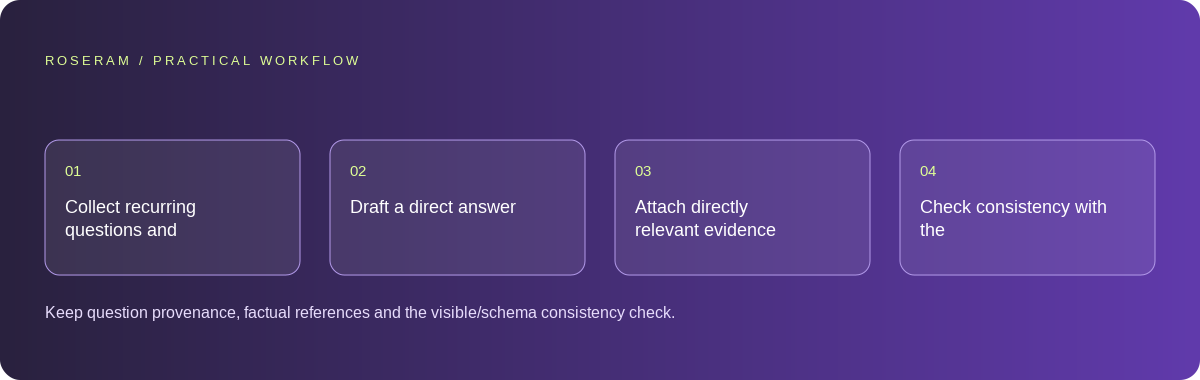
- Collect recurring questions and identify the underlying misunderstanding.
- Draft a direct answer with the important boundary in the same paragraph.
- Attach directly relevant evidence to technical or product claims.
- Check consistency with the article and remove repetitive filler questions.
A detailed brief you can adapt for your agent
Replace the illustrative context with your approved facts and controlled inputs. Keep the stated boundaries when adapting the brief. The expected deliverable matters more than a particular tool name: ask for an explanation grounded in the inspected material and evidence for the requested outcome.
Draft an FAQ for the supplied installable-website guide. Use these real and editorially proposed questions, preserving their origin. Distinguish installation, offline behavior and native distribution. Cite platform-specific facts and mark untested cases. Do not promise rich results or invent customer counts. Keep each answer direct and bounded.
Failure modes that an attractive preview can hide
Generated FAQs often make universal claims from one browser or vendor example. Qualify the platform and date where necessary. Do not invent support volume or pretend the questions came from customers when they are editorially proposed. A helpful FAQ can use anticipated questions honestly; it should not fabricate a popularity or testing claim.
Read more: Google: SEO starter guide
Acceptance checks and the evidence to retain
Keep question provenance, factual references and the visible/schema consistency check. The FAQ should resolve actual uncertainty rather than add repetitive keyword variants.
| Controlled case | Expected evidence |
|---|---|
| Answer is read without the rest of the page | Its key limitation remains understandable. |
| Question involves a platform capability | The answer states scope and links to relevant evidence. |
| Schema is present | Its contents match the visible FAQ exactly. |
Common questions
Can anticipated questions be included?
Yes. Present them as useful editorial questions rather than fabricated customer feedback.
Does FAQ markup guarantee a rich result?
No. Search feature availability and eligibility are separate from writing useful visible answers.
What is the practical completion criterion?
Keep question provenance, factual references and the visible/schema consistency check. The FAQ should resolve actual uncertainty rather than add repetitive keyword variants.
Where the facts come from
Use these links to check the technical facts. The stories here are made-up examples to help you learn. Roseram sells AI tools; our examples are not promises of results.
- Google: SEO starter guide ↗
What this source covers
Discovery, descriptive titles, useful content and understandable links.
References last reviewed 2026-10-11. Writing refreshed 2026-10-14. Spot a mistake? Tell us.
