Welcome to honest web pages
You have one web page to explain your service. A landing page is a page made for one goal. Readers need to know who it helps right away. They must see what they get without delay. Clear words do the heavy lifting for your firm.
Think of your page like a clear shop sign. A bakery sign should promise warm bread, not cars. AI tools can draft words for you very fast. But fast words can make big false claims. Good writing tells the simple truth to every client.
Meet Nora. Nora runs a fictional shop called Bright Audit. She checks business websites to fix slow pages. She wants clients to book her service without confusion. We will follow Nora as she makes her page. She will use an AI app to write words.
- Name the problem your client faces today.
- Describe your offer with real, honest facts.
- Use one simple call to action button.
Tools and facts you need first
Do not ask an AI to write without facts. Think of AI as an engine that needs fuel. If you give it thin air, it invents things. You need an approved fact sheet before you write. Keep this simple text file open on your screen.
Write down your true price and your delivery speed. Add every exclusion to your list before drafting. An exclusion is a task that you do not do. Nora states she inspects speed, but never rewrites code. This clear line protects Nora from bad client jobs.
Gather your sample notes and your audience definition next. An audience is the group of people who buy. Nora serves small shop owners who sell items online. Keep your notes brief, clear, and very easy to read.
How to draft your page in steps
First, draft the headline with the client problem. A headline is the large title at the top. The headline should name the true pain clients feel. It shows that you understand their daily work. It invites them to read the rest of the text.
Second, show how your service solves that exact problem. Use your approved facts to explain each step. Tell the reader what file or report they get. A deliverable is the finished item handed to a client. Keep every single sentence short and plain to read.
Third, build the next step with one clear path. A call to action or CTA is your button. Make sure the button text matches what comes next. If it says waitlist, open a waitlist form. Never open a checkout screen without warning the client.
- Draft approved offer facts, limits, and client pain first.
- Build a clean path from problem to proof.
- Check every single claim against your true fact sheet.
- Test how the words read on a small phone.
A worked example: Bright Audit
Here is where writing with AI can get tricky. Nora asked an AI app to write her review page. The first draft made wild claims about massive growth. It said, Guaranteed ten times growth in two days! Those words were invented, silly, and completely false.
Those big claims bring clients who expect magic rebuilds. Nora does not rebuild entire websites from scratch. Her real offer is a fifty-point speed and checkout report. Her true report takes three days to send by email. It costs four hundred dollars for each small business.
Nora fixed the prompt with labeled practice facts. She added real sample findings from a test shop. She removed every invented star quote from the draft. The new copy states what the audit includes and excludes. Now, only the right clients book her review service.
A second use case: green lawn care
Let us look at Marcus and his lawn care firm. Marcus uses an AI app to write a page. He offers lawn aeration to home owners every autumn. Aeration means punching small holes in soil for air. Marcus wants local clients to book an inspection visit.
The first AI draft promised golf greens in one night. It also added five fake star ratings from neighbors. Marcus removed those false ratings to protect local trust. He replaced them with photos of his real aerator machine. Real photos show clients how his tool works outside.
Marcus also wrote clear exclusions on his landing page. He stated he only works on yards under one acre. His button says, Request a lawn date on our calendar. Visitors know what happens next on the screen. His phone calls stay friendly and free from confusion.
Mistakes to avoid and how to fix them
Attractive previews can hide dangerous traps in sales copy. A flashy headline may get clicks, but causes angry calls. If people buy the wrong service, support inboxes fill up. We must track happy, qualified leads, not just clicks. A qualified lead is a client who fits your offer.
Do not invent fake deadlines or fake counts of stock. A countdown timer that resets every hour is a trick. False urgency makes your firm look cheap over time. Honest clarity will always win better clients for your work.
Avoid huge pop-up windows that block the screen. A pop-up overlay is a window over the words. Visitors must be able to close boxes with one tap. Make sure mobile clients can read all terms with ease.
Check your links so they guide readers along safely. Google guides show that clear links help readers find info. A link is clickable text connecting two web pages. When words describe destinations well, clients feel safe browsing.
Read more: Google: SEO starter guide
Checks to run before you launch
You must run acceptance checks before your page goes live. Keep an approved claim sheet in a folder for staff. A claim is a statement of fact or benefit. You should verify every link, claim, and button carefully.
Never swap missing proof with a fake star rating. If you lack case studies, share your working method. You can also show an inspectable sample report instead. This table shows how to check your new landing page.
| Controlled case | Expected evidence |
|---|---|
| Visitor reads the page briefly | They can explain what is included and what the next action does. |
| CTA is labeled as a waitlist | It opens the expected opt-in workflow rather than an unannounced purchase. |
| Page includes a proof statement | Its underlying sample or source is real and inspectable. |
Your clear next action
Now it is time to test your landing page copy. Show your drafted page to a friend on a phone. Give them thirty seconds to read from top to bottom. Then take the phone away and ask two simple questions.
Ask what service is sold and what the button does. If they can answer both, your copy is working. If they are confused, trim big words from the page. Rewrite the headline until your simple offer is crystal clear.
Roseram can help you test drafts and organize inputs. Access and limits depend on the current plan you use. Start with honest facts today and build real client trust.
Draft a landing page for this approved website-review service. Explain the deliverable, audience, exclusions and enquiry process. Use only the supplied evidence: Bright Audit costs four hundred dollars, checks site speed, and takes three days. It does not rebuild code. Do not invent testimonials, scarcity, or growth guarantees. Match the CTA to the actual opt-in form and propose a mobile comprehension check before copy experiments.
Your idea. Your next step.
Put Roseram super intelligence to work.
Bring the idea you keep coming back to. Choose a Roseram plan, then give your project a clear first task. You can think it through, build a first version, and improve it as you learn.
Check current access, plan limits, and pricing before joining.
Your next step
Your quick checklist.
Tick a step as you finish it. Your ticks and feedback stay on this device. They are not public reviews.
0 of 6 complete
Tell the community what you tried or tell us what needs fixing. Include a source if you are correcting a fact.
Your questions, answered
Can AI make up examples for my page?
You can use pretend stories. Label pretend stories as pretend clearly. Never call them real customer wins.
Are clicks the only score that matters?
No. Good visitor questions matter too. Truthful expectations matter for users. Working buttons matter after clicks happen.
How do I know the task is done?
Save approved facts and claims lists. Check the path to big buttons. Watch lead quality and user knowledge.
What if my service has tasks it skips?
Put excluded tasks near the top. Place limits right by your offer. Tell people what you cannot do.
Want the technical details?Open the code notes, deeper checks, and common questions.
These notes go deeper. Use the parts that fit your project. Examples are for learning; they are not claims that we tested your app.
A worked example: where the task becomes difficult
A fictional consultancy offers a paid website review, not a full rebuild. The AI draft promises a complete redesign and “guaranteed growth.” Those claims attract the wrong expectations. A useful landing page states what the review includes, how it is delivered, who it suits and what the customer must provide. Genuine sample findings can demonstrate value without invented testimonials.
Decisions to make before implementation
Define the conversion and the commitment it creates: enquiry, waitlist or purchase. Keep availability and pricing accurate. Match the CTA to the actual next screen so a “join waitlist” button does not open unexpected checkout. Place important exclusions near the offer. Evidence can be a real sample, method or attributable case; do not substitute fabricated star ratings for missing proof.
A practical sequence for the work
Use the sequence below as a task boundary, not as a claim that the example has been executed. Work with approved inputs and the project’s actual architecture. If a required integration or permission is unavailable, keep that stage visibly incomplete rather than generating a plausible substitute result.
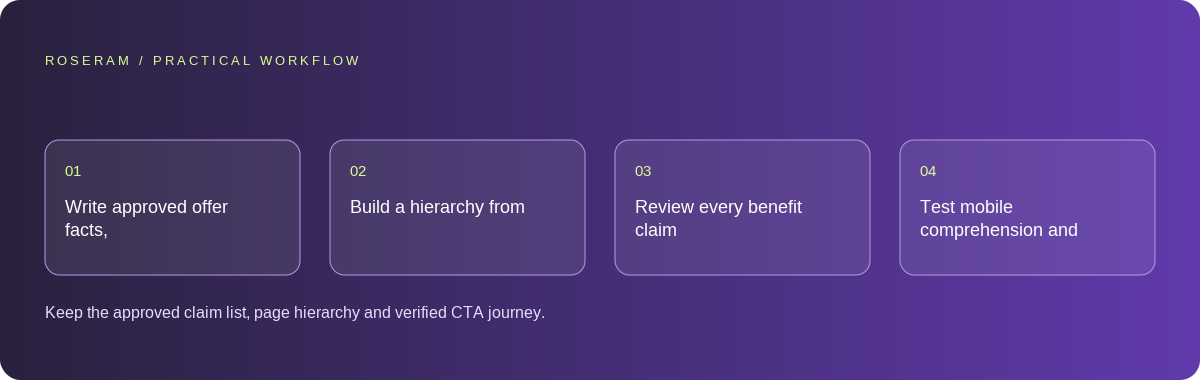
- Write approved offer facts, audience and exclusions before drafting.
- Build a hierarchy from customer problem to method, evidence and next step.
- Review every benefit claim and the actual CTA destination.
- Test mobile comprehension and the complete enquiry or purchase journey.
A detailed brief you can adapt for your agent
Replace the illustrative context with your approved facts and controlled inputs. Keep the stated boundaries when adapting the brief. The expected deliverable matters more than a particular tool name: ask for an explanation grounded in the inspected material and evidence for the requested outcome.
Draft a landing page for this approved website-review service. Explain the deliverable, audience, exclusions and enquiry process. Use only the supplied evidence. Do not invent testimonials, scarcity or growth guarantees. Match the CTA to the actual opt-in form and propose a mobile comprehension check before copy experiments.
Failure modes that an attractive preview can hide
A persuasive headline can increase clicks while creating unsuitable leads. Track qualified outcomes and support confusion, not only button activation. Avoid invented scarcity, customer counts and guarantees. Promotional overlays should remain dismissible and must not prevent a visitor from understanding the offer or reaching terms relevant to a purchase.
Read more: Google: SEO starter guide
Acceptance checks and the evidence to retain
Keep the approved claim list, page hierarchy and verified CTA journey. Copy performance should be assessed alongside lead quality and customer understanding.
| Controlled case | Expected evidence |
|---|---|
| Visitor reads the page briefly | They can explain what is included and what the next action does. |
| CTA is labeled as a waitlist | It opens the expected opt-in workflow rather than an unannounced purchase. |
| Page includes a proof statement | Its underlying sample or source is real and inspectable. |
Common questions
Can AI invent examples to demonstrate the service?
Hypothetical examples can be labeled clearly; do not present them as real customers or results.
Is click-through rate the only measure?
No. Qualified enquiries, fulfilled expectations and working downstream actions matter too.
What is the practical completion criterion?
Keep the approved claim list, page hierarchy and verified CTA journey. Copy performance should be assessed alongside lead quality and customer understanding.
Where the facts come from
Use these links to check the technical facts. The stories here are made-up examples to help you learn. Roseram sells AI tools; our examples are not promises of results.
- Google: SEO starter guide ↗
What this source covers
Discovery, descriptive titles, useful content and understandable links.
References last reviewed 2026-10-11. Writing refreshed 2026-10-14. Spot a mistake? Tell us.
