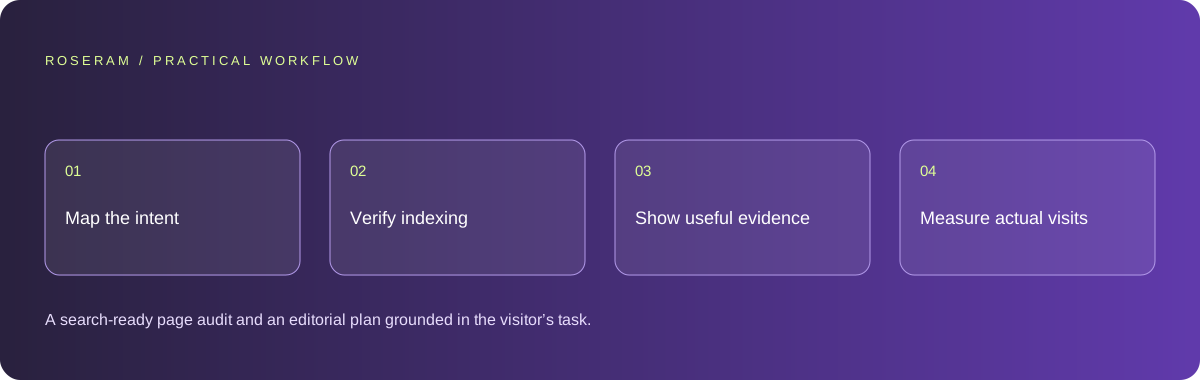
Choose a question the page can genuinely answer
Map each intended query to the reader’s task. Someone asking how to build a website needs a workable method. Someone comparing costs needs assumptions, limits and arithmetic. Someone debugging an imported project needs a diagnosis path. These intents should not all lead to the same generic page with a renamed heading.
Cluster close variants on one strong page where the answer is the same. Create separate pages only when the task, evidence or outcome differs substantially. A query spreadsheet is a planning artifact, not permission to publish thousands of lightly rephrased pages. Keep a reason for each URL and an explicit relationship to nearby pages.
Validate demand with a source that reports search volume for the relevant geography and period. Search results demonstrate that content exists, not how many people searched. Google Ads competition concerns advertisers, so do not present it as organic keyword difficulty. Record unknown metrics as unknown instead of filling a table with plausible numbers.
Check crawlability, successful responses and canonical output
Open the public route directly and inspect its rendered output. Verify a successful response and substantive readable content. Check whether the route is disallowed, marked noindex or requires sign-in. A JavaScript application can need additional care to make its primary content understandable and accessible.
Choose a stable canonical URL and avoid competing versions of the same page. Align internal links and sitemap entries with that URL. Keep private account and application workflows out of indexing while retaining useful interface metadata. A sitemap suggests discovery; it does not prove Google has indexed a page.
Use Search Console to inspect representative pages after deployment. Keep a record of what Google reports and when. A local metadata check is valuable engineering evidence, but it cannot establish live index coverage. Distinguish “indexable in source,” “deployed,” “indexed” and “ranking” in your reporting.
Technical references: Google: SEO starter guide
Build content around original work and traceable evidence
Add the information that helps the visitor complete the task: examples, tradeoffs, failure cases, decision tables and verification criteria. For a product review, distinguish publisher claims from your own observed tests. For a public-record investigation, identify the source, record date and whether a matter is an allegation, settlement or final outcome.
Use expert review when the topic requires it and identify the actual reviewer. Do not invent biographies or imply laboratory testing because the article includes a scorecard. An original worked example is useful when its assumptions are visible and the reader can adapt or reproduce it.
For public interviews, summarize the relevant argument in your own words and link to the original with contextual timestamps when verified. Keep direct excerpts brief and properly attributed. Do not republish a complete copyrighted transcript or attach a celebrity name to an unrelated sales page merely to capture search traffic.
Make a dense article easy to navigate
Answer the main question early. Use a table of contents, descriptive headings, clear examples and concise comparison tables. Let readers choose the depth they need. A long page should contain more useful analysis, not a slower route to the same answer. Bold a decision or condition; use emphasis sparingly; underline links so their purpose is recognizable.
Supply descriptive image alternatives and an explanation of what each chart represents. Use original diagrams where they teach a process. Reserve media dimensions and load embedded video only when requested. A video introduction does not replace written instructions for someone who cannot or does not want to watch it.
Keep the main content distinguishable from promotions. A waitlist invitation can be relevant after the page delivers its answer, and readers should be able to dismiss it and continue. Evaluate the effect of mobile overlays and interruptions on actual customer journeys instead of assuming every popup improves conversions.
Technical references: Google: semantic HTML · Google: Web Vitals
Optimize for AI answers through clarity and trustworthy substance
Google’s current guidance for generative AI search emphasizes technical clarity and valuable original content. A page must be eligible for discovery and indexing before its content can be considered. There is no dependable shortcut that makes a weak article authoritative by adding an “AI-optimized” label.
Make important factual claims easy to inspect. State definitions, include units and date assumptions, link to primary sources and distinguish advice from observed evidence. Structured data should reflect the visible page. Do not add invented reviews, hidden claims or a FAQ schema solely to imply eligibility for a rich result.
Write coherent sections that can stand on their own without contradicting the rest of the article. This helps a reader who arrives at a particular answer and makes the material easier to interpret. Keep the broader context available so a concise answer does not omit an important limitation.
Technical references: Google: optimizing for generative AI search · Google: people-first content
Measure useful engagement without inventing ranking signals
Track qualified outcomes alongside visits: completed enquiries, successful applications of a guide and recurring support questions. Use Search Console for queries, impressions and clicks where access is available. Page analytics and search visibility measure different things; neither should be rewritten as a guaranteed ranking factor.
Use a review queue for pages with poor engagement or outdated evidence. Investigate intent mismatch, an unclear answer, broken mobile controls, slow loading or obsolete product behavior. Consolidate overlapping pages and correct internal links when needed. Publishing more pages is not always the best response to a weak existing page.
Set a practical standard: the reader can answer the question, understand the limits, trace important sources and perform the next step. Google’s people-first guidance explicitly discourages chasing a supposed preferred word count. Expand a page when it needs additional substance, not merely because another result is longer.
Technical references: Google: people-first content
Specific answers
Common questions
Can an AI-generated website rank on Google?
Its origin does not by itself establish quality or prevent eligibility. Useful content, technical accessibility and the search engine’s evaluation determine the outcome; ranking is not guaranteed.
Does every article need 20,000 words?
No. Use enough detail to satisfy the intent. A longer article can be appropriate for a complex subject, but repeating material to reach a word count reduces clarity.
Do bold tags, keywords or FAQ schema guarantee rankings?
No. Use formatting to help readers and structured data to represent visible content accurately. These are not substitutes for substantive evidence or a guarantee of search placement.
Sources and editorial method
These references support the indicated technical facts. Workflows, examples and decision tables are original Roseram analysis. Illustrative costs are not vendor prices. No search volume, organic difficulty, ranking result or product endorsement is implied.
- Google: SEO starter guide ↗
Discovery, descriptive titles, useful content and understandable links.
- Google: semantic HTML ↗
Meaningful document structure supports readers and accessibility tools.
- Google: Web Vitals ↗
LCP, INP and CLS measure loading, interaction and visual stability.
- Google: optimizing for generative AI search ↗
Technical SEO and useful original content remain relevant to AI search; inclusion is not guaranteed.
- Google: people-first content ↗
Evaluate usefulness and originality instead of targeting a prescribed word count.
Roseram offers AI software and may compete with tools discussed here. Sources checked 2026-10-11. Send a sourced correction.
Your next step
Keep a practical checklist.
Mark your progress. This checklist and helpfulness choice are saved on this device only; they are not public reviews.
0 of 5 complete
Share your experience in the community or submit a sourced correction. Public experiences remain separate from editorial claims.
Bring your next idea
Keep learning. Build with context.
Get Roseram model and workspace reopening updates. The guide remains available whether or not you subscribe.
Explore the workspace guide →