Start here with a clear plan
Meet Nora. Nora runs a busy shop for green plants. She wants to cut her website costs. Writing without a plan is hard work. An AI content brief is a short instruction note. It tells an app what to write. Think of it like a recipe card. A good recipe names the dish and steps. It also names the fresh food to use.
A weak note creates dull, empty words. Nora needs true facts before she starts. She must list the client question first. Next, she lists the facts to check. Then she adds one good practice case. This keeps the whole draft on track. It saves her team many long hours. Let us learn how to make one.
Good briefs give smart bounds to the app. An app can write fast. But an app does not check the truth. You must direct the work with care. Give the tool solid facts up front. Then the tool produces clear, helpful text. Your readers will thank you for it.
Gather your tools and inputs
First, gather your basic tools and facts. You need four items before opening an app. You need your reader name and job. You need the main problem they face. You need official links for big claims. A claim is a statement made as fact. Last, you need one original case to share.
Never ask an app to invent facts. A source is an official page that proves truth. Broad sales pages do not count here. You need current help guides from the makers. Nora collects two direct help articles now. Now her card has clean, fresh ingredients.
Pick a single clear goal for the page. Do not chase five goals at once. One strong goal keeps the draft sharp. Tell the app who will read this. Give the app the required starting steps. Note what done looks like for the reader. This stops the app from rambling on.
- A clear client name and daily role.
- One exact problem the article will solve.
- Direct links to official help documents.
- One planned practice case for the reader.
A practical sequence for the work
Now build the brief in clean order. First, write down the reader outcome. What will the client finish today? List the main claims that matter most. Tie each big claim to an approved source. Do not guess on hard technical points. Keep factual claims separate from your own thoughts.
Next, design an original test or case. Do not copy headings from other web pages. That makes every article look the same. Build an original breakdown of a real failure. This adds fresh value for the reader. It sets your work apart from others.
Last, draft the outline with care. Check if every section helps the client. Does each line advance the reader task? If a source link is missing, stop. Mark that part unfinished right away. Do not invent a fake fact to fill it.
- Define client, task, and completion outcome.
- List critical claims and their direct sources.
- Design an original example or failure check.
- Draft the outline and check reader value.
A worked example: where the task becomes difficult
Now let us study a harder case. Fictional book publisher Apex Books wants a guide. The guide explains testing an AI checkout app. A bare list of headings produces weak advice. The brief must set exact task boundaries. It must define a controlled purchase journey.
The brief must track rejected cards clearly. It must handle duplicate orders without error. These points need current official documentation. Broad web pages will not help here. The team must look up actual rules. They assign a direct source for each rule.
Apex Books builds a practice test matrix. They do not rewrite rival headings. They make a clean test grid instead. All practice figures get an illustrative label. The brief leaves no room for guesses. The writer knows what to show first.
- Define the full client purchase flow.
- List payment provider rules for bad cards.
- Map handling steps for duplicate order charges.
- Label all test matrix data as practice.
A second real-world use case
Let us study another clear use case. Fictional shop Bright Solar writes on website fees. Many writers just guess at monthly server bills. That confuses readers who need real savings. Bright Solar maps each claim to real pricing. They use current hosting rate sheets directly.
Their brief demands an original cost sheet. It contrasts flat plans against pay-per-use plans. It leaves out generic marketing words. The final guide helps store owners make choices. Every price claim holds solid proof behind it. Nothing is left to pure guesswork.
The brief marks optional background as extra. It keeps the main buying steps front and center. The writer gets a firm source date too. A named team member owns all factual fixes. This stops outdated prices from reaching print. The client gets clear help they can trust.
Failure modes and how to fix them
Briefs copied from rivals repeat old errors. This makes new pages boring and weak. An acceptance check is a test of work quality. Inspect primary evidence to spot open gaps. See what existing web coverage leaves out. Build your piece to answer those open gaps.
Never ask for invented client quotes. Avoid asking for fake test results too. If you have not run a test, say so. Present its plain procedure and expected evidence instead. Do not set a fixed word length. Long counts make writers repeat old answers.
- Never copy headings from rival web pages.
- Avoid invented first-person tests and fake quotes.
- Do not force a fixed word count.
- Mark unfinished research as incomplete with honesty.
Read more: Google: SEO starter guide
Acceptance checks to review
Run these checks before writing begins. Keep your brief and source map ready. Keep the original example plan in view. The writer must know which facts are solid. They must see which parts need more research.
Use this check table to stay safe. It keeps your team on the right track. Each controlled case demands solid, direct proof. If proof is missing, fix it now. Do not send weak notes to your writer.
| Controlled case | Expected evidence |
|---|---|
| Brief contains a vendor capability claim | A directly supporting current source is assigned. |
| Section repeats an earlier answer | It is removed or given a distinct reader purpose. |
| Example is hypothetical | The article labels it as illustrative rather than observed customer evidence. |
A quick test you can perform
You can test your brief right now. This quick test takes under five minutes. Print your brief on a clean sheet. Take a bright pen in your hand. Circle every single factual statement you see.
Now draw a line to its source. Every circled fact needs a real link. Did you find a fact with no link? Do not let the app guess that part. Go find the official document right now. If no source exists, remove the claim.
Check your original example next. Is it clearly labeled as a practice case? It must never look like an observed test. If the label is missing, write it down. Your brief passes only when every claim connects.
Your clear next action
Pick one article topic on your desk. Write down the reader goal right now. Collect three verified sources for key claims. Use our prompt template below to start. Roseram can help with a task like this. Access and limits depend on your current plan. Real evidence always beats unguided guesses. Build your clean claim map first today. Then let your app draft the clear text.
Create a source-backed brief for testing an AI-built checkout for Apex Books. Define the reader outcome, required provider evidence, and an original failure matrix for rejected cards and duplicate orders. Separate factual claims, analysis, and hypothetical examples. Do not copy competitor text, invent tests, or force a word target. Explain what each section adds and identify unanswered research questions.
Your idea. Your next step.
Put Roseram super intelligence to work.
Bring the idea you keep coming back to. Choose a Roseram plan, then give your project a clear first task. You can think it through, build a first version, and improve it as you learn.
Check current access, plan limits, and pricing before joining.
Your next step
Your quick checklist.
Tick a step as you finish it. Your ticks and feedback stay on this device. They are not public reviews.
0 of 6 complete
Tell the community what you tried or tell us what needs fixing. Include a source if you are correcting a fact.
Your questions, answered
Is a list of titles enough?
No. You need real sources. Explain what readers should learn.
Should our page have more words?
Longer pages are not better. Give the most helpful answers.
How do I know the task is done?
Keep your brief and sources. Show which facts need research. Let writers work with ease.
Why label practice sample data?
Tell readers examples are fake. Do not fool your readers.
Want the technical details?Open the code notes, deeper checks, and common questions.
These notes go deeper. Use the parts that fit your project. Examples are for learning; they are not claims that we tested your app.
A worked example: where the task becomes difficult
A fictional publisher wants an article about testing an AI-generated checkout. A headings-only outline produces generic advice. The brief should define a controlled purchase journey, rejected-payment behavior, duplicate handling and evidence boundaries. It should also identify which payment-provider facts need current official documentation. The original contribution can be a worked test matrix, not a rewritten list of competitor headings.
Decisions to make before implementation
Assign one primary intent and distinguish essential sections from optional background. Keep sourced facts separate from original analysis and hypothetical examples. Set a source date and correction owner. Require factual product claims to use directly relevant evidence rather than broad marketing pages. Do not specify a fixed word count that encourages the writer to repeat an answer after it is complete.
A practical sequence for the work
Use the sequence below as a task boundary, not as a claim that the example has been executed. Work with approved inputs and the project’s actual architecture. If a required integration or permission is unavailable, keep that stage visibly incomplete rather than generating a plausible substitute result.
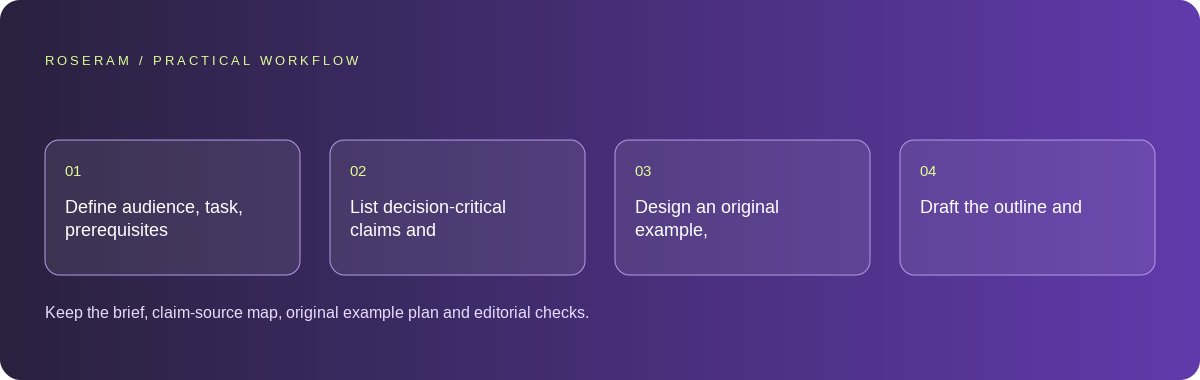
- Define audience, task, prerequisites and completion outcome.
- List decision-critical claims and the sources needed to support them.
- Design an original example, comparison or failure analysis.
- Draft the outline and evaluate whether each section advances the reader’s task.
A detailed brief you can adapt for your agent
Replace the illustrative context with your approved facts and controlled inputs. Keep the stated boundaries when adapting the brief. The expected deliverable matters more than a particular tool name: ask for an explanation grounded in the inspected material and evidence for the requested outcome.
Create a source-backed brief for testing an AI-built checkout. Define the reader outcome, required provider evidence and an original failure matrix. Separate factual claims, analysis and hypothetical examples. Do not copy competitor text, invent tests or force a word target. Explain what each section adds and identify unanswered research questions.
Failure modes that an attractive preview can hide
A brief assembled from competing articles can reproduce their errors and make every new page interchangeable. Inspect primary evidence and identify what the existing coverage leaves unresolved. Avoid asking for invented first-person testing or customer quotes. If a test has not been run, present its procedure and expected evidence rather than writing a fabricated result.
Read more: Google: SEO starter guide
Acceptance checks and the evidence to retain
Keep the brief, claim-source map, original example plan and editorial checks. The writer should know which statements are publishable and which still require research.
| Controlled case | Expected evidence |
|---|---|
| Brief contains a vendor capability claim | A directly supporting current source is assigned. |
| Section repeats an earlier answer | It is removed or given a distinct reader purpose. |
| Example is hypothetical | The article labels it as illustrative rather than observed customer evidence. |
Common questions
Is a list of headings a complete brief?
No. It also needs evidence, intent and the page’s original contribution.
Should the brief demand more words than competitors?
Demand a more complete answer where useful; length alone does not establish quality.
What is the practical completion criterion?
Keep the brief, claim-source map, original example plan and editorial checks. The writer should know which statements are publishable and which still require research.
Where the facts come from
Use these links to check the technical facts. The stories here are made-up examples to help you learn. Roseram sells AI tools; our examples are not promises of results.
- Google: SEO starter guide ↗
What this source covers
Discovery, descriptive titles, useful content and understandable links.
References last reviewed 2026-10-11. Writing refreshed 2026-10-14. Spot a mistake? Tell us.
