What Search Intent Means for You
A person types words into a small web box. Search intent is the true goal behind those words. Think of a guest walking into a shop. If they ask for water, do not hand them a map. Hand them a cool cup of water first. Match their clear need right away.
Clara owns a busy bakery called Sweet Pine. Her website gets visits, but people leave fast. Clara wants to use AI to analyze search intent. AI means artificial intelligence, which is a smart computer program. It sorts words to find real human goals. It helps Clara see what her clients want.
Clara learns a good lesson on day one. A person searches for a broken contact form. They need a fix, not a speech about AI. Ask what result would make that visitor glad they clicked. Good sites help the client win.
When your page meets the true goal, clients stay. They read your words and trust your shop. Today, we will help Clara inspect search words. We will show you how to give each client real help.
- Search intent is the real goal behind words.
- Good pages give visitors fast, direct help.
- Happy readers stay longer and trust your site.
Tools and Notes You Need First
Clara gathers her facts before she touches an app. You do not need costly tools to inspect search words. You need a text file, your eyes, and an AI app. Clara opens a blank note on her screen. She is ready to start her work.
First, Clara writes down her target search phrase. A query is the phrase a person types into a web box. Next, Clara looks at live web results on her screen. She writes down the date of her search. Web results change over time, so the date matters.
She also writes down each page format. A page format is the shape of a web page. It can be a guide, a shop, or a list. Never guess what people want without looking at real pages. Real pages show what works right now.
Keep your notes clean, plain, and honest. An AI app cannot read minds, so feed it real notes. When you give it dated facts, your helper stays sharp. Clara now has her notes ready for the test.
- A blank text file for your dated notes.
- A target query that you want to test.
- Live web results that show current page shapes.
- An AI app to help read your notes.
Read more: Google: SEO starter guide
Three Plain Steps to Sort Goals
Clara follows three plain steps to sort client goals. First, she reads the search phrase with care. She writes down two ways a person might mean those words. This keeps her open to surprise goals. It stops bad guesses early.
Second, she looks at current useful answers and reader questions. What tasks do other good pages solve right now? Clara spots missing tips that clients still need. She notes these gaps in her short file. She wants to fill those gaps well.
Third, she picks a page format that solves the task. A word in the search phrase does not always mean buying intent. Buying intent means the client wants to spend money now. Some words look like sales words but are not.
If clients want steps, give them a guide. If they want to compare tools, build a list. Clara matches each clear goal to one smart page shape. Now her readers find what they need fast.
- Step 1: Read the search phrase and list two goals.
- Step 2: Check current answers and find reader gaps.
- Step 3: Choose a page format that solves the task.
Read more: Google: SEO starter guide
A Worked Example with Practice Data
Clara tests her method with a tricky phrase: AI appointment booking. Some searchers want software to buy. Other searchers want steps to build a booking tool. A tutorial and a product comparison answer different questions. They do not serve the same goal.
Clara reviews sample results for her market. She notes whether they are tools, guides, or help pages. She writes: Sample Date: October 12; Top format: tool lists. Clara keeps that dated note separate from monthly demand claims. Demand means how many people search each month.
Clara does not guess demand without real data. She only studies the intent shown on her screen. She tells her AI app to focus on clients buying tools. Clara picks a tool comparison list format. Her page will compare top tools for small bakery shops.
She leaves out code steps. A client who wants to buy an app does not want code. Clara solves the exact task her client brings to the page. Her plan is tight and clean.
| Searcher Goal | What the Client Wants | Best Page Format |
|---|---|---|
| Buying a tool | Wants to buy a booking app | Tool comparison list |
| Building a tool | Wants steps to write booking code | How-to guide |
| Fixing a bug | Wants to fix a broken calendar | Help page |
Read more: Google: SEO starter guide
A Second Story: Fixing Bike Brakes
Let us visit Marco in his bike shop. Marco fixes bikes on a quiet street corner. He wants more clients to book tune-ups on his site. Marco looks at a new query: squeaky bike brakes fix. He wants to know the intent.
Marco wonders if this client wants to pay for repairs. He checks the top search results on his phone. Every top page shows a short video or cleaning steps. The searchers want to fix the squeak at home. They do not want a shop visit yet.
If Marco makes a sales page, visitors leave fast. Instead, he writes a short guide on brake dust. At the end, he adds a polite note about bent parts. He solves the client's home task first. This builds trust with local riders.
When a bike frame breaks later, riders call Marco. Knowing search intent helps Marco make friends, not bounce guests. His site gains trust because it helps first.
Read more: Google: SEO starter guide
Mistakes to Avoid and How to Fix Them
Many site owners make easy slips when using AI. An AI model can claim that a query has low competition. It says that just because a phrase sounds long. That is not measured evidence. Words alone do not prove an easy win.
Keep volume, ad bids, and organic strength separate. Organic results are normal web links that win without paid ads. Inspect real result quality, authority, and intent instead. Do not fear an exact-match web name until you read its page.
Another slip is making too many tiny pages. If two phrases share the same task, stop right there. They belong together on one canonical article. A canonical article is the single home page for one core topic.
Do not split twin queries across two weak pages. Combine them into one great page that answers both fully. This helps clients find everything in one clean spot.
- Mistake: Believing an AI guess about low competition.
- Fix: Keep search numbers separate from word intent.
- Mistake: Making two pages for twin queries.
- Fix: Combine identical tasks into one main page.
- Mistake: Fearing big site names without checking them.
- Fix: Inspect the actual page to see its quality.
Read more: Google: SEO starter guide
A Quick Test You Can Run Today
You can test your search intent skills right now. Pick one search phrase from your own site list. Write down your guess about what the client wants. Do they want to buy, learn, or fix something? Keep your guess short and plain.
Next, open a private web tab on your screen. Search for your target phrase in that tab. Open the top three links and look at their shapes. Are they how-to guides, lists, or direct answers? Compare those live shapes with your first guess.
Now ask your AI app to read those three titles. Ask it to name the main task they solve. Does the AI answer match what you saw with your eyes? If they match, your intent choice is sound.
You now know the real goal of the query. You can outline your new page with full confidence. You are ready to help your site visitors win.
Read more: Google: SEO starter guide
Acceptance Checks and Your Next Steps
Before you write, check off your final steps. Keep the dated result sample, intent choice, reader task, and outline. Treat the brief as a research decision. You can revise it when real performance data arrives. Do not guess what you cannot see.
Validate your outline against a reader scenario before drafting copy. Roseram can help with this task. Roseram is an AI platform that organizes search research and outlines. Access and limits depend on your current plan. Roseram keeps your research notes in line.
Start with your target query today. Match your page shape to the reader task. Build a web page that makes your clients glad they clicked.
| Controlled Case | Expected Evidence |
|---|---|
| Query supports buying and building interpretations | The brief selects and explains one primary intent. |
| Two phrases imply the same task | They are mapped to one page unless meaningful differences justify separation. |
| Metrics are unavailable | The plan labels opportunity as unqualified rather than inventing numbers. |
Read more: Google: SEO starter guide
Analyze this query for the supplied market using the dated result observations: 'AI appointment booking'. Compare buying, learning, and troubleshooting intent. Recommend a page format and the questions it must answer. Keep search volume and organic competition unknown unless measured data is supplied. Explain overlapping queries that should share a canonical page.
Your idea. Your next step.
Put Roseram super intelligence to work.
Bring the idea you keep coming back to. Choose a Roseram plan, then give your project a clear first task. You can think it through, build a first version, and improve it as you learn.
Check current access, plan limits, and pricing before joining.
Your next step
Your quick checklist.
Tick a step as you finish it. Your ticks and feedback stay on this device. They are not public reviews.
0 of 7 complete
Tell the community what you tried or tell us what needs fixing. Include a source if you are correcting a fact.
Your questions, answered
Can wording prove people search this?
Words show what people want. They do not count clicks. You must measure real visits.
Should every search phrase get a page?
No. Similar phrases need one page. Do not make duplicate pages.
How do I know the task is done?
Save your dated search sample. Save the chosen reader goal. Keep your final page outline.
What if data numbers are missing?
Mark the search term unapproved. Never make up fake numbers.
Want the technical details?Open the code notes, deeper checks, and common questions.
These notes go deeper. Use the parts that fit your project. Examples are for learning; they are not claims that we tested your app.
A worked example: where the task becomes difficult
A fictional business considers the phrase “AI appointment booking.” Some searchers want software to buy, others want instructions for building a booking system. A tutorial and a product comparison answer different questions. Review representative results for the intended market and note whether they are tools, guides, directories or troubleshooting pages. Keep that dated observation separate from any claim about monthly demand.
Decisions to make before implementation
Define the primary user job, secondary questions and appropriate next step. Check whether the visitor needs an answer, a comparison or an executable tool. Avoid forcing every informational query into a sales landing page. The observed result mix can change by location and date, so keep the sampling context. If two phrases share the same task and expected page, they may belong to one canonical article.
A practical sequence for the work
Use the sequence below as a task boundary, not as a claim that the example has been executed. Work with approved inputs and the project’s actual architecture. If a required integration or permission is unavailable, keep that stage visibly incomplete rather than generating a plausible substitute result.
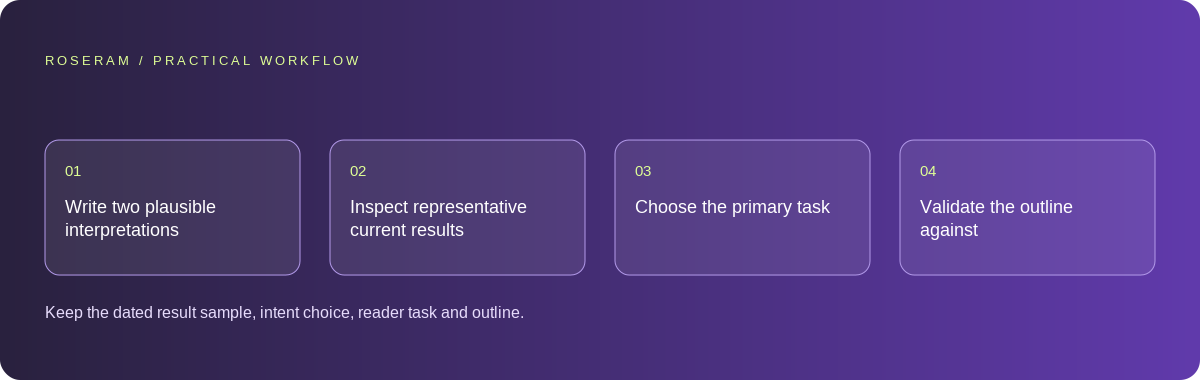
- Write two plausible interpretations of the target query.
- Inspect representative current results and record their formats and gaps.
- Choose the primary task and a page structure that completes it.
- Validate the outline against a reader scenario before drafting promotional copy.
A detailed brief you can adapt for your agent
Replace the illustrative context with your approved facts and controlled inputs. Keep the stated boundaries when adapting the brief. The expected deliverable matters more than a particular tool name: ask for an explanation grounded in the inspected material and evidence for the requested outcome.
Analyze this query for the supplied market using the dated result observations. Compare buying, learning and troubleshooting intent. Recommend a page format and the questions it must answer. Keep search volume and organic competition unknown unless measured data is supplied. Explain overlapping queries that should share a canonical page.
Failure modes that an attractive preview can hide
An AI model can claim that a query is “low competition” because it sounds specific. That is not measured evidence. Keep volume, advertiser competition and organic result strength separate. Also avoid assuming a top-ranked exact-match domain makes a topic impossible; inspect the actual result quality, authority and intent rather than relying on the domain alone.
Read more: Google: SEO starter guide
Acceptance checks and the evidence to retain
Keep the dated result sample, intent choice, reader task and outline. Treat the brief as a research decision that can be revised when actual query performance becomes available.
| Controlled case | Expected evidence |
|---|---|
| Query supports buying and building interpretations | The brief selects and explains one primary intent. |
| Two phrases imply the same task | They are mapped to one page unless meaningful differences justify separation. |
| Metrics are unavailable | The plan labels opportunity as unqualified rather than inventing numbers. |
Common questions
Can wording prove a keyword has demand?
No. It can suggest intent; demand requires appropriate measurement.
Should every phrase have its own page?
Not when the phrases ask for the same answer and would create overlapping content.
What is the practical completion criterion?
Keep the dated result sample, intent choice, reader task and outline. Treat the brief as a research decision that can be revised when actual query performance becomes available.
Where the facts come from
Use these links to check the technical facts. The stories here are made-up examples to help you learn. Roseram sells AI tools; our examples are not promises of results.
- Google: SEO starter guide ↗
What this source covers
Discovery, descriptive titles, useful content and understandable links.
References last reviewed 2026-10-11. Writing refreshed 2026-10-14. Spot a mistake? Tell us.
