Sorting Words Like Mail
Meet Nora. Nora runs a busy tool shop named Fix-It Fast. People send her many notes every single week. Each note asks for help with a tool. Some people write messy notes. Other people use long words. Nora wants to answer them fast. She hates writing duplicate notes.
Think of search words like post office mail. Keywords are words people type into search apps. A search app is a web tool that finds information fast. When you sort mail, you use postal bins. You put letters for one house into one box. You do not drive to one house ten times.
That is what clustering does for your site. To cluster means to group like items together. When you cluster keywords with AI, you group words by client goals. An AI is a smart computer app. It spots word patterns fast. You make one page for each real job.
Understanding the Reader Goal
Every search phrase has a clear purpose. We call this purpose search intent. Search intent is the job the reader wants done. Some clients want to fix an old form. Other clients want to build a brand new form. Those are two very different jobs.
Several phrases ask how to build the same booking page. They may fit one strong guide. A question about cancelling a booking may need its own section or page. You must look at the real goal. Group phrases by the job the reader wants done.
Keep similar questions on one helpful page. Split only when the answer or task changes. Do not publish near-copy pages for every small word change. If two words need the same answer, keep them together. Put them in one safe cluster box.
A bad site makes thin pages for tiny word shifts. That confuses clients. It also wastes your work time. Always think of the reader first. Make sure each page does one job well.
- Group phrases by the job the reader wants done.
- Keep similar questions on one helpful page.
- Split only when the answer or task changes.
Tools and Data to Start
You do not need hard math to sort words. First, collect your search words in a grid. Keep your word list clean and plain. Next, pick an AI helper tool. A good AI app spots word meaning fast. It helps you group phrases into neat rows.
Feed only clean words into your AI app. Check your list for bad spelling errors. Remove rows that repeat the exact same text. A clean list gives you much better groups. Bad data only brings sloppy work later.
Never make up search numbers. If a tool shows no volume data, leave it empty. Do not guess false counts. Keep the primary intent in your notes. Track your facts with care at every step.
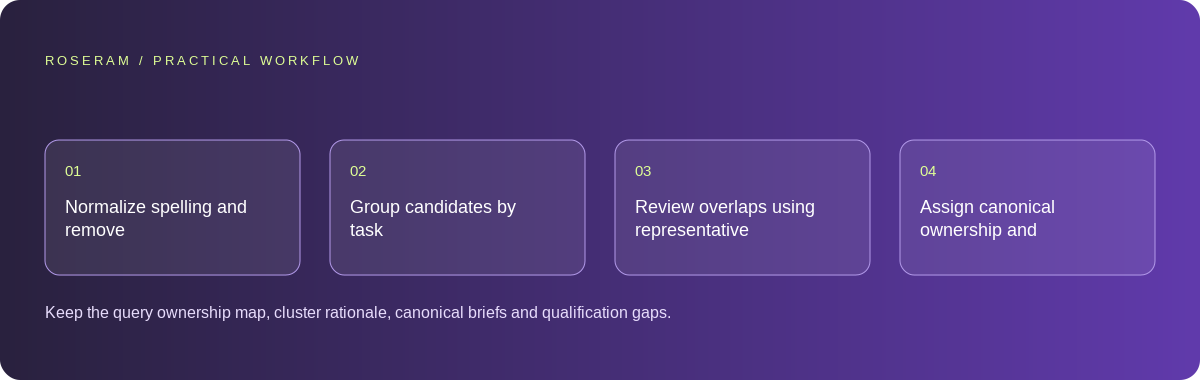
- Normalize spelling and remove exact duplicate query rows.
- Group candidates by task and expected answer format.
- Review overlaps using representative result observations.
- Assign canonical ownership and keep unqualified metrics visibly empty.
A Worked Example in Nora's Shop
Let us look at a hard word list from Nora's desk. Her shop list has three tricky phrases. The phrases are AI contact form broken, AI form not sending email, and build contact form with AI. We must group them by their real job.
A simple tool might group them by the words contact form. But look at the real reader task. The first two phrases are repair jobs. Something broke down. The client wants to fix a bad bug right now. Those two belong together in one repair guide.
The third phrase is a build job. That client wants to make a new web page. That needs a setup tutorial. Grouping solely by shared words would collapse distinct tasks. It could also create several competing articles. Always look at meaning before you group.
A canonical page is the single main page that owns a topic. Nora gives the broken form cluster one main page. She gives the build form cluster its own tutorial page. This keeps her shop website clear and strong.
Read more: Google: SEO starter guide
Key Decisions Before You Group
You must make key choices before you write new pages. Decide which phrase is your primary term. A primary phrase is the main search term for a page. Other matching terms are secondary variants. Keep these choices in your cluster log.
A large cluster may need a hub page and supporting guides. That works when each child page answers a unique question. Do not make endless city or job name word twists. Never build new pages without fresh facts and real client need.
Check how pages link together on your site. Clear links help readers hop between related guides. If two drafts answer the same core question, combine them. One solid page wins over three weak pages.
A Second Real World Case
Let us explore another real case at Nora's shop. Nora rents out moving vans and lawn mowers. Her list has words like rent lawn mower, lawn mower rental rates, and mower return rules. How should she sort these words?
Rent lawn mower and lawn mower rental rates share one clear job. The client wants to hire a mower today. Price details belong on that main rental page. The client wants both facts in one spot. They stay in one main cluster.
Mower return rules is quite different. The client already holds the mower at home. They want to return the mower before dusk. That topic needs its own short return guide. Grouping by user task keeps clients happy and calm.
Common Mistakes and Smart Fixes
A spreadsheet with a thousand combinations is not a thousand validated opportunities. Do not count mechanically generated variations as measured demand. Beginners often swap one city word to make fifty thin pages. That makes messy duplicate web pages.
Another error is assigning the same primary phrase to multiple pages. That makes your own pages fight one another. An overlap happens when two pages try to answer the same search. We call this search conflict or page cannibalization.
Fix this by checking page outlines before you write. Keep an editorial review queue for clusters whose meaning is unclear. Consolidate drafts when their answers remain substantially the same. Merge thin drafts into one solid, useful article.
Read more: Google: SEO starter guide
A Quick Test Readers Can Perform
You can run a fast test on your clusters right now. Take three keywords from any cluster you made today. Ask this simple question: Would one great answer satisfy all three readers completely? If the answer is yes, keep them together.
Now open your favorite search tool. Type each phrase into the search box. Look at the top results on the screen. Do the top pages provide the same kind of answer? If they show tutorials for one and repairs for another, split them.
Use the check table below to guide your choices. It shows how good cluster proof looks in practice. Check your work against these lines every single time. Good checks keep your site neat and clear.
| Controlled case | Expected evidence |
|---|---|
| Two variants require the same troubleshooting steps | They map to one canonical answer. |
| A build tutorial and a repair query share words | Their distinct tasks remain separately evaluated. |
| Export lacks monthly-search data | No fabricated volume is inserted during clustering. |
Your Practical Next Action
Now you are ready to organize your own search words. Start small. Pick twenty search terms from your project notes. Group them by reader intent using the steps we covered today. Save your cluster notes in a clean table.
Keep the query ownership map, cluster rationale, and canonical briefs together. This map prevents competing duplicate content while revealing genuinely distinct opportunities. It gives your team a clear path forward without guesswork. Roseram can help with this task. Access and limits depend on your current plan.
Cluster this candidate list by reader task and expected page format: ["AI contact form broken", "AI form not sending email", "build contact form with AI"]. Assign a primary phrase and canonical page brief to each distinct cluster. Preserve ambiguous cases for review and identify overlapping proposed articles. Do not invent volumes or organic difficulty. Explain why any supporting page deserves a separate answer.
Your idea. Your next step.
Put Roseram super intelligence to work.
Bring the idea you keep coming back to. Choose a Roseram plan, then give your project a clear first task. You can think it through, build a first version, and improve it as you learn.
Check current access, plan limits, and pricing before joining.
Your next step
Your quick checklist.
Tick a step as you finish it. Your ticks and feedback stay on this device. They are not public reviews.
0 of 6 complete
Tell the community what you tried or tell us what needs fixing. Include a source if you are correcting a fact.
Your questions, answered
Is semantic similarity enough to cluster queries?
Matching meaning is just a start. You must check real search goals. Think about the needed page answer.
Should every low-volume variant get a page?
Only build pages for unique jobs. Similar words belong on one strong page.
How do I know the task is done?
Map out where search words go. Write clear reasons for groups. Help stop pages from fighting each other.
What should I do if two keywords mean almost the same thing?
Put both words in one group. Pick one word as the leader. Answer both questions on one page.
Want the technical details?Open the code notes, deeper checks, and common questions.
These notes go deeper. Use the parts that fit your project. Examples are for learning; they are not claims that we tested your app.
A worked example: where the task becomes difficult
A fictional publisher has a list containing “AI contact form broken,” “AI form not sending email” and “build contact form with AI.” The first two may share a troubleshooting answer; the third may need an implementation tutorial. Grouping solely by shared words would collapse distinct tasks or create several competing articles. Use query meaning and representative result observations, not only phrase similarity.
Decisions to make before implementation
Keep primary intent, secondary variants, canonical page and evidence status in the cluster record. Detect synonyms, broad topics and problem-specific subtopics. A large cluster may deserve a hub and supporting guides when each supporting page answers a distinct question. Avoid generating city, profession or adjective permutations without corresponding original evidence and a different reader need.
A practical sequence for the work
Use the sequence below as a task boundary, not as a claim that the example has been executed. Work with approved inputs and the project’s actual architecture. If a required integration or permission is unavailable, keep that stage visibly incomplete rather than generating a plausible substitute result.
- Normalize spelling and remove exact duplicate query rows.
- Group candidates by task and expected answer format.
- Review overlaps using representative result observations and article outlines.
- Assign canonical ownership and keep unqualified metrics visibly empty.
A detailed brief you can adapt for your agent
Replace the illustrative context with your approved facts and controlled inputs. Keep the stated boundaries when adapting the brief. The expected deliverable matters more than a particular tool name: ask for an explanation grounded in the inspected material and evidence for the requested outcome.
Cluster this candidate list by reader task and expected page format. Assign a primary phrase and canonical page brief to each distinct cluster. Preserve ambiguous cases for review and identify overlapping proposed articles. Do not invent volumes or organic difficulty. Explain why any supporting page deserves a separate answer.
Failure modes that an attractive preview can hide
A spreadsheet with a thousand combinations is not a thousand validated opportunities. Do not count mechanically generated variations as measured demand. Also avoid assigning the same primary phrase to multiple pages. Preserve an editorial review queue for clusters whose meaning is unclear, and consolidate drafts when their answers remain substantially the same.
Read more: Google: SEO starter guide
Acceptance checks and the evidence to retain
Keep the query ownership map, cluster rationale, canonical briefs and qualification gaps. The map should prevent competing duplicate content while revealing genuinely distinct opportunities.
| Controlled case | Expected evidence |
|---|---|
| Two variants require the same troubleshooting steps | They map to one canonical answer. |
| A build tutorial and a repair query share words | Their distinct tasks remain separately evaluated. |
| Export lacks monthly-search data | No fabricated volume is inserted during clustering. |
Common questions
Is semantic similarity enough to cluster queries?
It is a useful starting point, but the required answer and observed search intent matter.
Should every low-volume variant get a page?
Only if it represents a distinct useful task; synonyms can be covered by one strong page.
What is the practical completion criterion?
Keep the query ownership map, cluster rationale, canonical briefs and qualification gaps. The map should prevent competing duplicate content while revealing genuinely distinct opportunities.
Where the facts come from
Use these links to check the technical facts. The stories here are made-up examples to help you learn. Roseram sells AI tools; our examples are not promises of results.
- Google: SEO starter guide ↗
What this source covers
Discovery, descriptive titles, useful content and understandable links.
References last reviewed 2026-10-11. Writing refreshed 2026-10-14. Spot a mistake? Tell us.
