A worked example: where the task becomes difficult
A fictional team must choose whether to build a small customer portal or buy a hosted product. A generated memo might favor the more exciting build without accounting for maintenance. Define the customer requirements, available engineering time, data needs and exit plan. Include “do less now” as an alternative if the immediate problem can be solved without either major investment.
Decisions to make before implementation
Separate one-time cost, recurring cost, operational ownership and uncertainty. Score criteria only when their meaning is clear; arbitrary numbers can hide subjective preferences. State what evidence supports the recommendation and what is missing. Consider reversibility: exporting records or preserving source ownership can matter as much as a feature checklist. Keep the memo’s date so changing facts can trigger review.
A practical sequence for the work
Use the sequence below as a task boundary, not as a claim that the example has been executed. Work with approved inputs and the project’s actual architecture. If a required integration or permission is unavailable, keep that stage visibly incomplete rather than generating a plausible substitute result.
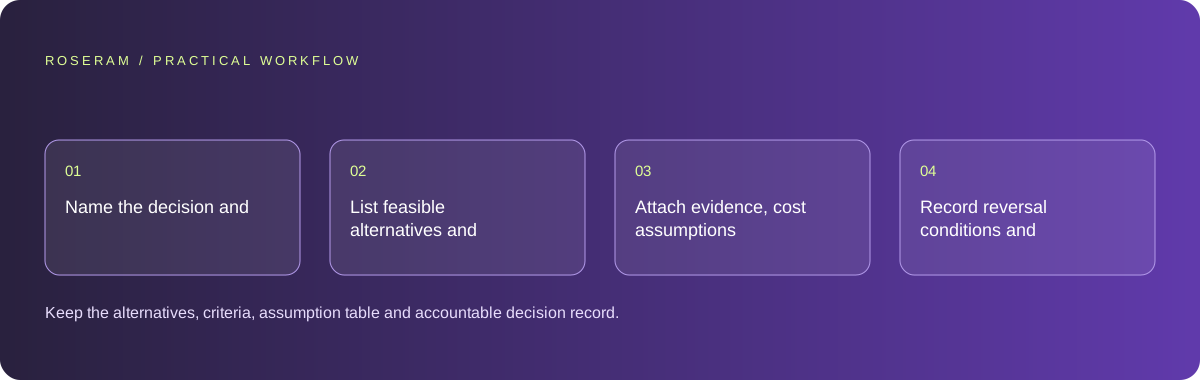
- Name the decision and the outcome it must improve.
- List feasible alternatives and criteria before drafting the recommendation.
- Attach evidence, cost assumptions and operational responsibilities.
- Record reversal conditions and a review date for uncertain assumptions.
A detailed brief you can adapt for your agent
Replace the illustrative context with your approved facts and controlled inputs. Keep the stated boundaries when adapting the brief. The expected deliverable matters more than a particular tool name: ask for an explanation grounded in the inspected material and evidence for the requested outcome.
Draft a build-versus-buy memo from these requirements and supplied cost assumptions. Include a smaller interim option. Compare recurring ownership, data exit, delivery risk and reversibility. Mark unverified features and show a sensitivity case. Do not invent agreement or prices. Finish with evidence that would reverse the recommendation.Failure modes that an attractive preview can hide
A persuasive memo can present estimates as quotes or omit the cost of human review and maintenance. Use clearly labeled assumptions and sensitivity cases. Avoid letting the model invent stakeholder agreement. A recommendation should distinguish its author’s analysis from an approved decision and should not automatically authorize purchases, contracts or production changes.
Technical references: NIST: AI Risk Management Framework
Acceptance checks and the evidence to retain
Keep the alternatives, criteria, assumption table and accountable decision record. The memo should remain useful when a central assumption changes, not only when it supports the first recommendation.
| Controlled case | Expected evidence |
|---|---|
| Key maintenance estimate doubles | The memo shows whether the recommendation changes. |
| A required data-export feature is unverified | The uncertainty appears as a decision condition. |
| Stakeholder has not approved the choice | The memo remains a recommendation rather than a claimed agreement. |
Specific answers
Common questions
Should AI make the final decision?
It can support analysis, but the accountable decision and consequential actions remain with the authorized owner.
Do numerical scores make the comparison objective?
Only if their definitions and evidence are meaningful; otherwise they can disguise subjective assumptions.
What is the practical completion criterion?
Keep the alternatives, criteria, assumption table and accountable decision record. The memo should remain useful when a central assumption changes, not only when it supports the first recommendation.
Sources and editorial method
These references support the indicated technical facts. Workflows, examples and decision tables are original Roseram analysis. Illustrative costs are not vendor prices. No search volume, organic difficulty, ranking result or product endorsement is implied.
- NIST: AI Risk Management Framework ↗
A reference for managing AI risk; these task examples are original editorial workflows, not a NIST endorsement or a compliance assessment.
Roseram offers AI software and may compete with tools discussed here. Sources checked 2026-10-11. Send a sourced correction.
Your next step
Keep a practical checklist.
Mark your progress. This checklist and helpfulness choice are saved on this device only; they are not public reviews.
0 of 5 complete
Share your experience in the community or submit a sourced correction. Public experiences remain separate from editorial claims.
Bring your next idea
Keep learning. Build with context.
Get Roseram model and workspace reopening updates. The guide remains available whether or not you subscribe.
Explore the workspace guide →