Start here with a sharp eye
Meet Nora. Nora owns a busy bike shop called Spokes. She helps many clients every single week. She uses smart computer bots to research tools. The bots draft text with neat blue links. The text looks clean and very sure.
A link is a web address for a page. A link is just an address label on a door. It does not prove what sits inside the room. Think of this work like checking an old lock. You must turn the key yourself. Never assume the door opens to good facts. You want the real truth for your clients.
Bots often sound very sure of their facts. But bots make simple errors on basic facts. A real link can still show the wrong thing. You cannot risk your client cash on weak guesses. Check the main page with your own eyes. Real checks keep your store safe and sound.
- Look past smooth and shiny text.
- Treat each sentence like a small clue.
- Read each main source on your own.
Spot the claims that matter most
Nora prints out her fresh bot sheet. A claim is a point stated as true fact. Saying an app ships parts is one claim. Saying a tool exports files is another claim. Nora numbers each clean claim down her page.
Not all claims need the same hard work. Nora cares most about choices that cost cash. If an error hurts a client, she marks it. If a line brings no harm, she moves on. Pick claims that change your real next steps. This habit saves many hours of lost work.
Separate cheer words from real tool steps. A sales site may boast of grand power. That boast is just broad market cheer. You only need to verify actual tool steps. Write down hard facts on your clear lines. Keep your list tied to real client needs.
Keep each single point on its own line. Do not pack four thoughts into one spot. Clear claim lines make review work quite swift. You will see what is true right away.
- List claims that guide choices for clients.
- Skip past happy market cheer on sites.
- Cut long lines into single brief facts.
Open original sources and test math
Next, Nora tracks down the first clean source. A primary source is the first main official record. It is not an informal chat post. Nora skips side notes that carry bad flaws. She opens the true vendor handbook online. She reads the exact lines on that page.
Sometimes a bot adds up fees for you. It might mix month rates with year rates. That mistake makes the total sum quite wrong. Nora grabs her small desk pad and pencil. She checks each sum with careful steps. Month costs must not mix with year costs.
Never let a bot make up facts. If a handbook skips a tool part, pause. An omission is when a key fact is left out. Mark that empty spot as not yet known. Do not guess what an absent line means. Honest notes keep client projects on track.
- Open the main site for the app.
- Run the math using the same time spans.
- Leave clear blanks when data is not there.
A worked example with practice data
Look at this file marked as invented practice data. Nora wants a new bill app for client repairs. Her bot wrote a note about Tool Alpha. It said Tool Alpha bills clients in Spain. It linked right to the Tool Alpha site.
Nora clicked the web link with high hopes. The link led to a broad home page. It spoke of fast speed and nice staff. Yet it never named billing in Spain once. The link worked, but the point lacked proof. The bot just gave an empty broad link.
Nora split this test into three clear rows. She tracked live access, tool parts, and real runs. She labeled the Spain tool part as unconfirmed. That tag means no hard proof was found. Then she asked the sales team for true facts. Checking first saved her from a bad buy.
- Keep the live link apart from the claim.
- Tag points without proof as unconfirmed items.
- Find the exact tool rules in official guides.
A second case on harbor rules
Here is a second case from a nearby dock. A boat boss named Leo ships dry freight. Leo used an app to read harbor fee rules. The app said small crates dock for zero cash. It cited a real harbor news post.
Leo clicked the link to read the full page. The link showed a true port news post. But Leo checked the print year on top. The post came out six long years ago. An outdated source is an old rule no longer used. The port fee rules changed two months back.
Leo pulled up the current harbor rule book. Small crates now pay a plain dock fee. If Leo trusted the old post, his client lost cash. Checking the date saved a great deal of money. Always check the date on every site.
- Check the date stamp on every old post.
- Search online for the newest rule changes.
- Set aside old news that no longer applies.
Common traps and how to fix them
The most common trap is reading a brief preview. A snippet is a short text piece on a screen. Snippets often leave out crucial context and limits. Never trust a snippet without seeing the full page. Open the page and read the text with care.
Another big trap is confusing guides with user accounts. A public web page might list a tool tier. But your current account plan might lack it. A guide does not prove your account holds it. When you have an account, test the real button.
Leading teams warn against blind trust in automated output. The NIST group shares clear ways to manage risks. You can review advice in the NIST papers today. Human review keeps your work safe from bad errors.
Fixing these slips keeps your final page brief. You strip out weak notes and keep solid facts. A brief true note beats a long false page.
Read more: NIST: AI Risk Management Framework
Compare findings with this check table
Nora keeps a simple chart on her desk. This chart lists hard traps and the right fix. It keeps her shop crew aligned on every job. Use this chart when you inspect any bot draft.
This clear chart guides your daily fact work. It stops bad facts from reaching your dear client. Keep these simple rules near your shop computer.
| Controlled Case | What You Must Check | Expected Evidence |
|---|---|---|
| Link leads to a broad home page | Search the text for the exact feature claim | The unsupported claim stays unconfirmed |
| Bot math mixes month and year rates | Change all rates into the same time span | Units are normalized before comparing totals |
| Fact comes from a very old post | Check current handbook dates and active rules | Current applicability is checked or marked unresolved |
A quick test you can run today
You can run this test in your own room. Ask your bot for three city bus times. Ask it for links to official bus schedules. Watch how it builds three tidy links for you.
Open all three web links in your browser now. Look for the exact run times listed before. Does the schedule verify the lines from the bot? You may find links that show broad bus maps. Some links will lack the exact run times.
This five minute drill trains your inner fact finder. You will see how often bot text goes wrong. You will learn to catch poor links quite fast.
- Ask the bot for three exact bus times.
- Open each link in a separate tab.
- Mark every claim lacking proof as unconfirmed.
Your clear next action
Start on your own fresh research file today. Print your bot summary and circle the main claims. Make a clean list of facts that sway decisions. Check each link and review every single math step.
Roseram can help with a task like organizing claims. Access and limits depend on your current active plan. Clean tools make your regular review run much faster. But your own sharp eyes will stay quite vital. Careful human checks protect each client from bad errors.
- Pull out key claims that sway client choices.
- Test math sums with matching spans of time.
- Write a short brief of fully tested facts.
Audit this research answer claim by claim. Identify which statements change the buying decision for our client. Use directly supporting sources and preserve dates and scope. Recalculate supplied arithmetic using normalized monthly and annual units. Distinguish confirmed facts, inference, and unknowns; do not invent citations or claim account testing from public documentation.
Your idea. Your next step.
Put Roseram super intelligence to work.
Bring the idea you keep coming back to. Choose a Roseram plan, then give your project a clear first task. You can think it through, build a first version, and improve it as you learn.
Check current access, plan limits, and pricing before joining.
Your next step
Your quick checklist.
Tick a step as you finish it. Your ticks and feedback stay on this device. They are not public reviews.
0 of 7 complete
Tell the community what you tried or tell us what needs fixing. Include a source if you are correcting a fact.
Your questions, answered
Is a real source link enough?
No. The link must match. The dates must match too.
Must I check every fact equally?
Check big facts very first. Check small details after that.
How do I know the task is done?
Save your chart of facts. Cut out claims with weak proof. State clearly what remains unsure.
What if an official link breaks?
Mark the fact as unproven. Do not guess the answer.
Want the technical details?Open the code notes, deeper checks, and common questions.
These notes go deeper. Use the parts that fit your project. Examples are for learning; they are not claims that we tested your app.
A worked example: where the task becomes difficult
A fictional founder receives an AI summary saying a software provider supports a specific region and exports a particular format. The linked page describes the product generally but not those capabilities. Build a claim list and inspect current official documentation or account behavior where access exists. Keep the provider’s availability, product capability and tested configuration as separate facts.
Decisions to make before implementation
Prioritize claims whose failure would change the decision or cause harm. Distinguish current product documentation, historical announcements, independent reporting and opinion. Check whether a source is quoting another source that should be inspected directly. For calculations, preserve inputs and reproduce the arithmetic. Do not require the model to produce certainty where primary evidence is unavailable.
A practical sequence for the work
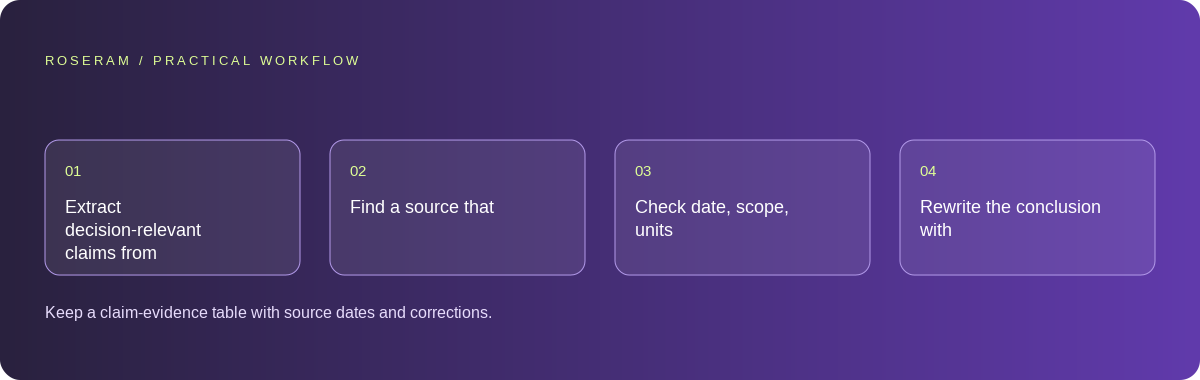
Use the sequence below as a task boundary, not as a claim that the example has been executed. Work with approved inputs and the project’s actual architecture. If a required integration or permission is unavailable, keep that stage visibly incomplete rather than generating a plausible substitute result.
- Extract decision-relevant claims from the generated answer.
- Find a source that directly supports each claim in the intended context.
- Check date, scope, units and any missing qualifications.
- Rewrite the conclusion with confirmed facts, inference and unknowns separated.
A detailed brief you can adapt for your agent
Replace the illustrative context with your approved facts and controlled inputs. Keep the stated boundaries when adapting the brief. The expected deliverable matters more than a particular tool name: ask for an explanation grounded in the inspected material and evidence for the requested outcome.
Audit this research answer claim by claim. Identify which statements change the buying decision. Use directly supporting sources and preserve dates and scope. Recalculate supplied arithmetic. Distinguish confirmed facts, inference and unknowns; do not invent citations or claim account testing from public documentation.
Failure modes that an attractive preview can hide
Link checking alone verifies that a page exists, not that it says what the answer claims. Another trap is accepting a historical announcement as proof of current availability. Mark live account tests separately from public documentation. When a source cannot be accessed, report that limit rather than quoting a search snippet as if the complete page was reviewed.
Read more: NIST: AI Risk Management Framework
Acceptance checks and the evidence to retain
Keep a claim-evidence table with source dates and corrections. The revised answer should be shorter where weak assertions were removed and clearer about what remains uncertain.
| Controlled case | Expected evidence |
|---|---|
| Citation points to a related but insufficient page | The unsupported claim stays unconfirmed. |
| Calculation uses a monthly and annual cost | Units are normalized before comparing totals. |
| Product statement comes from an old announcement | Current applicability is checked or clearly marked unresolved. |
Common questions
Is a real citation enough?
No. It must support the specific statement and its intended timeframe.
Should every claim receive equal effort?
Prioritize decision-critical facts, then verify supporting details according to their importance.
What is the practical completion criterion?
Keep a claim-evidence table with source dates and corrections. The revised answer should be shorter where weak assertions were removed and clearer about what remains uncertain.
Where the facts come from
Use these links to check the technical facts. The stories here are made-up examples to help you learn. Roseram sells AI tools; our examples are not promises of results.
- NIST: AI Risk Management Framework ↗
What this source covers
A reference for managing AI risk; these task examples are original editorial workflows, not a NIST endorsement or a compliance assessment.
References last reviewed 2026-10-11. Writing refreshed 2026-10-14. Spot a mistake? Tell us.
