A worked example: where the task becomes difficult
A fictional founder is considering scheduling software for independent tutors. The initial question is whether tutors struggle with cancellations enough to buy a new tool. A broad AI report about education technology does not answer that buying decision. Start with specific customer segments, existing alternatives, public complaints and an explicit list of unknowns. Keep interviews and public desk research separate so their different coverage limits remain visible.
Decisions to make before implementation
Choose the decision the research must support and define a relevant geography and timeframe. Record each claim with its source, date and method. A company’s advertised customer count is not a neutral market estimate, and a handful of comments is not a representative survey. Ask the model to propose explanations and counterexamples rather than selecting only evidence that supports the founder’s idea.
A practical sequence for the work
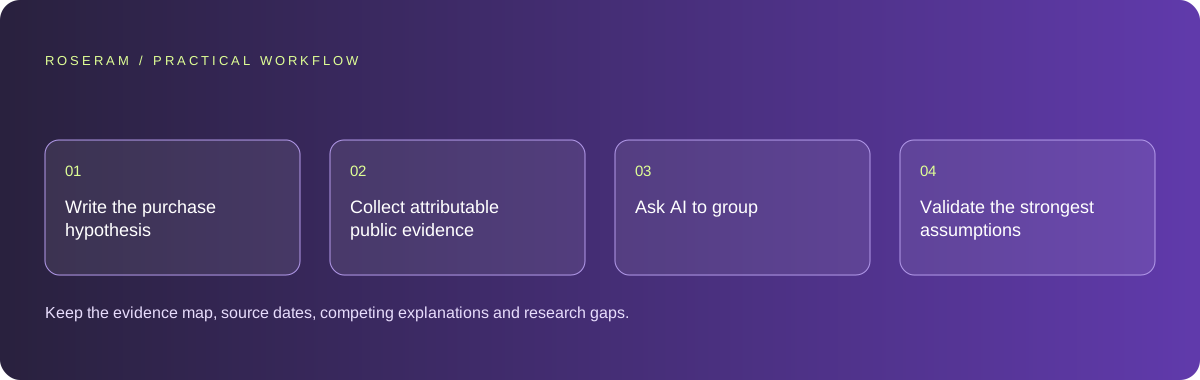
Use the sequence below as a task boundary, not as a claim that the example has been executed. Work with approved inputs and the project’s actual architecture. If a required integration or permission is unavailable, keep that stage visibly incomplete rather than generating a plausible substitute result.
- Write the purchase hypothesis and the customer segment in plain language.
- Collect attributable public evidence and mark promotional or anecdotal material.
- Ask AI to group patterns, disagreements and unresolved questions.
- Validate the strongest assumptions through an appropriate research method before investment.
A detailed brief you can adapt for your agent
Replace the illustrative context with your approved facts and controlled inputs. Keep the stated boundaries when adapting the brief. The expected deliverable matters more than a particular tool name: ask for an explanation grounded in the inspected material and evidence for the requested outcome.
Analyze the supplied public evidence about tutor cancellation workflows. Separate sourced facts, anecdotes, vendor claims and hypotheses. Compare existing alternatives and explain evidence that weakens the product idea. Do not invent market-size figures or survey results. Return an evidence table and the five most important unanswered questions for the buying decision.Failure modes that an attractive preview can hide
Generated reports often blend different regions, dates and definitions into a single precise total. Check the denominator behind every quantity. Do not paste confidential interview recordings into a new service without the necessary authorization. If evidence is thin, report that gap and design a follow-up question rather than asking the model for a more persuasive conclusion.
Technical references: NIST: AI Risk Management Framework
Acceptance checks and the evidence to retain
Keep the evidence map, source dates, competing explanations and research gaps. The output should support a decision about the proposed customer problem, not merely describe a growing industry.
| Controlled case | Expected evidence |
|---|---|
| A market-size claim appears | Its definition, geography, date and underlying source are inspectable. |
| Comments support only one customer segment | The conclusion does not generalize to every tutor. |
| Evidence contradicts the proposed product | The analysis preserves the contradiction and changes the decision memo. |
Specific answers
Common questions
Can AI establish market demand by itself?
It can organize evidence and propose research, but generated confidence does not replace measured customer demand.
Should public reviews count as a survey?
They can reveal problems, but their sampling and representativeness differ from a designed survey.
What is the practical completion criterion?
Keep the evidence map, source dates, competing explanations and research gaps. The output should support a decision about the proposed customer problem, not merely describe a growing industry.
Sources and editorial method
These references support the indicated technical facts. Workflows, examples and decision tables are original Roseram analysis. Illustrative costs are not vendor prices. No search volume, organic difficulty, ranking result or product endorsement is implied.
- NIST: AI Risk Management Framework ↗
A reference for managing AI risk; these task examples are original editorial workflows, not a NIST endorsement or a compliance assessment.
Roseram offers AI software and may compete with tools discussed here. Sources checked 2026-10-11. Send a sourced correction.
Your next step
Keep a practical checklist.
Mark your progress. This checklist and helpfulness choice are saved on this device only; they are not public reviews.
0 of 5 complete
Share your experience in the community or submit a sourced correction. Public experiences remain separate from editorial claims.
Bring your next idea
Keep learning. Build with context.
Get Roseram model and workspace reopening updates. The guide remains available whether or not you subscribe.
Explore the workspace guide →