A worked example: where the task becomes difficult
A fictional app sells downloadable templates. The generated success page unlocks files when the URL contains paid=true. A visitor can alter that value. The proper journey checks the trusted transaction and its association with the intended account and product. Use provider test mode and a controlled product while designing status transitions; do not make live charges simply to check the interface.
Decisions to make before implementation
Define what “paid” means for the selected provider and payment method. Some methods complete asynchronously. Bind payment identity to the order and account, validate amount and product where required by the contract, and keep duplicate fulfilment safe. Refunds and disputes may affect access differently under the approved policy. Do not invent financial or legal rules in generated code.
A practical sequence for the work
Use the sequence below as a task boundary, not as a claim that the example has been executed. Work with approved inputs and the project’s actual architecture. If a required integration or permission is unavailable, keep that stage visibly incomplete rather than generating a plausible substitute result.
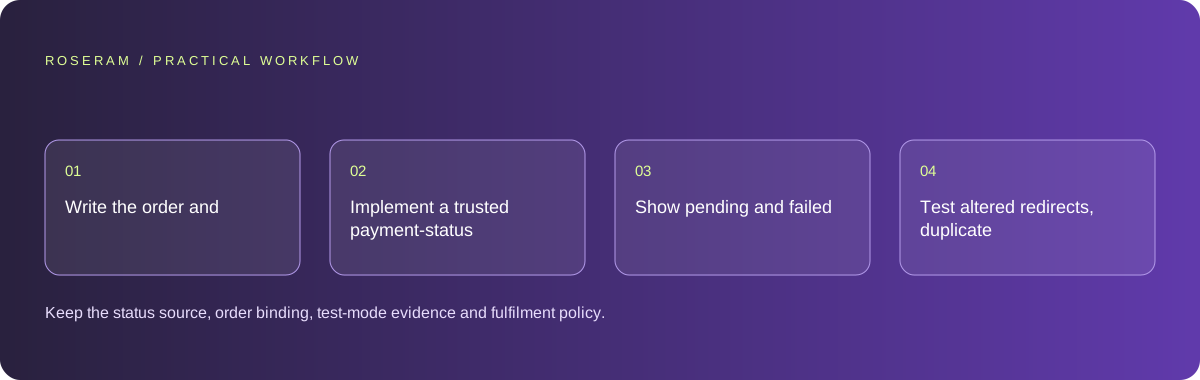
- Write the order and fulfilment contract from approved business policy.
- Implement a trusted payment-status lookup or event workflow.
- Show pending and failed states without exposing private transaction details.
- Test altered redirects, duplicate notifications and delayed completion in test mode.
A detailed brief you can adapt for your agent
Replace the illustrative context with your approved facts and controlled inputs. Keep the stated boundaries when adapting the brief. The expected deliverable matters more than a particular tool name: ask for an explanation grounded in the inspected material and evidence for the requested outcome.
Implement test-mode payment confirmation for this controlled template order. Authorize fulfilment from trusted provider or server state, not URL parameters. Bind status to the intended order and account. Include pending, failed and duplicate-event behavior. Do not charge live customers or expose secret keys. Report provider configuration and observed test outcomes separately.Failure modes that an attractive preview can hide
A test that only reaches a success page verifies navigation, not money movement or fulfilment authority. A provider accepting a checkout request is also not the same as a completed payment. Keep operational and browser evidence separate. Avoid exposing a secret payment key in the client to resolve a configuration issue.
Technical references: MDN: form validation
Acceptance checks and the evidence to retain
Keep the status source, order binding, test-mode evidence and fulfilment policy. A prepared checkout integration should not be reported as live payment processing until that state is actually verified.
| Controlled case | Expected evidence |
|---|---|
| Visitor changes the success query parameter | Private fulfilment remains protected. |
| Payment completes after a delay | The order transitions according to trusted status. |
| Completion notification repeats | The product is fulfilled under the duplicate-safe rule. |
Specific answers
Common questions
Can the return page prove payment?
No. It should consult the trusted transaction state before authorizing fulfilment.
Should I test by making a live purchase?
Use the selected provider’s supported test workflow unless a specifically authorized live transaction is required.
What is the practical completion criterion?
Keep the status source, order binding, test-mode evidence and fulfilment policy. A prepared checkout integration should not be reported as live payment processing until that state is actually verified.
Sources and editorial method
These references support the indicated technical facts. Workflows, examples and decision tables are original Roseram analysis. Illustrative costs are not vendor prices. No search volume, organic difficulty, ranking result or product endorsement is implied.
- MDN: form validation ↗
Client validation helps users but cannot replace server-side validation.
Roseram offers AI software and may compete with tools discussed here. Sources checked 2026-10-11. Send a sourced correction.
Your next step
Keep a practical checklist.
Mark your progress. This checklist and helpfulness choice are saved on this device only; they are not public reviews.
0 of 5 complete
Share your experience in the community or submit a sourced correction. Public experiences remain separate from editorial claims.
Bring your next idea
Keep learning. Build with context.
Get Roseram model and workspace reopening updates. The guide remains available whether or not you subscribe.
Explore the workspace guide →