A worked example: where the task becomes difficult
A fictional app wants to show delivery estimates from an external service. The generated integration includes a button linking to the provider homepage and a fake successful response. The real task needs account configuration, an authenticated operation and verified result mapping. Begin with a provider-supported test or read-only request and record which capabilities the account actually allows.
Decisions to make before implementation
Separate provider discovery, credential configuration, account permission and operational connectivity. Use official documentation rather than guessed endpoint paths. Validate returned fields and handle changed or missing values. Set timeouts, retry policy and request budgets appropriate to the operation. Do not automatically repeat writes after uncertain responses without an idempotency or reconciliation strategy.
A practical sequence for the work
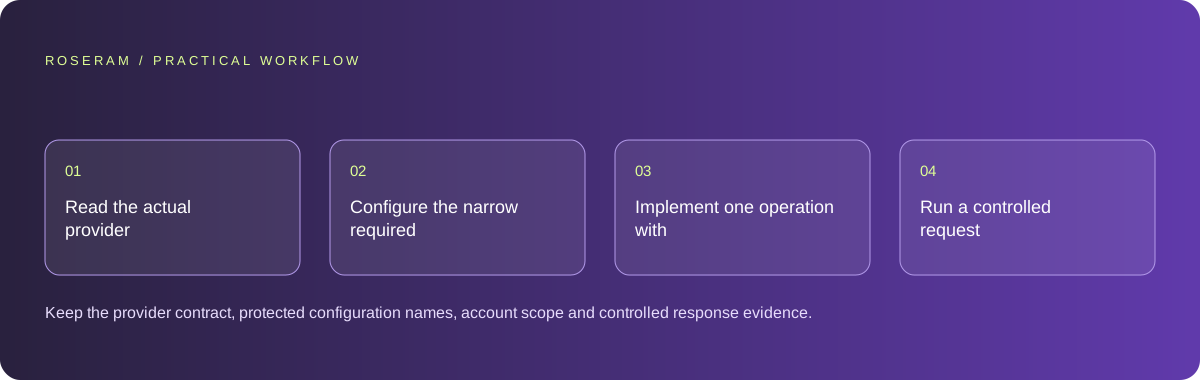
Use the sequence below as a task boundary, not as a claim that the example has been executed. Work with approved inputs and the project’s actual architecture. If a required integration or permission is unavailable, keep that stage visibly incomplete rather than generating a plausible substitute result.
- Read the actual provider contract and verify the intended account capability.
- Configure the narrow required credential through protected storage.
- Implement one operation with response validation and bounded errors.
- Run a controlled request and show connected, unavailable or incomplete state honestly.
A detailed brief you can adapt for your agent
Replace the illustrative context with your approved facts and controlled inputs. Keep the stated boundaries when adapting the brief. The expected deliverable matters more than a particular tool name: ask for an explanation grounded in the inspected material and evidence for the requested outcome.
Implement one delivery-estimate operation from this provider’s current official API contract. Separate configuration, permission and connection states. Protect credentials, validate responses and bound timeouts and retries. Use a controlled request and do not invent a successful fixture as live data. Trace active routes before reporting any old integration removed.Failure modes that an attractive preview can hide
An integration can be present in source but disabled or unconfigured in production. Conversely, removing a visible card does not remove active routes or dependencies. Trace imports, endpoints, configuration and live calls before claiming removal. Avoid exposing provider tokens in browser assets or logs while checking connection status.
Technical references: MDN: form validation
Acceptance checks and the evidence to retain
Keep the provider contract, protected configuration names, account scope and controlled response evidence. Connection status should describe what was actually verified.
| Controlled case | Expected evidence |
|---|---|
| Credential is absent | The app reports configuration needed without fabricating data. |
| Provider returns a changed payload | Validation produces an understandable failure rather than corrupt output. |
| Provider rate-limits the request | The workflow respects a bounded retry and recovery policy. |
Specific answers
Common questions
Does an external setup link mean integration exists?
No. It may only point to provider instructions; verify authenticated operations.
Can an installed package prove a live connection?
No. Active imports, configuration and observed requests need separate inspection.
What is the practical completion criterion?
Keep the provider contract, protected configuration names, account scope and controlled response evidence. Connection status should describe what was actually verified.
Sources and editorial method
These references support the indicated technical facts. Workflows, examples and decision tables are original Roseram analysis. Illustrative costs are not vendor prices. No search volume, organic difficulty, ranking result or product endorsement is implied.
- MDN: form validation ↗
Client validation helps users but cannot replace server-side validation.
Roseram offers AI software and may compete with tools discussed here. Sources checked 2026-10-11. Send a sourced correction.
Your next step
Keep a practical checklist.
Mark your progress. This checklist and helpfulness choice are saved on this device only; they are not public reviews.
0 of 5 complete
Share your experience in the community or submit a sourced correction. Public experiences remain separate from editorial claims.
Bring your next idea
Keep learning. Build with context.
Get Roseram model and workspace reopening updates. The guide remains available whether or not you subscribe.
Explore the workspace guide →