Finding clues in a huge paper stack
Think of your work files as a chest. Useful facts hide deep inside this box. You want to ask questions about your papers. A computer app can read through pages fast. Yet you must teach the app to show proof. An unchecked app might guess instead of reading. That can cause bad errors at work.
Meet Nora. Nora keeps giant water pumps running for her city. Three thick manuals sit on her tidy desk. She must know exact facts before turning valves. Nora uses a software app on her screen. The app helps her search long text fast. It saves her hours of slow reading.
Think of the app as a young helper. This helper grabs lines from files in seconds. Yet the helper can guess when facts get mixed. Nora checks each line against the paper book. This quick check keeps her city water pumps safe. You can use this exact method too.
Tools and files you need first
First, gather papers you have rights to view. A corpus means your chosen group of files. Never paste secret client names into public tools. Strip out private data before you start work. Keep your chosen file group small and clean. That stops errors before they start.
Next, inspect the words on every single page. Extraction means pulling text out of scanned pictures. A scan might hide text inside a chart. Make sure numbers and words copy over well. If numbers look messy, fix the text first. Clean inputs lead to clear facts.
Set strict work boundaries before you type prompts. Tell the app to search only your corpus. A prompt is an instruction you give the app. If the files lack facts, the app must stop. It should never pull answers from outside memory.
- Approved files with clear dates and model tags.
- A reading app that pulls clean letters from scans.
- A quiet space to check page notes yourself.
Four steps to steady document answers
First, give each file a short, plain label. Write down the title, year, and model name. Clear labels stop the app from mixing old rules. An organized pile helps the app pull truth. That makes every search fast and clean.
Next, write your prompt with strong, plain rules. Ask for the page and line for each claim. A citation is a note naming the source page. Demand citations for every claim the app writes. Never let the app guess without giving proof.
Then, compare the answer with the source page. Open the approved book right to that spot. If the words do not match, reject the claim. Keep a clear log of pages you check. Careful checks keep mistakes out of your work.
Last, watch for conflicts between old and new guides. If two books disagree, note both points down. High-risk machine rules need a human review. Never let an app make risky choices alone. Good checks protect your whole team.
- Label files with versions and model names.
- Check how clean charts and text look.
- Ask questions that need page-level proof.
- Log all conflicts between file versions.
A worked example with pump books
Nora tests her app on three fictional pump books. Practice File A covers Model-X from year one. Practice File B covers Model-X from year two. Practice File C covers Model-Y from today. Nora labels each file before she types.
File A says oil the bolt every ten days. File B says oil it every thirty days. A careless app blends them into twenty days. That blended number is wrong and ruins gears. Nora needs the app to show the change over time.
Nora gives the app strict practice rules. She tells it to name the right manual version. The app must keep old rules apart from new ones. It must state which pump model uses each rule. It must never blend numbers together.
The app writes back with a helpful answer. It states Model-X year two needs thirty days. It notes year one used ten days. It names page five of File B as proof. Nora checks page five and finishes her work.
Another real task: the bus handbook
Now look at another task at a school. Principal Dan holds three books of trip rules. Parents call to ask if trips allow peanut snacks. Dan needs to check rules without reading all day. He opens his document tool to check.
The old school rule banned all peanuts on buses. The new handbook allows sealed peanut snacks on trips. A quick reading might mix these two trip rules. Dan wants the current policy with zero guesses. He needs the exact sentence from the book.
Dan asks the app for the current bus rule. He demands the book title and page number. The app points to page twelve of the new guide. Dan reads page twelve before calling parents back. His check takes less than one minute.
Common mistakes and how to fix them
An app can invent a neat citation page note. You turn to that page and find no proof. We call this error a false citation. Always inspect the source line yourself to catch this. Never trust a page note without reading it.
Another mistake happens when two guides clash on rules. The app might hide the clash and pick one. Tell the app to report both sides when rules clash. You must decide which rule fits your task today. Do not let software choose for you.
A long file can pass the app limit. The app reads twenty pages and skips the rest. Tell the app to list pages it read. Check which parts it inspected and which it missed. That keeps blind spots out of your work.
Read more: NIST: AI Risk Management Framework
How to check every answer yourself
You need a simple check for every answer. Run three checks before trusting facts from your app. Make sure the app gives the exact evidence expected. This routine keeps your work safe from silent software bugs. It takes only a few seconds.
Use the check table below to grade your app. Match the case on the left with the proof. If the app fails a test, rewrite your prompt. Keep your test notes in a safe project log. Clear records build trust across your entire team.
| Controlled case | Expected evidence |
|---|---|
| Question concerns the newer equipment model | The answer uses the applicable manual version. |
| Corpus contains contradictory intervals | The response identifies the conflict instead of blending values. |
| Question has no supporting passage | The system states the evidence gap and does not invent an instruction. |
A small test readers can perform
You can run an easy test at your desk. Take two short recipe cards from your kitchen. On Card One, write that soup needs one salt spoon. On Card Two, write that soup needs three spoons. These two cards act as your test corpus.
Type both recipe cards into your testing app. Ask the app how much salt Card Two needs. Demand that the app name the card and line. Watch closely to see if it blends the numbers. Blended numbers show the app is guessing.
If the app names Card Two and three spoons, pass it. If it says two spoons, it failed your test. You now know how to catch blended answers fast. Practice this test until your prompts work every time. It builds strong habits for real files.
Your clear next practical actions
Put your approved manuals into one tidy folder today. Add the year and model name to each title. Strip private client details before you test any file. Good file prep makes every future search much easier. You save time on every project.
Roseram can help with a task like organizing notes. Your access and limits depend on your current plan. Set up your files before running questions through tools. Clean setups lead to much better results every day. Start with small test files first.
Even then, human eyes must check the real sources. Reviewing original pages keeps your equipment safe and sound. Pick one simple guide today and practice your first query. You have the skills to start right now.
Answer only from these approved manuals: [File A: Model-X Year One, File B: Model-X Year Two]. Identify document version and supporting passage for each factual claim. Preserve disagreements and equipment applicability. If the corpus does not answer the question, say what evidence is missing. Do not invent page references or treat a related passage as support for a different instruction. Question: What is the maintenance interval for the main bolt?
Your idea. Your next step.
Put Roseram super intelligence to work.
Bring the idea you keep coming back to. Choose a Roseram plan, then give your project a clear first task. You can think it through, build a first version, and improve it as you learn.
Check current access, plan limits, and pricing before joining.
Your next step
Your quick checklist.
Tick a step as you finish it. Your ticks and feedback stay on this device. They are not public reviews.
0 of 7 complete
Tell the community what you tried or tell us what needs fixing. Include a source if you are correcting a fact.
Your questions, answered
Does adding citations guarantee correctness?
No. A citation names the source text. That text must support the answer. It must also fit your question.
What if the documents disagree?
Show how the papers differ. Do not pick one secretly. Do not mash them together. Share document dates and clear uses.
How do I know the task is done?
Keep the list of source papers. Check how words were pulled out. Save answers you can trace back. An expert must review major guides.
What if the paper has no answer?
The app must say it cannot find facts. It must say facts are missing. The app must never make up answers.
Want the technical details?Open the code notes, deeper checks, and common questions.
These notes go deeper. Use the parts that fit your project. Examples are for learning; they are not claims that we tested your app.
A worked example: where the task becomes difficult
A fictional operations team wants answers from three approved equipment manuals. Two versions describe different maintenance intervals. A model may merge them into a confident but contradictory instruction. Give each file a title, version and applicable equipment model. Ask which manual supports the answer and retain the distinction between historical and current instructions.
Decisions to make before implementation
Decide whether answers may use outside knowledge or only the supplied corpus. For source-only work, unsupported questions should remain unanswered or trigger a request for more evidence. Check that tables, diagrams and scanned pages were extracted correctly. Record document access rights and remove irrelevant private material before using a new service. Retrieval quality and answer quality are different stages to inspect.
A practical sequence for the work
Use the sequence below as a task boundary, not as a claim that the example has been executed. Work with approved inputs and the project’s actual architecture. If a required integration or permission is unavailable, keep that stage visibly incomplete rather than generating a plausible substitute result.
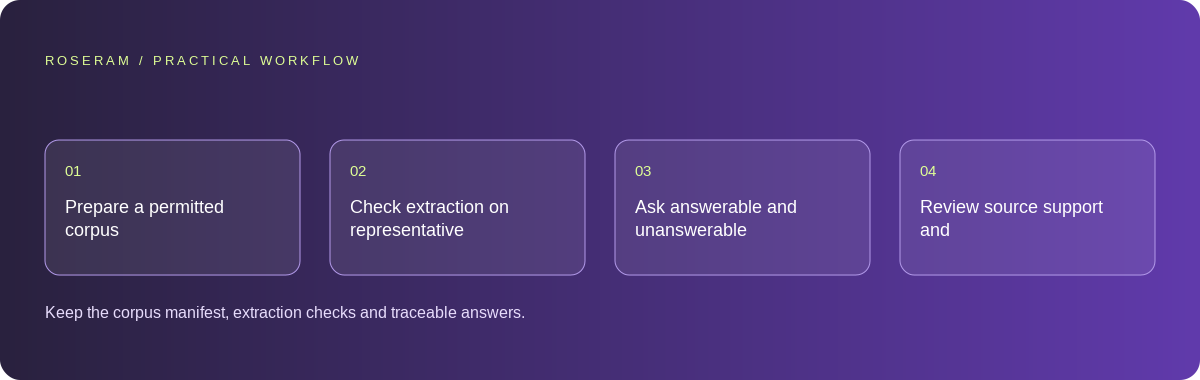
- Prepare a permitted corpus with versions and applicable contexts.
- Check extraction on representative paragraphs, tables and diagrams.
- Ask answerable and unanswerable questions with passage-level references.
- Review source support and preserve conflicting instructions for resolution.
A detailed brief you can adapt for your agent
Replace the illustrative context with your approved facts and controlled inputs. Keep the stated boundaries when adapting the brief. The expected deliverable matters more than a particular tool name: ask for an explanation grounded in the inspected material and evidence for the requested outcome.
Answer only from these approved manuals. Identify document version and supporting passage for each factual claim. Preserve disagreements and equipment applicability. If the corpus does not answer the question, say what evidence is missing. Do not invent page references or treat a related passage as support for a different instruction.
Failure modes that an attractive preview can hide
A citation can look precise while referring to a passage that does not contain the asserted fact. Inspect the original text rather than trusting the citation format. Long documents can also exceed the actually loaded context. Require the system to distinguish indexed paths, retrieved passages and inspected content instead of implying the whole library was read in full.
Read more: NIST: AI Risk Management Framework
Acceptance checks and the evidence to retain
Keep the corpus manifest, extraction checks and traceable answers. High-impact operating instructions should receive the appropriate domain review before use.
| Controlled case | Expected evidence |
|---|---|
| Question concerns the newer equipment model | The answer uses the applicable manual version. |
| Corpus contains contradictory intervals | The response identifies the conflict instead of blending values. |
| Question has no supporting passage | The system states the evidence gap and does not invent an instruction. |
Common questions
Does adding citations guarantee correctness?
No. The referenced passage must support the claim and apply to the question.
What if the documents disagree?
Show the disagreement, versions and applicability rather than silently selecting or combining them.
What is the practical completion criterion?
Keep the corpus manifest, extraction checks and traceable answers. High-impact operating instructions should receive the appropriate domain review before use.
Where the facts come from
Use these links to check the technical facts. The stories here are made-up examples to help you learn. Roseram sells AI tools; our examples are not promises of results.
- NIST: AI Risk Management Framework ↗
What this source covers
A reference for managing AI risk; these task examples are original editorial workflows, not a NIST endorsement or a compliance assessment.
References last reviewed 2026-10-11. Writing refreshed 2026-10-14. Spot a mistake? Tell us.
