A worked example: where the task becomes difficult
A fictional service company uploads monthly jobs with revenue, travel distance and completion status. Cancelled jobs have blank revenue; some distances are miles and others kilometers. An AI summary reporting average revenue per job will be wrong if it treats blanks as zero without an agreed definition. Start with a data dictionary and a few manually checked rows rather than asking for a dramatic business insight.
Decisions to make before implementation
Define the unit of analysis: row, completed job, customer or month. Choose treatment for duplicates, cancellations and missing values. Standardize units while preserving original fields for traceability. Calculate totals using formulas or a script that another analyst can rerun. Separate descriptive patterns from causal claims; higher revenue in one region does not prove that region causes better performance.
A practical sequence for the work
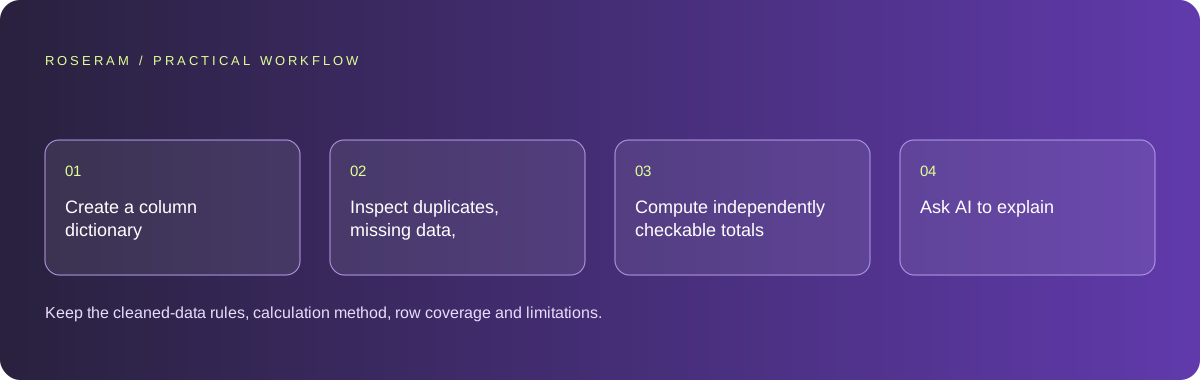
Use the sequence below as a task boundary, not as a claim that the example has been executed. Work with approved inputs and the project’s actual architecture. If a required integration or permission is unavailable, keep that stage visibly incomplete rather than generating a plausible substitute result.
- Create a column dictionary and identify confidential fields before sharing.
- Inspect duplicates, missing data, types and unit consistency.
- Compute independently checkable totals and a clearly defined comparison.
- Ask AI to explain patterns, alternative interpretations and follow-up questions.
A detailed brief you can adapt for your agent
Replace the illustrative context with your approved facts and controlled inputs. Keep the stated boundaries when adapting the brief. The expected deliverable matters more than a particular tool name: ask for an explanation grounded in the inspected material and evidence for the requested outcome.
Analyze this permitted job spreadsheet using the supplied column dictionary. Report row counts, duplicates, missing values and unit issues before insights. Calculate revenue per completed job with the agreed denominator and show a reproducible formula. Separate patterns from causal explanations. Do not expose identifiable small groups or invent unavailable fields.Failure modes that an attractive preview can hide
A model may describe a chart it did not actually calculate or silently drop inconvenient rows. Retain the row count before and after cleaning and document each exclusion. Small groups can expose individuals even after names are removed. Do not publish breakdowns whose apparent precision exceeds the data coverage or whose privacy boundary has not been checked.
Technical references: NIST: AI Risk Management Framework
Acceptance checks and the evidence to retain
Keep the cleaned-data rules, calculation method, row coverage and limitations. The result should let another person reproduce the reported total without trusting the model’s narrative.
| Controlled case | Expected evidence |
|---|---|
| Cancelled job has blank revenue | The approved denominator rule is applied and disclosed. |
| Distance uses mixed units | Conversion is explicit and original values remain traceable. |
| A reported total is challenged | The saved formula or script reproduces it from the permitted rows. |
Specific answers
Common questions
Should blanks be converted to zero?
Only when the field’s business meaning supports that rule; missing and zero are different facts.
Can AI explain why a pattern occurred?
It can propose hypotheses, but a descriptive spreadsheet usually does not establish causality.
What is the practical completion criterion?
Keep the cleaned-data rules, calculation method, row coverage and limitations. The result should let another person reproduce the reported total without trusting the model’s narrative.
Sources and editorial method
These references support the indicated technical facts. Workflows, examples and decision tables are original Roseram analysis. Illustrative costs are not vendor prices. No search volume, organic difficulty, ranking result or product endorsement is implied.
- NIST: AI Risk Management Framework ↗
A reference for managing AI risk; these task examples are original editorial workflows, not a NIST endorsement or a compliance assessment.
Roseram offers AI software and may compete with tools discussed here. Sources checked 2026-10-11. Send a sourced correction.
Your next step
Keep a practical checklist.
Mark your progress. This checklist and helpfulness choice are saved on this device only; they are not public reviews.
0 of 5 complete
Share your experience in the community or submit a sourced correction. Public experiences remain separate from editorial claims.
Bring your next idea
Keep learning. Build with context.
Get Roseram model and workspace reopening updates. The guide remains available whether or not you subscribe.
Explore the workspace guide →