Start Here: The Robot Delivery Box
A bot drops a box on your porch. A green tag says the work is done. Do you sign the slip right away? No, you open the box first. You look inside to see what you got. An AI code change is like that box.
A pull request is a bundle of new code lines. A bot asks to add them to your app. A diff is a list of these changed lines. Green lines are new adds. Red lines are cuts. You must check each line yourself.
Do not trust a green check mark on its own. A green badge can miss big bugs. Your own eyes must check every new piece.
- Check every file inside the pull request.
- Do not trust a green badge without proof.
- Make sure the bot made only what you asked.
Read more: GitHub: pull request reviews
Meet the Baker and Her Bot
Nora runs a sweet shop named The Cookie Cart. She keeps all her shop bills in a small app. Nora asked a bot to add a date filter. A filter sorts data so you see just one part. She wanted to see bills from just one month.
An agent is a computer tool that writes its own code. The agent said its work was done fast. Nora felt glad and was ready to click merge. A merge puts new code lines into your main live app. Nora stopped to think. She did not click the big green button yet. She sat down to read the code lines first.
Read more: GitHub: pull request reviews
Tools and Inputs for a Good Check
You need three main things to review robot code well. First, get your main work ticket. A ticket is the short plan that tells what to build. It lists each rule the code must follow. Keep this plan by your side as you read.
Next, open the git diff view. This screen shows every red cut and green add. Look for lines the bot cut out. Bots may cut safety checks to make tests pass fast. A safety check stops bad data from getting into your app.
Last, run the code in a test room. A test room is a safe place that uses fake data. Never test new robot code on real customer data.
- The work ticket with the real goals.
- The diff screen showing new and cut lines.
- A safe test room filled with fake data.
Read more: GitHub: pull request reviews
Step-by-Step Code Review Flow
First, match the diff to your work ticket. Did the bot build only what you asked for? Look out for extra files that do not belong. If you asked for one file, five files is bad. Extra files can add risk to your software.
Next, check user rights. A role is what a user is allowed to do. An admin can see all files. A clerk should see only a few files. Make sure the bot did not break these rules. Make sure the bot kept your lock on private data. Now, run the app with your own hands. Type in weird dates and empty words. See if the app breaks or stays strong.
Read more: GitHub: pull request reviews
A Worked Example: The Leaky Shop Ledger
Nora looks at the pull request for her cookie shop. The ticket says to filter bills by a set date. The bot added the date box, which is good. But it also changed who can see the bills. An export lets a user save data to their desk.
Here is our test data. User A is a shop clerk named Sam. User B is a shop boss named Pam. The bot cut a line of code. That cut line checked if the user was a boss. Now clerk Sam can download Pam's secret files.
The bot gave Nora a passing test. But that test did not check user roles at all. It only checked if the date box worked. Nora caught the leak before it went to her shop.
Read more: GitHub: pull request reviews
Reviewer Check Table
Use this quick check table when you review robot changes. Compare what the code does with what safe tools need. Never merge a pull request that fails any of these tests.
| Controlled Test Case | Expected Safe Evidence |
|---|---|
| Clerk account runs an export | Only basic public lines show up. |
| Date filter finds no match | Screen shows an empty list and does not crash. |
| New code is pushed during review | The app asks for a brand new review. |
Read more: GitHub: pull request reviews
Second Case: The Broken Clinic Desk
Now look at a doctor named Jan. Jan asked a bot to fix an icon on a calendar. An icon is a tiny picture on a computer button. The bot fixed the icon in two fast minutes. But it also did an unasked-for code clean.
The bot cut an old check to make code look neat. Validation checks that new data follows safe rules. The cut check kept two sick people from booking one room. Now two people could book the same bed at once.
Jan saw the extra files in the diff. She rejected the broad clean and kept the icon fix. Always watch out when a bot tries to clean extra files.
Read more: GitHub: pull request reviews
Common Bot Mistakes and Direct Fixes
Bots often write tests that share their own bad guesses. When a bot makes a bug, its test likes the bug. The test passes because both share the same mistake. You must test the code with your own fake data. Calculate what should happen before you run the test.
Another trap is late code changes. A commit is a saved step in code history. You might review commit one, but the bot adds commit two. Commit two might bring in a fresh bug. Tie your review to the exact commit ID you saw.
- Mistake: Trusting tests written by the same robot that wrote the code.
- Fix: Write your own test inputs with known results.
- Mistake: Missing late edits sent after your review was done.
- Fix: Tie your check to the exact commit ID number.
Read more: GitHub: pull request reviews
Try This Quick Test Right Now
Try this test on your next pull request. Open the page and click the Files tab. Count how many files the bot touched. If the task was tiny, the list must be tiny too. If you see ten files, stop and ask why.
Next, look only at the red lines. Ask what each cut line used to do. Did a red line check a password or role? If yes, stop the change. Put a block on the work until that check is back.
Read more: GitHub: pull request reviews
Your Practical Next Steps with Roseram
Write down what you find in short, plain notes. Put your notes right on the bad lines in the diff. Tell the agent what to fix before you can approve. Roseram can help you check diffs against your work ticket. Access and limits depend on your current plan. Take charge of your code review step today. Look at your team code pool now and open your first diff.
Read more: GitHub: pull request reviews
Review this export-filter pull request against the supplied acceptance criteria. Inspect authorization, pagination, output compatibility and deleted safeguards. Evaluate the tests without assuming their assertions are correct. Return file-specific findings with evidence and severity. Do not modify or merge the pull request during the review.
Your idea. Your next step.
Put Roseram super intelligence to work.
Bring the idea you keep coming back to. Choose a Roseram plan, then give your project a clear first task. You can think it through, build a first version, and improve it as you learn.
Check current access, plan limits, and pricing before joining.
Your next step
Your quick checklist.
Tick a step as you finish it. Your ticks and feedback stay on this device. They are not public reviews.
0 of 5 complete
Tell the community what you tried or tell us what needs fixing. Include a source if you are correcting a fact.
Your questions, answered
Do passing tests mean the pull request is safe?
No. Tests only check what the bot wrote. They can miss big bugs.
Can the same AI review its own pull request?
It can find simple typos. But it repeats its own bad guesses. A real human must check it.
What notes should I save when I finish?
Save the code commit ID. Keep diff notes and test runs. List parts you could not test.
What is the biggest red flag to look for?
Watch for lines that remove login checks. Never let code cut down safety walls.
Want the technical details?Open the code notes, deeper checks, and common questions.
These notes go deeper. Use the parts that fit your project. Examples are for learning; they are not claims that we tested your app.
A worked example: where the task becomes difficult
A fictional API change adds export filtering. The pull request includes a passing test but also broadens which records are returned to an authenticated user. The reviewer needs to inspect authorization, output format and pagination, not just confirm the new date parameter exists. Compare the patch with the approved request and check whether unrelated environment or dependency changes have been included.
Decisions to make before implementation
Separate implementation review, test evidence and release readiness. The author should explain what changed and why; the reviewer should independently check high-impact boundaries. Inspect removed lines as carefully as additions, especially deleted access checks or validation. Decide which evidence must be produced on a deployed environment and which can be established with controlled tests before merge.
A practical sequence for the work
Use the sequence below as a task boundary, not as a claim that the example has been executed. Work with approved inputs and the project’s actual architecture. If a required integration or permission is unavailable, keep that stage visibly incomplete rather than generating a plausible substitute result.
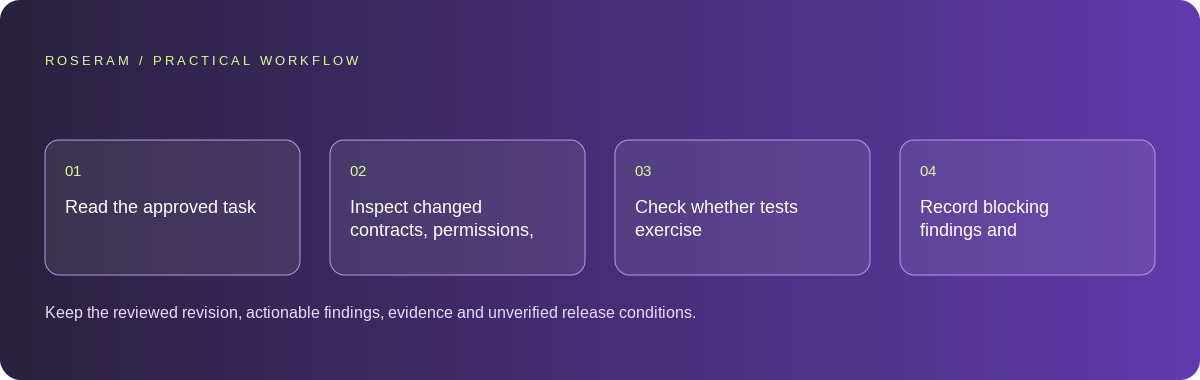
- Read the approved task and summarize the intended behavior independently.
- Inspect changed contracts, permissions, dependencies and external side effects.
- Check whether tests exercise failure paths and the original reported problem.
- Record blocking findings and release checks before approving the revision.
A detailed brief you can adapt for your agent
Replace the illustrative context with your approved facts and controlled inputs. Keep the stated boundaries when adapting the brief. The expected deliverable matters more than a particular tool name: ask for an explanation grounded in the inspected material and evidence for the requested outcome.
Review this export-filter pull request against the supplied acceptance criteria. Inspect authorization, pagination, output compatibility and deleted safeguards. Evaluate the tests without assuming their assertions are correct. Return file-specific findings with evidence and severity. Do not modify or merge the pull request during the review.
Failure modes that an attractive preview can hide
An AI-generated test can mirror the implementation so closely that both share the same mistaken assumption. Use a requirement-derived example with independently calculated expectations. Beware of large “cleanup” patches that obscure removed safeguards. A review performed before the last commit is not evidence for a materially changed final revision; tie approval and results to the reviewed commit.
Read more: GitHub: pull request reviews
Acceptance checks and the evidence to retain
Keep the reviewed revision, actionable findings, evidence and unverified release conditions. An approval should identify the scope actually reviewed, not imply a complete security audit.
| Controlled case | Expected evidence |
|---|---|
| Export is requested by a limited account | Only permitted records appear in the result. |
| Date filter excludes every record | Output remains valid and accurately empty. |
| New commit changes authorization after review | The approval workflow requires review of the changed revision. |
Common questions
Do passing tests make a pull request safe?
They establish only the behavior those tests meaningfully cover; inspect the product and access contracts too.
Can the same agent review its own changes?
It can help, but independent checks of critical assumptions add useful evidence.
What is the practical completion criterion?
Keep the reviewed revision, actionable findings, evidence and unverified release conditions. An approval should identify the scope actually reviewed, not imply a complete security audit.
Where the facts come from
Use these links to check the technical facts. The stories here are made-up examples to help you learn. Roseram sells AI tools; our examples are not promises of results.
- GitHub: pull request reviews ↗
What this source covers
Review and approval concepts; passing checks are not a universal security certification.
References last reviewed 2026-10-11. Writing refreshed 2026-10-14. Spot a mistake? Tell us.
