A worked example: where the task becomes difficult
A fictional workspace crashes when a user switches from Build to Chat after selecting a file. Reloading temporarily restores it. The report should name the mode sequence, whether an edit was pending, the selected file type and the first relevant console error. Repeating “the editor broke” does not let the agent distinguish a render loop, stale callback or failed network request.
Decisions to make before implementation
Capture the earliest error associated with the failure rather than every unrelated browser message. Record app revision, browser version and whether the issue occurs in a fresh controlled project. Remove tokens, private file contents and complete personal identifiers from pasted logs. Preserve the meaning of URLs and record IDs with consistent placeholders so requests can still be followed across the report.
A practical sequence for the work
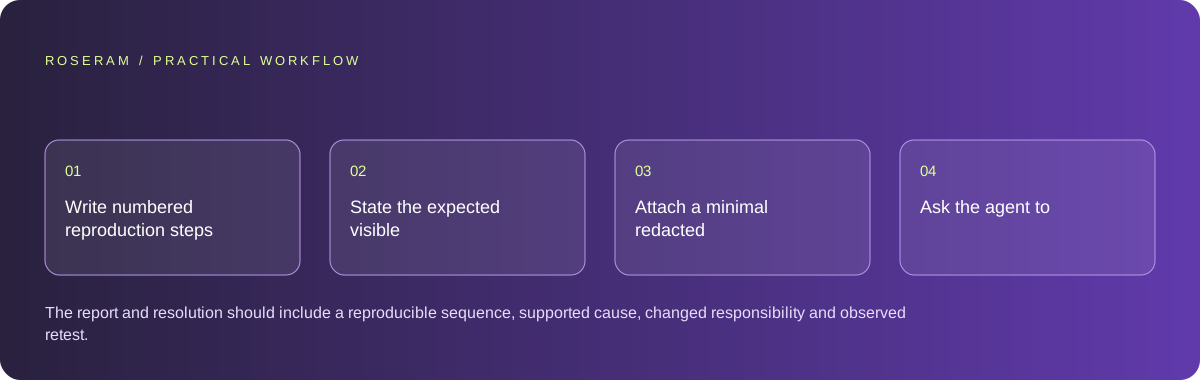
Use the sequence below as a task boundary, not as a claim that the example has been executed. Work with approved inputs and the project’s actual architecture. If a required integration or permission is unavailable, keep that stage visibly incomplete rather than generating a plausible substitute result.
- Write numbered reproduction steps starting from a known state.
- State the expected visible result and the first observed failure.
- Attach a minimal redacted trace with revision and browser context.
- Ask the agent to verify the same sequence after fixing the supported cause.
A detailed brief you can adapt for your agent
Replace the illustrative context with your approved facts and controlled inputs. Keep the stated boundaries when adapting the brief. The expected deliverable matters more than a particular tool name: ask for an explanation grounded in the inspected material and evidence for the requested outcome.
Investigate this mode-switch crash from the numbered sequence and trimmed trace. Find the component owning the first failure. Distinguish unrelated network warnings from causal evidence. Do not remove the error boundary or suppress errors as the fix. Reproduce the action after the change and report the result and revision.Failure modes that an attractive preview can hide
A blocked advertising request may appear beside an application crash without causing it. Keep the evidence streams separate unless source or runtime behavior connects them. Avoid treating a generic error boundary as the root error. If the agent cannot reproduce with available files, request the missing context rather than accepting a patch that simply suppresses the error screen.
Technical references: GitHub: getting useful results from coding tasks
Acceptance checks and the evidence to retain
The report and resolution should include a reproducible sequence, supported cause, changed responsibility and observed retest. Keep unsupported explanations marked as hypotheses.
| Controlled case | Expected evidence |
|---|---|
| Original mode-switch sequence is repeated | The expected mode appears without the reported crash. |
| Console contains unrelated network noise | The investigation identifies the error tied to the failing action. |
| Report uses redacted identifiers | The sequence remains traceable without exposing private values. |
Specific answers
Common questions
Should I paste the entire console?
Prefer the relevant error and surrounding context after removing secrets and unrelated personal data.
Is the generic crash message sufficient?
It identifies a failed experience but usually not the component or state transition that caused it.
What is the practical completion criterion?
The report and resolution should include a reproducible sequence, supported cause, changed responsibility and observed retest. Keep unsupported explanations marked as hypotheses.
Sources and editorial method
These references support the indicated technical facts. Workflows, examples and decision tables are original Roseram analysis. Illustrative costs are not vendor prices. No search volume, organic difficulty, ranking result or product endorsement is implied.
- GitHub: getting useful results from coding tasks ↗
Provider-specific reference for clear task scope and repository instructions; the worked workflows here are original analysis, not claims that every agent implements GitHub features.
Roseram offers AI software and may compete with tools discussed here. Sources checked 2026-10-11. Send a sourced correction.
Your next step
Keep a practical checklist.
Mark your progress. This checklist and helpfulness choice are saved on this device only; they are not public reviews.
0 of 5 complete
Share your experience in the community or submit a sourced correction. Public experiences remain separate from editorial claims.
Bring your next idea
Keep learning. Build with context.
Get Roseram model and workspace reopening updates. The guide remains available whether or not you subscribe.
Explore the workspace guide →