A worked example: where the task becomes difficult
A fictional status card displays views and active visitors but retrieves complete event records including user agents and page paths. The browser performs the aggregate repeatedly. A compact server result can reduce transfer and private-data exposure, but its time boundary and counting rules need to match the intended metric. Write the result contract before replacing the query.
Decisions to make before implementation
Choose the filter interval, grouping and definition of uniqueness. Keep exact counts separate from estimates. Bound result sets and select fields explicitly. Where multiple queries are necessary, consider consistency under concurrent updates. Do not expose sensitive fields in a public API simply because the browser currently discards them. Query optimization and access control should reinforce each other.
A practical sequence for the work
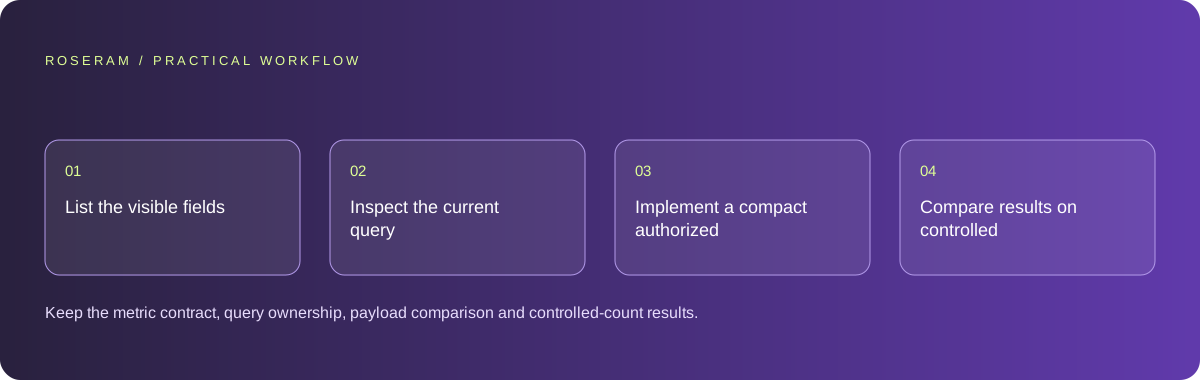
Use the sequence below as a task boundary, not as a claim that the example has been executed. Work with approved inputs and the project’s actual architecture. If a required integration or permission is unavailable, keep that stage visibly incomplete rather than generating a plausible substitute result.
- List the visible fields and the metric definitions behind them.
- Inspect the current query and returned payload size.
- Implement a compact authorized selection or aggregate.
- Compare results on controlled records and measure subsequent response volume.
A detailed brief you can adapt for your agent
Replace the illustrative context with your approved facts and controlled inputs. Keep the stated boundaries when adapting the brief. The expected deliverable matters more than a particular tool name: ask for an explanation grounded in the inspected material and evidence for the requested outcome.
Optimize this status query against the supplied metric contract. Select only needed fields or use a compact aggregate, preserving interval and uniqueness definitions. Test controlled boundary records and inspect response size. Keep authorization intact. Report any prepared database change separately from an actually applied and verified migration.Failure modes that an attractive preview can hide
A smaller query can accidentally count only the current page or omit late-arriving events. Test interval boundaries and pagination independently. Do not rewrite database schema merely to remove unused columns from a response. Index or aggregation changes may require authorized database access; a prepared migration should remain distinct from applied state.
Technical references: Google: Web Vitals
Acceptance checks and the evidence to retain
Keep the metric contract, query ownership, payload comparison and controlled-count results. A small response is useful only when it remains accurate for the intended task.
| Controlled case | Expected evidence |
|---|---|
| Controlled events span the interval boundary | Aggregate follows the approved inclusive or exclusive rule. |
| Same visitor has several events | Uniqueness matches the documented metric. |
| Public response is inspected | Unneeded private fields are absent. |
Specific answers
Common questions
Is selecting every column harmless if I hide it?
It can waste transfer and expose unnecessary data; request only the appropriate contract.
Should every summary use raw events?
Not necessarily. A supported aggregate can serve the task more efficiently.
What is the practical completion criterion?
Keep the metric contract, query ownership, payload comparison and controlled-count results. A small response is useful only when it remains accurate for the intended task.
Sources and editorial method
These references support the indicated technical facts. Workflows, examples and decision tables are original Roseram analysis. Illustrative costs are not vendor prices. No search volume, organic difficulty, ranking result or product endorsement is implied.
- Google: Web Vitals ↗
LCP, INP and CLS measure loading, interaction and visual stability.
Roseram offers AI software and may compete with tools discussed here. Sources checked 2026-10-11. Send a sourced correction.
Your next step
Keep a practical checklist.
Mark your progress. This checklist and helpfulness choice are saved on this device only; they are not public reviews.
0 of 5 complete
Share your experience in the community or submit a sourced correction. Public experiences remain separate from editorial claims.
Bring your next idea
Keep learning. Build with context.
Get Roseram model and workspace reopening updates. The guide remains available whether or not you subscribe.
Explore the workspace guide →