A worked example: where the task becomes difficult
A fictional status page requests full activity records every few seconds to display a small aggregate. Fifty visitors create repeated transfers even though the visible summary changes infrequently. Another source of bandwidth may be large stored files. Inspect provider breakdowns and endpoint payloads before attributing the whole usage total to the status page.
Decisions to make before implementation
Separate database, storage, realtime and other provider traffic categories where the account exposes them. Calculate a workload estimate from response size times frequency times active viewers, then compare it with observed usage. Choose compact aggregate queries and shared caching for suitable public data. Private account data needs scoped caching and should not be combined into a public response for efficiency.
A practical sequence for the work
Use the sequence below as a task boundary, not as a claim that the example has been executed. Work with approved inputs and the project’s actual architecture. If a required integration or permission is unavailable, keep that stage visibly incomplete rather than generating a plausible substitute result.
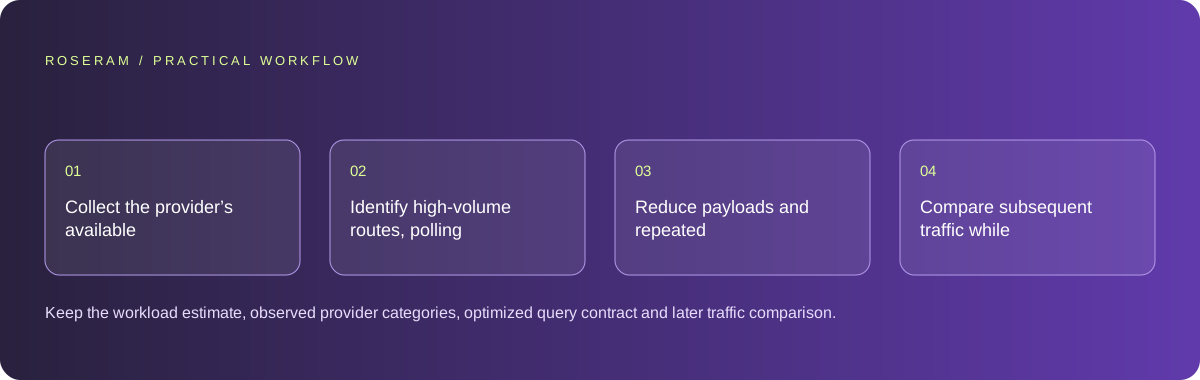
- Collect the provider’s available usage breakdown and representative response sizes.
- Identify high-volume routes, polling rates and unnecessarily returned fields.
- Reduce payloads and repeated reads at the authoritative query boundary.
- Compare subsequent traffic while checking summary correctness and freshness.
A detailed brief you can adapt for your agent
Replace the illustrative context with your approved facts and controlled inputs. Keep the stated boundaries when adapting the brief. The expected deliverable matters more than a particular tool name: ask for an explanation grounded in the inspected material and evidence for the requested outcome.
Audit bandwidth for these public summary and account endpoints. Measure response sizes, query fields and call frequency. Use available provider breakdowns rather than assigning the total to one route. Implement compact public aggregates and appropriately scoped caching. Verify correctness and subsequent usage; do not promise zero cost or erase prior-period usage.Failure modes that an attractive preview can hide
A dashboard total alone cannot identify a causal route. Do not claim a ten-gigabyte bill came from one page without supporting breakdowns. Turning off an interface may leave background callers active. Verify polling owners, scheduled jobs and client subscriptions. Cached responses still have costs and misses; “zero usage” is rarely an honest general promise.
Technical references: Google: Web Vitals
Acceptance checks and the evidence to retain
Keep the workload estimate, observed provider categories, optimized query contract and later traffic comparison. State any attribution gaps explicitly.
| Controlled case | Expected evidence |
|---|---|
| Summary endpoint is inspected | It returns only the aggregate fields required by the page. |
| Several visitors request unchanged public data | The chosen cache reduces duplicate database reads. |
| Optimization is released | Future usage trend is measured separately from earlier accumulated usage. |
Specific answers
Common questions
Can I identify the cause from one usage total?
Not reliably. Inspect category and route evidence where available.
Will optimization reset the current usage meter?
It reduces future consumption; already recorded period usage remains a separate fact.
What is the practical completion criterion?
Keep the workload estimate, observed provider categories, optimized query contract and later traffic comparison. State any attribution gaps explicitly.
Sources and editorial method
These references support the indicated technical facts. Workflows, examples and decision tables are original Roseram analysis. Illustrative costs are not vendor prices. No search volume, organic difficulty, ranking result or product endorsement is implied.
- Google: Web Vitals ↗
LCP, INP and CLS measure loading, interaction and visual stability.
Roseram offers AI software and may compete with tools discussed here. Sources checked 2026-10-11. Send a sourced correction.
Your next step
Keep a practical checklist.
Mark your progress. This checklist and helpfulness choice are saved on this device only; they are not public reviews.
0 of 5 complete
Share your experience in the community or submit a sourced correction. Public experiences remain separate from editorial claims.
Bring your next idea
Keep learning. Build with context.
Get Roseram model and workspace reopening updates. The guide remains available whether or not you subscribe.
Explore the workspace guide →