A worked example: where the task becomes difficult
A fictional project contains a website, an API package and shared types. The developer wants to add an order-history filter but has only opened the page component. The filter may already exist in a server query or shared library. Start by locating the application root and tracing a current order request. A tree of filenames alone cannot show which package executes or which service owns the result.
Decisions to make before implementation
Record entry point, request contract, data ownership, authorization and presentation separately. Mark generated files, vendored dependencies and build output so they are not edited accidentally. For a monorepo, identify package boundaries and the command used to run the relevant app. Keep confidence proportional to inspected source: a model should not claim an entire repository has been audited after reading a handful of files.
A practical sequence for the work
Use the sequence below as a task boundary, not as a claim that the example has been executed. Work with approved inputs and the project’s actual architecture. If a required integration or permission is unavailable, keep that stage visibly incomplete rather than generating a plausible substitute result.
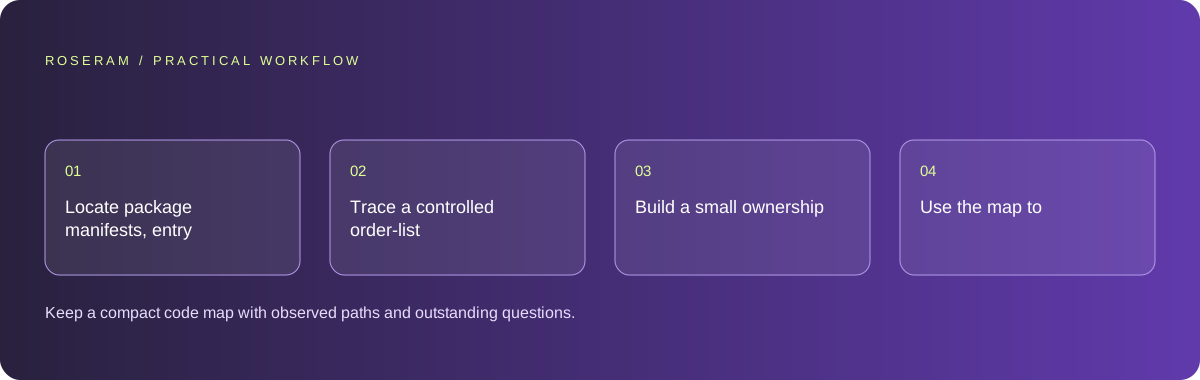
- Locate package manifests, entry points and repository instructions.
- Trace a controlled order-list request through actual handlers and data access.
- Build a small ownership table with file path, responsibility and unresolved dependency.
- Use the map to select the smallest change location and required tests.
A detailed brief you can adapt for your agent
Replace the illustrative context with your approved facts and controlled inputs. Keep the stated boundaries when adapting the brief. The expected deliverable matters more than a particular tool name: ask for an explanation grounded in the inspected material and evidence for the requested outcome.
Map the order-history journey in this repository without changing files. Identify the running package, route, authorization, data query and rendering component. Cite paths you inspected. Separate confirmed ownership from inferred dependencies. Finish with the likely location for a date filter and the additional source needed before editing.Failure modes that an attractive preview can hide
A plausible architecture diagram can invent a backend that is not present. Require file references for every concrete component and mark external services as configured, referenced or actually observed. Avoid sending a complete repository to a model just because context is missing. Load relevant source progressively, especially files that contain credentials, private fixtures or large generated artifacts.
Technical references: GitHub: getting useful results from coding tasks
Acceptance checks and the evidence to retain
Keep a compact code map with observed paths and outstanding questions. A useful map guides the next edit and can be updated after architectural changes; it is not a certificate of repository completeness.
| Controlled case | Expected evidence |
|---|---|
| Map names a data service | A corresponding source or configuration reference can be inspected. |
| Same component name exists in two packages | The active application path is identified explicitly. |
| Requested file has not been loaded | The map preserves an unknown rather than inventing its behavior. |
Specific answers
Common questions
Is the folder tree enough context?
It helps locate files but does not establish their runtime responsibility.
Should every file be loaded first?
Usually no; follow the affected journey and expand only when a dependency requires it.
What is the practical completion criterion?
Keep a compact code map with observed paths and outstanding questions. A useful map guides the next edit and can be updated after architectural changes; it is not a certificate of repository completeness.
Sources and editorial method
These references support the indicated technical facts. Workflows, examples and decision tables are original Roseram analysis. Illustrative costs are not vendor prices. No search volume, organic difficulty, ranking result or product endorsement is implied.
- GitHub: getting useful results from coding tasks ↗
Provider-specific reference for clear task scope and repository instructions; the worked workflows here are original analysis, not claims that every agent implements GitHub features.
Roseram offers AI software and may compete with tools discussed here. Sources checked 2026-10-11. Send a sourced correction.
Your next step
Keep a practical checklist.
Mark your progress. This checklist and helpfulness choice are saved on this device only; they are not public reviews.
0 of 5 complete
Share your experience in the community or submit a sourced correction. Public experiences remain separate from editorial claims.
Bring your next idea
Keep learning. Build with context.
Get Roseram model and workspace reopening updates. The guide remains available whether or not you subscribe.
Explore the workspace guide →