A worked example: where the task becomes difficult
A fictional scheduling app sends duplicate reminders when an appointment is edited. “Fix notifications” is too broad: it does not identify whether the duplicate comes from saving, queueing or delivery. A useful brief includes a controlled appointment, the edit performed, the two reminder references and the expected single reminder. Remove customer details while preserving the sequence needed to reproduce the issue.
Decisions to make before implementation
Separate facts from hypotheses. “Two queue records were observed” is stronger than “the frontend probably saves twice.” Describe what the agent may inspect and what it may modify, including the active branch and permitted test environment. Name external side effects that need explicit authorization. Set an exit condition for missing evidence so the agent asks for a precise input instead of rewriting an unrelated subsystem.
A practical sequence for the work
Use the sequence below as a task boundary, not as a claim that the example has been executed. Work with approved inputs and the project’s actual architecture. If a required integration or permission is unavailable, keep that stage visibly incomplete rather than generating a plausible substitute result.
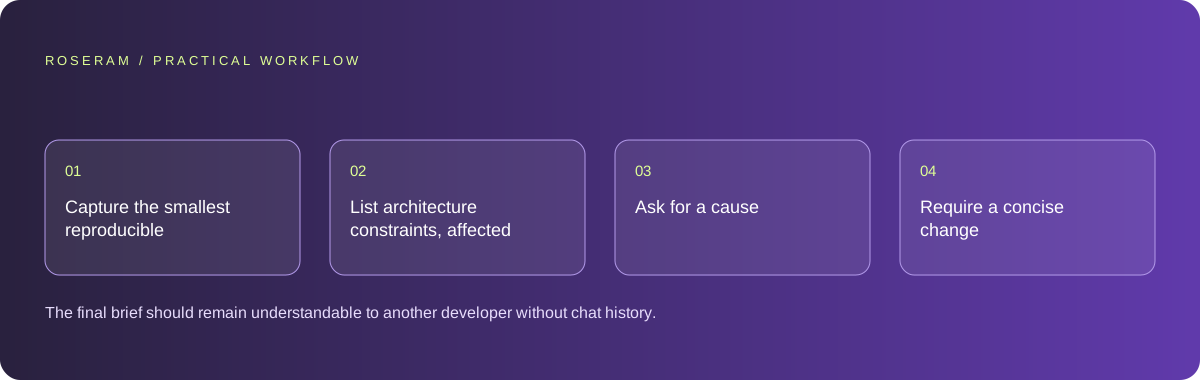
- Capture the smallest reproducible example and its expected result.
- List architecture constraints, affected users and allowed files or investigation boundaries.
- Ask for a cause supported by code or runtime evidence before the edit.
- Require a concise change explanation and a check that exercises the reported failure.
A detailed brief you can adapt for your agent
Replace the illustrative context with your approved facts and controlled inputs. Keep the stated boundaries when adapting the brief. The expected deliverable matters more than a particular tool name: ask for an explanation grounded in the inspected material and evidence for the requested outcome.
Investigate duplicate reminders for the controlled appointment described below. Establish whether duplication begins at save, queue creation or delivery. Preserve the existing provider and public API. Edit only after finding a supported cause. Test one appointment edit and one retry. Report changed files, observed results and remaining uncertainty; do not send reminders to actual customers.Failure modes that an attractive preview can hide
Prescribing a patch before identifying the cause can hide the duplicate rather than prevent it. A client-only debounce, for example, may not affect two server jobs. Avoid giving an agent contradictory goals such as “change nothing” and “replace the notification system.” Keep unrelated improvements in another task so completion has an unambiguous meaning.
Technical references: GitHub: getting useful results from coding tasks
Acceptance checks and the evidence to retain
The final brief should remain understandable to another developer without chat history. Keep reproduction inputs, constraints, accepted behavior and verification evidence together with the changed revision.
| Controlled case | Expected evidence |
|---|---|
| Brief contains only a vague symptom | Agent requests the missing reproduction or narrows an explicit investigation. |
| Two plausible causes exist | The proposed edit names evidence for the selected cause. |
| Agent reports completion | The original controlled sequence no longer produces the duplicate. |
Specific answers
Common questions
Should I tell the agent exactly which line to change?
Use a suspected location as context, but let evidence confirm whether it owns the failure.
How long should a task brief be?
Long enough to remove ambiguity about the problem, constraints and completion; avoid unrelated project history.
What is the practical completion criterion?
The final brief should remain understandable to another developer without chat history. Keep reproduction inputs, constraints, accepted behavior and verification evidence together with the changed revision.
Sources and editorial method
These references support the indicated technical facts. Workflows, examples and decision tables are original Roseram analysis. Illustrative costs are not vendor prices. No search volume, organic difficulty, ranking result or product endorsement is implied.
- GitHub: getting useful results from coding tasks ↗
Provider-specific reference for clear task scope and repository instructions; the worked workflows here are original analysis, not claims that every agent implements GitHub features.
Roseram offers AI software and may compete with tools discussed here. Sources checked 2026-10-11. Send a sourced correction.
Your next step
Keep a practical checklist.
Mark your progress. This checklist and helpfulness choice are saved on this device only; they are not public reviews.
0 of 5 complete
Share your experience in the community or submit a sourced correction. Public experiences remain separate from editorial claims.
Bring your next idea
Keep learning. Build with context.
Get Roseram model and workspace reopening updates. The guide remains available whether or not you subscribe.
Explore the workspace guide →