A worked example: where the task becomes difficult
A fictional beginner wants a page that filters a list of books. Copying a full generated application hides the relationship between input state, filtering and rendering. Begin with a short list and one search field. Before running it, predict what happens for an empty query, mixed case and no matches. The learner should explain why the predicate includes or excludes each book.
Decisions to make before implementation
Choose a concept-sized exercise rather than a production feature with many dependencies. Ask the model to separate language behavior from framework conventions. Keep explanations grounded in the actual code and avoid unnecessary abstractions. Decide when the learner should attempt a solution before receiving one. A useful tutor can ask a focused question and wait, not immediately replace every incomplete attempt.
A practical sequence for the work
Use the sequence below as a task boundary, not as a claim that the example has been executed. Work with approved inputs and the project’s actual architecture. If a required integration or permission is unavailable, keep that stage visibly incomplete rather than generating a plausible substitute result.
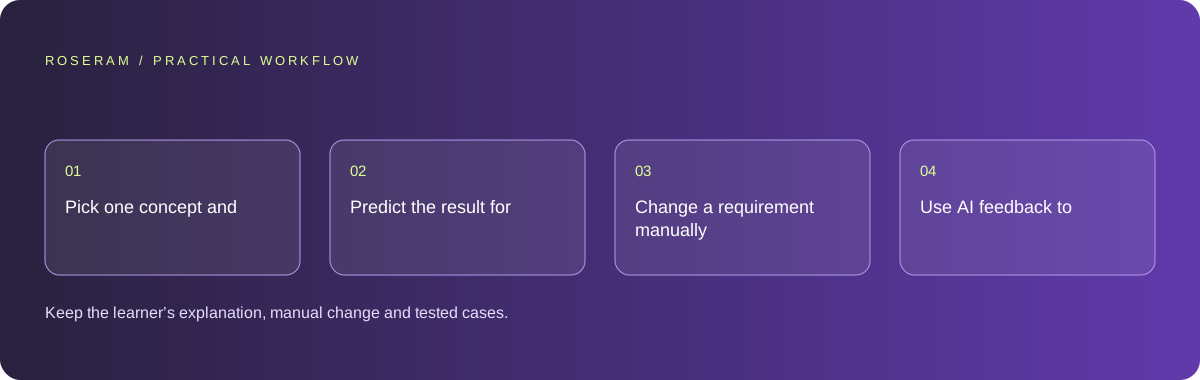
- Pick one concept and a minimal runnable exercise.
- Predict the result for ordinary and edge-case inputs before execution.
- Change a requirement manually and explain the expected effect.
- Use AI feedback to compare reasoning, then repeat without the full solution.
A detailed brief you can adapt for your agent
Replace the illustrative context with your approved facts and controlled inputs. Keep the stated boundaries when adapting the brief. The expected deliverable matters more than a particular tool name: ask for an explanation grounded in the inspected material and evidence for the requested outcome.
Act as a programming tutor for a small book-filter exercise. Ask me to predict behavior before showing the answer. Explain the actual code and give hints for errors. Keep dependencies minimal. After I implement case-insensitive title matching, ask me to handle no results and explain the predicate. Do not replace the whole exercise on every mistake.Failure modes that an attractive preview can hide
An agent that fixes every error instantly can remove the opportunity to diagnose it. Request hints and explanations before a replacement patch. Also avoid treating generated comments as proof that the code behaves that way. Test the actual function and ask why a counterexample differs from your prediction. Keep credentials and paid services out of early exercises unless they are essential.
Technical references: NIST: AI Risk Management Framework
Acceptance checks and the evidence to retain
Keep the learner’s explanation, manual change and tested cases. The useful outcome is the ability to adapt the concept to another list, not only possession of a generated page.
| Controlled case | Expected evidence |
|---|---|
| Search uses mixed uppercase and lowercase | Learner can explain and implement the chosen matching rule. |
| No book matches | The learner predicts the empty result and intentional UI state. |
| Requirement changes to title-only matching | The learner edits the predicate without regenerating the entire application. |
Specific answers
Common questions
Should beginners avoid AI entirely?
It can be useful when it supports reasoning and practice rather than replacing every attempt.
How do I know I understood the code?
Predict a new case, modify the requirement and explain the observed result without relying on the original answer.
What is the practical completion criterion?
Keep the learner’s explanation, manual change and tested cases. The useful outcome is the ability to adapt the concept to another list, not only possession of a generated page.
Sources and editorial method
These references support the indicated technical facts. Workflows, examples and decision tables are original Roseram analysis. Illustrative costs are not vendor prices. No search volume, organic difficulty, ranking result or product endorsement is implied.
- NIST: AI Risk Management Framework ↗
A reference for managing AI risk; these task examples are original editorial workflows, not a NIST endorsement or a compliance assessment.
Roseram offers AI software and may compete with tools discussed here. Sources checked 2026-10-11. Send a sourced correction.
Your next step
Keep a practical checklist.
Mark your progress. This checklist and helpfulness choice are saved on this device only; they are not public reviews.
0 of 5 complete
Share your experience in the community or submit a sourced correction. Public experiences remain separate from editorial claims.
Bring your next idea
Keep learning. Build with context.
Get Roseram model and workspace reopening updates. The guide remains available whether or not you subscribe.
Explore the workspace guide →