A worked example: where the task becomes difficult
A fictional service app tracks customers, jobs and job visits. One job can require several visits, so putting a single visit date on the job will fail later. Describe real examples and cancellation behavior before asking for tables. Use controlled identifiers and a relationship diagram, then check whether the model supports the product’s ordinary and exceptional workflows.
Decisions to make before implementation
Choose authoritative identifiers, required fields, uniqueness and deletion behavior. Separate derived values from stored facts where useful. Define ownership and access alongside relationships, not after the interface is complete. Plan compatible migrations for existing records and identify who has permission to apply them. Avoid adding every possible future feature to the first schema.
A practical sequence for the work
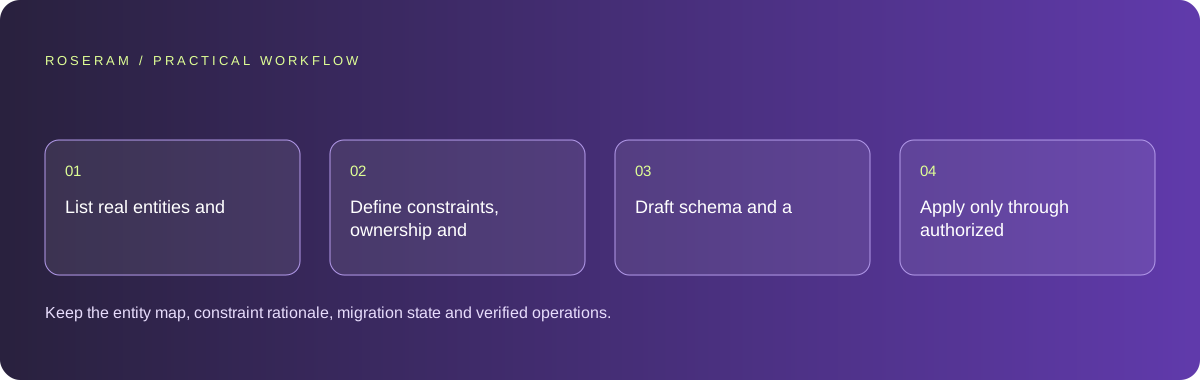
Use the sequence below as a task boundary, not as a claim that the example has been executed. Work with approved inputs and the project’s actual architecture. If a required integration or permission is unavailable, keep that stage visibly incomplete rather than generating a plausible substitute result.
- List real entities and representative relationships from the product task.
- Define constraints, ownership and lifecycle with normal and exceptional examples.
- Draft schema and a migration plan against the existing database.
- Apply only through authorized tooling and verify reads, writes and access rules.
A detailed brief you can adapt for your agent
Replace the illustrative context with your approved facts and controlled inputs. Keep the stated boundaries when adapting the brief. The expected deliverable matters more than a particular tool name: ask for an explanation grounded in the inspected material and evidence for the requested outcome.
Model customers, jobs and multiple visits from these examples. Inspect the existing schema first. Define ownership, constraints and deletion behavior, then propose a compatible migration. Separate generated SQL from applied state. Include direct constraint and access checks using controlled records; do not assume database permission from code access.Failure modes that an attractive preview can hide
A schema can compile while failing the business contract, such as allowing duplicate job references or deleting shared customers unexpectedly. Test constraints directly. Do not claim production tables exist because a migration passed an isolated syntax check. Keep migration preparation, application and live validation as distinct evidence.
Technical references: MDN: form validation
Acceptance checks and the evidence to retain
Keep the entity map, constraint rationale, migration state and verified operations. Record unresolved ownership decisions before generating dependent screens.
| Controlled case | Expected evidence |
|---|---|
| One job has three visits | The model represents the relationship without overwriting earlier visits. |
| Duplicate business identifier is inserted | The approved uniqueness rule is enforced. |
| Migration is prepared but not applied | The interface does not report the database capability as available. |
Specific answers
Common questions
Does valid SQL prove the schema is right?
It proves limited syntax or execution conditions, not the product’s data relationships and access contract.
Can a prepared migration be treated as production state?
No. Apply it with appropriate authority and verify the intended database.
What is the practical completion criterion?
Keep the entity map, constraint rationale, migration state and verified operations. Record unresolved ownership decisions before generating dependent screens.
Sources and editorial method
These references support the indicated technical facts. Workflows, examples and decision tables are original Roseram analysis. Illustrative costs are not vendor prices. No search volume, organic difficulty, ranking result or product endorsement is implied.
- MDN: form validation ↗
Client validation helps users but cannot replace server-side validation.
Roseram offers AI software and may compete with tools discussed here. Sources checked 2026-10-11. Send a sourced correction.
Your next step
Keep a practical checklist.
Mark your progress. This checklist and helpfulness choice are saved on this device only; they are not public reviews.
0 of 5 complete
Share your experience in the community or submit a sourced correction. Public experiences remain separate from editorial claims.
Bring your next idea
Keep learning. Build with context.
Get Roseram model and workspace reopening updates. The guide remains available whether or not you subscribe.
Explore the workspace guide →