A worked example: where the task becomes difficult
A fictional product team wants a short video explaining how a customer requests a quote. Generating several impressive clips first produces inconsistent characters and a sequence that never shows the request outcome. Begin with a six-shot board tied to the actual workflow: problem, input, estimate, review, confirmation and next step. Keep product screens consistent with features that really exist.
Decisions to make before implementation
Define aspect ratio, duration, scene purpose, visual continuity and audio needs. Decide which shots need actual screen recording instead of a generated representation. Keep claims and on-screen text approved before production. Plan captions and transcript from the beginning. Avoid implying that a generated person is a real customer endorsing the product.
A practical sequence for the work
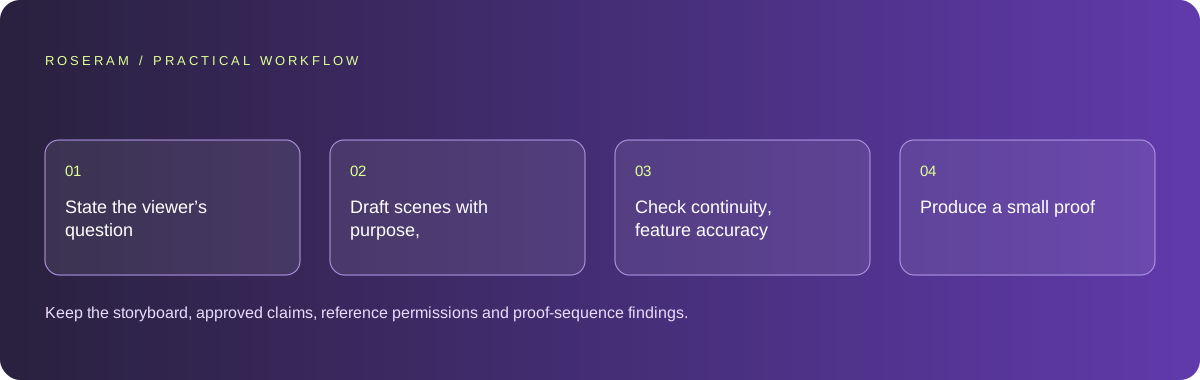
Use the sequence below as a task boundary, not as a claim that the example has been executed. Work with approved inputs and the project’s actual architecture. If a required integration or permission is unavailable, keep that stage visibly incomplete rather than generating a plausible substitute result.
- State the viewer’s question and the action the video should explain.
- Draft scenes with purpose, visual, narration and transition.
- Check continuity, feature accuracy and permitted references.
- Produce a small proof sequence and review it before expanding the video.
A detailed brief you can adapt for your agent
Replace the illustrative context with your approved facts and controlled inputs. Keep the stated boundaries when adapting the brief. The expected deliverable matters more than a particular tool name: ask for an explanation grounded in the inspected material and evidence for the requested outcome.
Storyboard a short quote-request explainer using this approved workflow. Define six scenes with visual purpose, narration and transitions. Mark shots requiring real screen capture. Include captions and avoid fabricated customer endorsement. Produce a proof-sequence plan and list continuity risks before generating full footage.Failure modes that an attractive preview can hide
A storyboard can overpromise what the product does or leave important steps out for visual drama. Keep the written workflow as the source of truth. Generation may not preserve identity, text or spatial continuity automatically. Budget for revision and editing rather than treating every first clip as production-ready.
Technical references: W3C WAI: accessibility tutorials
Acceptance checks and the evidence to retain
Keep the storyboard, approved claims, reference permissions and proof-sequence findings. The production should remain traceable to the real customer workflow.
| Controlled case | Expected evidence |
|---|---|
| Scene sequence is read without footage | It explains the customer journey coherently. |
| Generated screen shows a feature | The feature exists in the actual product or is clearly conceptual. |
| Clip transitions are assembled | Continuity supports the intended meaning rather than confusing it. |
Specific answers
Common questions
Should I generate clips before planning?
A small experiment can help, but a coherent storyboard prevents disconnected production.
Can generated product screens substitute for the real app?
Only in clearly conceptual material; demonstrations should accurately represent available behavior.
What is the practical completion criterion?
Keep the storyboard, approved claims, reference permissions and proof-sequence findings. The production should remain traceable to the real customer workflow.
Sources and editorial method
These references support the indicated technical facts. Workflows, examples and decision tables are original Roseram analysis. Illustrative costs are not vendor prices. No search volume, organic difficulty, ranking result or product endorsement is implied.
- W3C WAI: accessibility tutorials ↗
Reference material for accessible content and media; an individual checklist does not establish complete conformance.
Roseram offers AI software and may compete with tools discussed here. Sources checked 2026-10-11. Send a sourced correction.
Your next step
Keep a practical checklist.
Mark your progress. This checklist and helpfulness choice are saved on this device only; they are not public reviews.
0 of 5 complete
Share your experience in the community or submit a sourced correction. Public experiences remain separate from editorial claims.
Bring your next idea
Keep learning. Build with context.
Get Roseram model and workspace reopening updates. The guide remains available whether or not you subscribe.
Explore the workspace guide →