A Club Needs Fair Gate Rules
Meet Nora. Nora teaches acoustic guitar on the web. She wants to build a membership site with ai. Nora loves helping eager adult students pick strings. Right now, her digital door swings wide open. That means her private guitar lessons are free today.
Think of a music club with a velvet rope. A velvet rope is a soft fence for guests. A friendly guard stands right beside that soft fence. The guard checks paper tickets for every single guest. Paid guests step inside with joy and sing songs. Guests without tickets stay outside in the front yard.
A weak guard just trusts any smiling stranger. Our digital guard needs firm rules to read daily. Write the club rules before you build code. Nora needs clean doors that welcome paid friends fast. Let us look at what every safe club needs.
- List what each plan includes for all clients.
- Connect access to confirmed membership records directly.
- Test joining, renewal, and cancellation with great care.
Define Each Seat at the Table
Nora opens a clean notebook on her desk. She writes down each member stage in plain words. An access right is a confirmed right to enter. A server record proves that a real ticket exists. Our app must read this record before opening doors. This keeps private guitar lessons safe from outside eyes.
A visitor can read free open tune sheets. An active member can open deep paid guitar lessons. A cancelled student keeps access until their paid days end. This fair rule honors money already spent by clients. If someone pays for May, let them stay all May. That builds real trust between Nora and her clients.
Do not leave access rules to random browser guesses. Write start dates, grace days, and end dates first. When renewals fail, a brief grace period helps clients. A grace period is extra time to pay debts. Give them three days to fix a bad card. Your central billing app must control every state update.
Keep the Private Door Locked Tight
Some web makers make a big mistake here. They trust the return page from a checkout cart. A sneaky visitor can type that link without paying. A simple return link does not prove money arrived. Anyone can copy a web link and press enter. That makes the whole velvet rope fall flat down.
Your private content needs a strong server check. A server check is a safe test on your app. The server looks up the true account in secret. It ignores wild claims made by a web link. The server asks if this client bought a ticket. If the answer is yes, the door opens wide.
Sending web form data only passes raw text along. A form submission transports data to a receiving endpoint. Downstream delivery is a separate step behind the curtain. It checks true client records away from public eyes. Safe guards make honest membership systems run with total peace.
Read more: MDN: sending form data
Nora and Sam: A Practice Run
Let us watch Nora build a practice lesson gate. She invents a student named Sam for this test. Sam joins the guitar club on May tenth. Nora marks Sam as active in her practice sheet. Sam can now see every fingerpicking lesson inside. The digital guard checks Sam and waves him inside.
On May twentieth, Sam decides to cancel his seat. Sam already paid for all thirty days of May. The guard lets Sam watch guitar videos through May thirty. His access ends smoothly when that last day arrives. Nora does not cut Sam off on May twenty. That would be mean to a paying client.
Nora tests Sam with three clean rows of data. She tests free lessons, paid riffs, and expiry dates. The simple app answers each request with direct logic. No private data leaks out to any other screen. Nora keeps her test data neat, safe, and true.
| Controlled case | Expected evidence |
|---|---|
| Visitor alters a checkout-success query parameter | Restricted content remains protected. |
| Member cancels halfway through an approved paid period | Access follows the documented paid-through policy. |
| Renewal event arrives twice | Entitlement is updated predictably without duplicate benefits. |
Kite Makers Use the Same Door
This same access pattern works for many creative skills. Think of Marco, who runs a paper kite school. Marco sells monthly craft plans to busy adult makers. His club uses the exact same member gate logic. He wants paying kite builders to see new plans. Free guests only see basic open kite patterns.
Marco offers free paper bird folds to everyone online. He saves master dragon kite builds for paid members. When parents pause plans for winter, grace rules hold. Marco gives them five extra days to fix cards. His app checks each access right record before showing plans. The kite app never relies on weak browser tricks.
Marco also knows about downloaded files. A downloaded file is a document saved to a disk. Once a client saves a file, it stays there. Revoking web access cannot pull back files from laptops. Marco designs his printable pattern sheets with that clear truth. He knows once a sheet leaves, it stays away.
- Free bird folds stay open for every visiting maker.
- Dragon kite blueprints stay behind the private server gate.
- Saved pattern files stay on the client device forever.
Avoid Sneaky Traps in Your Build
A common trap is locking out members too fast. A client cancels, and a bot cuts access instantly. That member paid for thirty full days of learning. Cutting them off early creates anger and refund fights. Always let clients stay until their paid days expire. Your app must check the expiry date every time.
Another trap comes from duplicate payment notices. A network hiccup can send one renewal notice twice. A good access right system updates smoothly without double days. It logs the event once and stays calm. It checks the event number and ignores repeats. That prevents big mess in your client records.
Keep billing identifiers private inside your protected data store. A billing identifier is a secret code linking a card. If an account fails a check, show simple words. Tell the user their pass expired without showing secrets. Never reveal another person account data on the screen. Preserve a clear support trace for every billing dispute.
Read more: MDN: sending form data
Run a Hands-On Lock Test
Now you can run your own safe test today. Open an incognito browser window on your home machine. An incognito window is a private window without cookies. Paste the private lesson web link directly into it. The app should stop you right at the door. You should see a polite note asking to join.
Next, log in as your test student named Sam. Look at the free fingerpicking video without any trouble. Then click the master solo lesson while Sam stays active. Watch the video play clearly with good clean sound. This proves that an active member can reach lessons. The digital rope lifted up just like it should.
Now set Sam to expired in your test table. Refresh the web page right in front of you. Sam should see a kind note to renew access. He should not see the video player load now. If this works, your core gate stands firm today. You have built a safe lock for your site.
Move Ahead with Your Project
You now understand how club access really operates online. Write your own plain policy table on paper next. Set your start dates, trial rules, and cancel dates. Keep that sheet beside your computer while you work. When your rules are simple, building your app feels easy. Good planning saves you many hours of fixing bugs.
Roseram can help with drafting clear member state models. Roseram access and limits depend on your current plan. Give your tool precise rules so it builds safe gates. Ask it to check entitlements only on your server. Clear written limits stop bad code before it begins. You stay in charge of every member rule you write.
Smart tools will always follow the clear structures you build. Solid logic protects your hard work and your clients. Build your policy table today, test each state, and go! Your new membership site is ready to open doors.
Act as a software architect. Implement lesson access from a server-owned entitlement record for my music site. Model free, active, grace, and expired states using this policy: Sam joined May 10, cancelled May 20, and retains access through May 30. Keep billing identifiers private. Do not trust checkout redirects for authorization. Provide controlled tests for cancellation and expiry, plus a user-facing explanation of denied access that does not reveal another account.
Your idea. Your next step.
Put Roseram super intelligence to work.
Bring the idea you keep coming back to. Choose a Roseram plan, then give your project a clear first task. You can think it through, build a first version, and improve it as you learn.
Check current access, plan limits, and pricing before joining.
Your next step
Your quick checklist.
Tick a step as you finish it. Your ticks and feedback stay on this device. They are not public reviews.
0 of 7 complete
Tell the community what you tried or tell us what needs fixing. Include a source if you are correcting a fact.
Your questions, answered
Can a successful redirect unlock the library?
A page jump starts a check. But the database must say yes. That record gives real access.
Can access to a downloaded file be withdrawn?
No. Saved files stay on their machine. You cannot wipe their downloads. Design your site with that limit.
How do I know the task is done?
Keep the membership rule chart. Confirm paid member checks work. Plan how to match payments. Label fake test payments clearly.
Why must the server check member rights?
People can change browser screen code. They can view hidden screens easily. Central servers guard real member files.
Want the technical details?Open the code notes, deeper checks, and common questions.
These notes go deeper. Use the parts that fit your project. Examples are for learning; they are not claims that we tested your app.
A worked example: where the task becomes difficult
A fictional craft educator sells access to a lesson library. A visitor can read free lessons; an active member can open paid lessons; a cancelled member retains access only until the approved expiry. The first build uses fake entitlements and one lesson of each type. Write the policy in plain language before asking the agent to create subscription cards, because trial promises and refunds change who should retain access.
Decisions to make before implementation
Specify when access starts, whether failed renewals have a grace period and whether refunds remove access. Keep these decisions out of arbitrary frontend conditions. The trusted billing or entitlement service should own the state used by content endpoints. Also decide what a user may download permanently. Revoking access to a web lesson cannot necessarily revoke a file already saved to a personal device.
A practical sequence for the work
Use the sequence below as a task boundary, not as a claim that the example has been executed. Work with approved inputs and the project’s actual architecture. If a required integration or permission is unavailable, keep that stage visibly incomplete rather than generating a plausible substitute result.
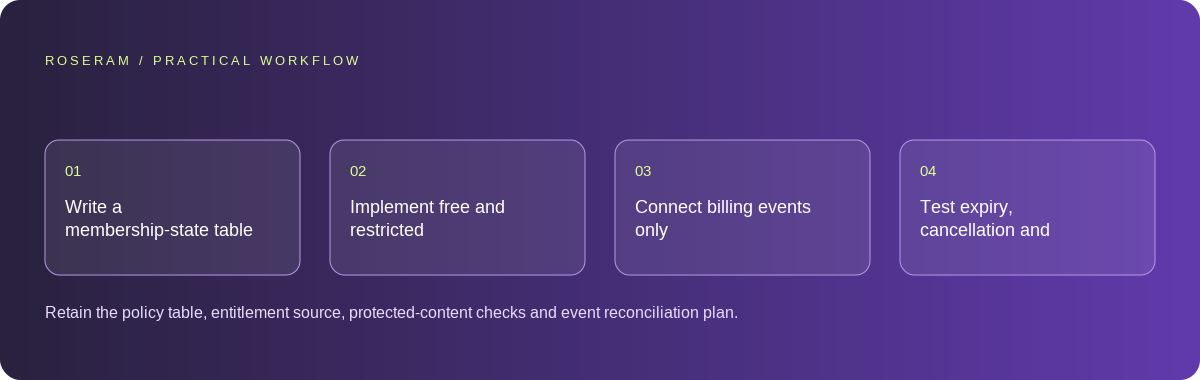
- Write a membership-state table with start and expiry rules approved by the owner.
- Implement free and restricted lesson retrieval against controlled entitlement records.
- Connect billing events only after event authenticity and duplicate handling are designed.
- Test expiry, cancellation and payment failure before publishing membership promises.
A detailed brief you can adapt for your agent
Replace the illustrative context with your approved facts and controlled inputs. Keep the stated boundaries when adapting the brief. The expected deliverable matters more than a particular tool name: ask for an explanation grounded in the inspected material and evidence for the requested outcome.
Implement lesson access from a server-owned entitlement record. Model free, trial, active, grace and expired states only where the supplied policy uses them. Keep billing identifiers private. Do not trust checkout redirects for authorization. Provide controlled tests for cancellation and expiry, plus a user-facing explanation of denied access that does not reveal another account.
Failure modes that an attractive preview can hide
An agent may unlock content when a query string says payment succeeded or when a browser flag is set. Those signals are user-controlled and cannot authorize paid access. Another trap is deleting access immediately when cancellation is requested despite a paid-through period. Match behavior to the published policy and preserve a support trace for disputed entitlement decisions.
Read more: MDN: sending form data
Acceptance checks and the evidence to retain
Retain the policy table, entitlement source, protected-content checks and event reconciliation plan. Clearly identify payment integrations that are still simulated rather than operational.
| Controlled case | Expected evidence |
|---|---|
| Visitor alters a checkout-success query parameter | Restricted content remains protected. |
| Member cancels halfway through an approved paid period | Access follows the documented paid-through policy. |
| Renewal event arrives twice | Entitlement is updated predictably without duplicate benefits. |
Common questions
Can a successful redirect unlock the library?
It can start a status check, but the trusted membership record must authorize access.
Can access to a downloaded file be withdrawn?
A saved copy may remain available to its recipient; design licensing and distribution with that limitation in mind.
What is the practical completion criterion?
Retain the policy table, entitlement source, protected-content checks and event reconciliation plan. Clearly identify payment integrations that are still simulated rather than operational.
Where the facts come from
Use these links to check the technical facts. The stories here are made-up examples to help you learn. Roseram sells AI tools; our examples are not promises of results.
- MDN: sending form data ↗
What this source covers
Form submission transports data to a receiving endpoint; downstream delivery is a separate implementation.
References last reviewed 2026-10-11. Writing refreshed 2026-10-14. Spot a mistake? Tell us.
