A worked example: where the task becomes difficult
A fictional scheduling product receives repeated questions about rescheduling, notifications and exporting appointments. The support team has existing answers with contradictory screenshots from older versions. Before generating a hundred articles, choose ten common tasks and identify the correct current workflow. An article should tell a customer what they need, what to click and how to recognize completion, rather than rewriting a feature description.
Decisions to make before implementation
Assign an owner and review date to each article. Separate public help from internal troubleshooting that includes credentials or private customer records. Decide whether search indexes titles, body content and aliases, and how archived content is handled. An AI answer layer should cite the underlying article and admit when the library does not contain an answer. Do not silently fill gaps with invented product instructions.
A practical sequence for the work
Use the sequence below as a task boundary, not as a claim that the example has been executed. Work with approved inputs and the project’s actual architecture. If a required integration or permission is unavailable, keep that stage visibly incomplete rather than generating a plausible substitute result.
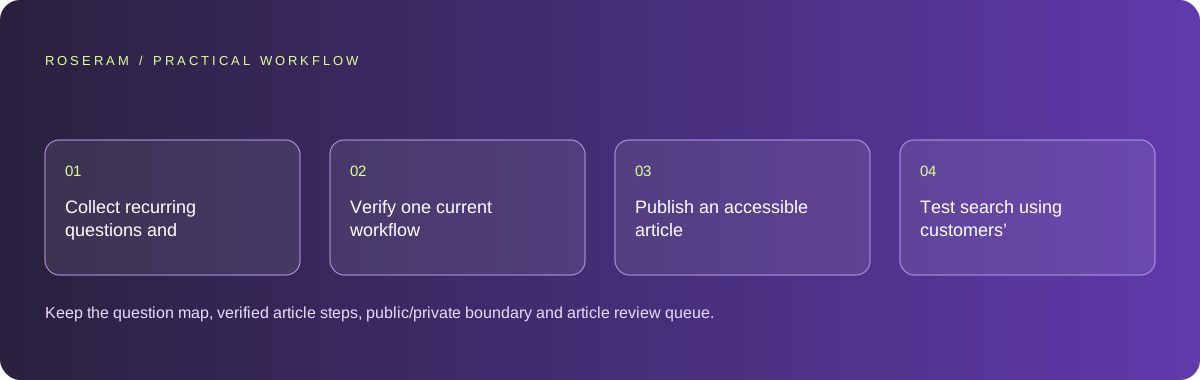
- Collect recurring questions and deduplicate them by the customer task.
- Verify one current workflow and capture only approved public screenshots.
- Publish an accessible article with prerequisites, steps, result and recovery options.
- Test search using customers’ vocabulary and establish an update queue.
A detailed brief you can adapt for your agent
Replace the illustrative context with your approved facts and controlled inputs. Keep the stated boundaries when adapting the brief. The expected deliverable matters more than a particular tool name: ask for an explanation grounded in the inspected material and evidence for the requested outcome.
Create a help-center structure from these ten approved questions. Draft only the supplied current workflows and mark gaps. Include prerequisites, numbered steps, expected result and failure recovery. Keep internal ticket material out of public pages. Add search aliases from the provided customer vocabulary and identify an owner for future updates.Failure modes that an attractive preview can hide
Drafting from old support tickets can reproduce private account details or obsolete workarounds. Remove identifiers before giving examples to a model and check current product behavior. Search can also surface an old article above the corrected one. Use an explicit archive policy and redirects where the same answer has moved; do not leave competing instructions without version context.
Technical references: MDN: sending form data
Acceptance checks and the evidence to retain
Keep the question map, verified article steps, public/private boundary and article review queue. Search should return useful evidence rather than a confident unsupported answer.
| Controlled case | Expected evidence |
|---|---|
| Customer searches a common synonym | The relevant current article appears with an understandable title. |
| An archived procedure contradicts the current release | Readers reach the approved answer or see clear historical context. |
| Question is absent from the library | The answer layer declines unsupported instructions and offers support. |
Specific answers
Common questions
Can AI publish answers directly from tickets?
Tickets require privacy screening and product verification before becoming public instructions.
Should every synonym become a separate article?
Usually aliases should lead to one canonical answer when the customer task is the same.
What is the practical completion criterion?
Keep the question map, verified article steps, public/private boundary and article review queue. Search should return useful evidence rather than a confident unsupported answer.
Sources and editorial method
These references support the indicated technical facts. Workflows, examples and decision tables are original Roseram analysis. Illustrative costs are not vendor prices. No search volume, organic difficulty, ranking result or product endorsement is implied.
- MDN: sending form data ↗
Form submission transports data to a receiving endpoint; downstream delivery is a separate implementation.
Roseram offers AI software and may compete with tools discussed here. Sources checked 2026-10-11. Send a sourced correction.
Your next step
Keep a practical checklist.
Mark your progress. This checklist and helpfulness choice are saved on this device only; they are not public reviews.
0 of 5 complete
Share your experience in the community or submit a sourced correction. Public experiences remain separate from editorial claims.
Bring your next idea
Keep learning. Build with context.
Get Roseram model and workspace reopening updates. The guide remains available whether or not you subscribe.
Explore the workspace guide →