A worked example: where the task becomes difficult
A fictional agent adds three libraries to format dates and show a modal in a project that already has those capabilities. Another package has a similar name to a familiar dependency but comes from a different publisher. Compare the manifest and lockfile with the prior revision. Do not install an unknown package merely because the generated code imports it.
Decisions to make before implementation
Distinguish direct and transitive dependencies, development and runtime use, and optional adapters. Use official registry and maintainer information to establish provenance. Review advisories in the context of the installed version and actual exposure. A warning may require action, but automatic major upgrades can break the app. Document license questions for the appropriate review rather than inventing a legal conclusion.
A practical sequence for the work
Use the sequence below as a task boundary, not as a claim that the example has been executed. Work with approved inputs and the project’s actual architecture. If a required integration or permission is unavailable, keep that stage visibly incomplete rather than generating a plausible substitute result.
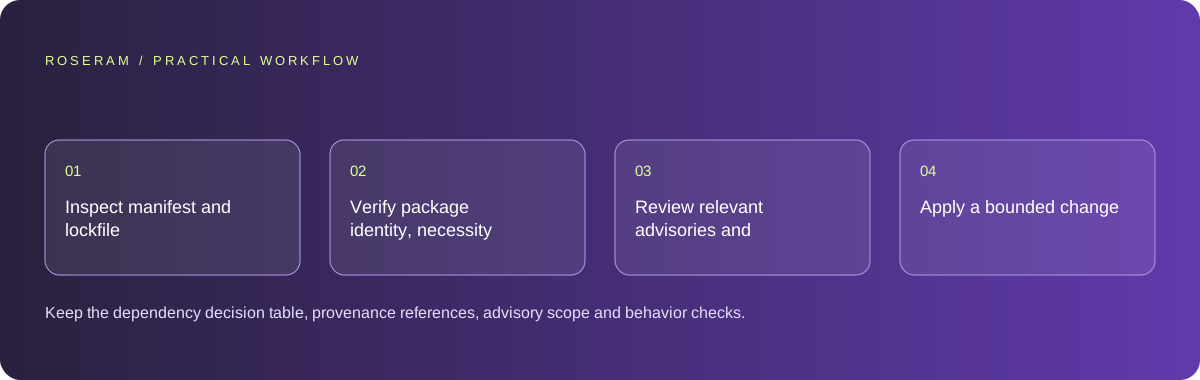
- Inspect manifest and lockfile changes with the intended feature in mind.
- Verify package identity, necessity and existing alternatives.
- Review relevant advisories and maintenance implications for installed versions.
- Apply a bounded change and retest the behavior that depends on the package.
A detailed brief you can adapt for your agent
Replace the illustrative context with your approved facts and controlled inputs. Keep the stated boundaries when adapting the brief. The expected deliverable matters more than a particular tool name: ask for an explanation grounded in the inspected material and evidence for the requested outcome.
Review dependencies added by this agent change. Inspect manifest and lockfile differences, package provenance and existing alternatives. Identify relevant advisory exposure without blindly upgrading major versions. Explain active runtime use and optional adapters. Keep the current package manager and test the affected feature after any authorized change.Failure modes that an attractive preview can hide
Deleting every flagged dependency can disable unrelated functions, while ignoring all warnings because tests pass misses exposure. Avoid unsolicited package-manager switches or lockfile regeneration. A package name in an old build artifact does not alone prove a live network integration, but source imports and active configuration should be traced before declaring it removed.
Technical references: MDN: practical security implementation guides
Acceptance checks and the evidence to retain
Keep the dependency decision table, provenance references, advisory scope and behavior checks. Removal claims should distinguish manifests, source imports, built artifacts and live deployed state.
| Controlled case | Expected evidence |
|---|---|
| New package duplicates an existing capability | The agent justifies it or reuses the established implementation. |
| Manifest removes a runtime adapter | Affected routes and build output are checked for remaining active imports. |
| Upgrade changes an API | The dependent behavior is retested rather than assuming compatibility. |
Specific answers
Common questions
Does a package name prove an active subscription?
No. Trace configuration and runtime use; billing state is a separate provider fact.
Should all updates be automatic?
Use a policy appropriate to compatibility and exposure; major changes often require targeted verification.
What is the practical completion criterion?
Keep the dependency decision table, provenance references, advisory scope and behavior checks. Removal claims should distinguish manifests, source imports, built artifacts and live deployed state.
Sources and editorial method
These references support the indicated technical facts. Workflows, examples and decision tables are original Roseram analysis. Illustrative costs are not vendor prices. No search volume, organic difficulty, ranking result or product endorsement is implied.
- MDN: practical security implementation guides ↗
Web security implementation reference; task-specific threat models and review remain necessary.
Roseram offers AI software and may compete with tools discussed here. Sources checked 2026-10-11. Send a sourced correction.
Your next step
Keep a practical checklist.
Mark your progress. This checklist and helpfulness choice are saved on this device only; they are not public reviews.
0 of 5 complete
Share your experience in the community or submit a sourced correction. Public experiences remain separate from editorial claims.
Bring your next idea
Keep learning. Build with context.
Get Roseram model and workspace reopening updates. The guide remains available whether or not you subscribe.
Explore the workspace guide →