A worked example: where the task becomes difficult
A fictional workspace intermittently fails to publish a project. Current logs say only “error,” while debug mode dumps all source files and configuration. Neither serves the operator well. Define events for requested publication, provider response, accepted revision and failure category. A request reference should connect those stages without exposing the complete private project.
Decisions to make before implementation
Separate operational timing, security audit events and product analytics. Define which actor identifier is necessary and who can read it. Store milliseconds with clear units and stage names. Log outcomes after actual confirmation rather than recording a planned action as completed. Set sampling or aggregation for noisy low-value events while retaining required meaningful failures under the chosen policy.
A practical sequence for the work
Use the sequence below as a task boundary, not as a claim that the example has been executed. Work with approved inputs and the project’s actual architecture. If a required integration or permission is unavailable, keep that stage visibly incomplete rather than generating a plausible substitute result.
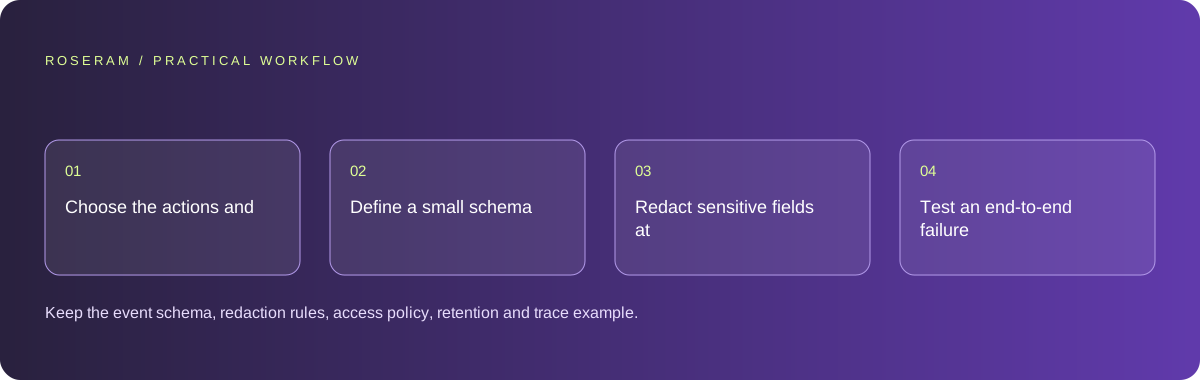
- Choose the actions and failures that require investigation evidence.
- Define a small schema with stage, duration, outcome and correlation reference.
- Redact sensitive fields at the logging boundary and restrict reader access.
- Test an end-to-end failure trace and enforce retention and noise controls.
A detailed brief you can adapt for your agent
Replace the illustrative context with your approved facts and controlled inputs. Keep the stated boundaries when adapting the brief. The expected deliverable matters more than a particular tool name: ask for an explanation grounded in the inspected material and evidence for the requested outcome.
Design structured diagnostics for publication and preview failures. Record confirmed stages, duration units, redacted actor references and outcomes. Keep private source and secrets out of default logs. Add bounded noise handling and authorized report access. Demonstrate one controlled failure trace and distinguish operational events from public analytics.Failure modes that an attractive preview can hide
Logging every polling response can create cost and drown important failures. Aggregate repeated unavailable states and use bounded retry behavior. Do not expose an unrestricted global terminal containing other users’ private logs. A professional daily report should summarize patterns and link to authorized detailed evidence rather than email raw secrets or entire source archives.
Technical references: MDN: practical security implementation guides
Acceptance checks and the evidence to retain
Keep the event schema, redaction rules, access policy, retention and trace example. Report configured logging separately from verified collection and scheduled report delivery.
| Controlled case | Expected evidence |
|---|---|
| Publication fails after provider request | Events identify the confirmed last stage and relevant request reference. |
| Error payload includes a token | Logging redacts or excludes the sensitive field. |
| Same unavailable poll repeats | Noise controls reduce repetition while preserving useful failure counts. |
Specific answers
Common questions
Should every prompt be logged in full?
Only if an explicit justified handling policy requires it; minimized operational metadata is often more appropriate.
Can all users read a global diagnostic terminal?
Do not expose private cross-account events; scope views to authorized roles and resources.
What is the practical completion criterion?
Keep the event schema, redaction rules, access policy, retention and trace example. Report configured logging separately from verified collection and scheduled report delivery.
Sources and editorial method
These references support the indicated technical facts. Workflows, examples and decision tables are original Roseram analysis. Illustrative costs are not vendor prices. No search volume, organic difficulty, ranking result or product endorsement is implied.
- MDN: practical security implementation guides ↗
Web security implementation reference; task-specific threat models and review remain necessary.
Roseram offers AI software and may compete with tools discussed here. Sources checked 2026-10-11. Send a sourced correction.
Your next step
Keep a practical checklist.
Mark your progress. This checklist and helpfulness choice are saved on this device only; they are not public reviews.
0 of 5 complete
Share your experience in the community or submit a sourced correction. Public experiences remain separate from editorial claims.
Bring your next idea
Keep learning. Build with context.
Get Roseram model and workspace reopening updates. The guide remains available whether or not you subscribe.
Explore the workspace guide →