A worked example: where the task becomes difficult
A fictional resource directory serves the same public categories to every visitor, making it a suitable cache candidate. A neighboring endpoint returns account preferences under a similar URL. Applying one broad caching rule to both would leak or mix private results. Classify responses before optimizing and keep user-specific behavior outside the shared public cache.
Decisions to make before implementation
Identify which query parameters change the result and include them in the relevant key. Define how long stale information is acceptable and whether a background refresh is suitable. Choose application, server or delivery-layer caching based on deployment behavior. Treat errors and empty results deliberately: a temporary failure should not become an apparently valid long-lived summary.
A practical sequence for the work
Use the sequence below as a task boundary, not as a claim that the example has been executed. Work with approved inputs and the project’s actual architecture. If a required integration or permission is unavailable, keep that stage visibly incomplete rather than generating a plausible substitute result.
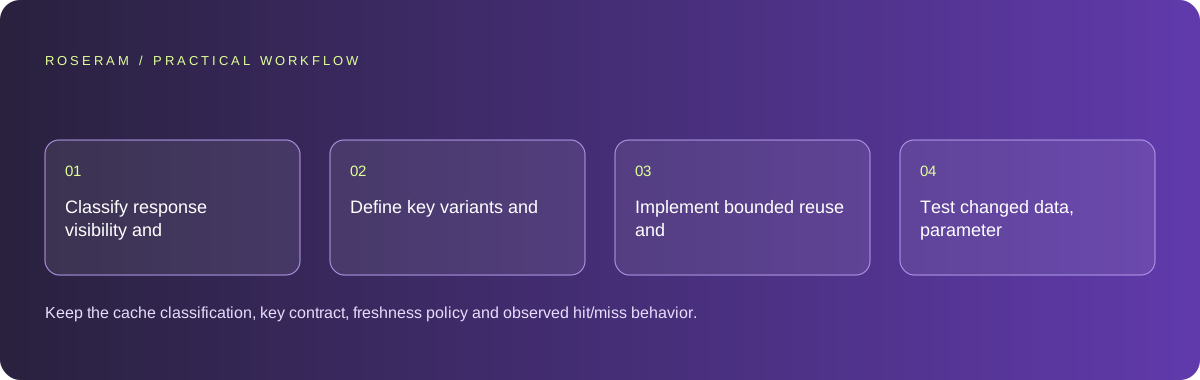
- Classify response visibility and the acceptable freshness window.
- Define key variants and the layer that owns the cache.
- Implement bounded reuse and a deliberate refresh or invalidation path.
- Test changed data, parameter variants and private-response exclusion.
A detailed brief you can adapt for your agent
Replace the illustrative context with your approved facts and controlled inputs. Keep the stated boundaries when adapting the brief. The expected deliverable matters more than a particular tool name: ask for an explanation grounded in the inspected material and evidence for the requested outcome.
Cache the public category endpoint under this freshness policy. Inspect response visibility and parameter variants first. Define the key, lifetime and refresh behavior at the intended deployment layer. Keep account preferences out of the shared cache and handle errors separately. Test source updates and different interval requests.Failure modes that an attractive preview can hide
A cache can improve response time while serving the wrong interval, language or account. Keep keys tied to the result contract. Long-lived caching of an error can make recovery look broken. Do not infer current state from an old cached payload without showing its timestamp where the user’s decision depends on freshness.
Technical references: MDN: HTTP caching
Acceptance checks and the evidence to retain
Keep the cache classification, key contract, freshness policy and observed hit/miss behavior. Document what can remain stale and for how long.
| Controlled case | Expected evidence |
|---|---|
| Two interval parameters request different summaries | Cache keys preserve the intended distinction. |
| Public source data changes | Refresh follows the documented freshness policy. |
| Endpoint includes account-specific fields | It is excluded from shared public reuse. |
Specific answers
Common questions
Can every GET request be publicly cached?
No. Visibility, authorization and response variants must be considered.
Does caching mean the displayed data is current?
Only within the documented freshness contract; expose timing when the decision requires it.
What is the practical completion criterion?
Keep the cache classification, key contract, freshness policy and observed hit/miss behavior. Document what can remain stale and for how long.
Sources and editorial method
These references support the indicated technical facts. Workflows, examples and decision tables are original Roseram analysis. Illustrative costs are not vendor prices. No search volume, organic difficulty, ranking result or product endorsement is implied.
- MDN: HTTP caching ↗
Cache visibility and freshness concepts; the example policy must be adapted to the actual response contract.
Roseram offers AI software and may compete with tools discussed here. Sources checked 2026-10-11. Send a sourced correction.
Your next step
Keep a practical checklist.
Mark your progress. This checklist and helpfulness choice are saved on this device only; they are not public reviews.
0 of 5 complete
Share your experience in the community or submit a sourced correction. Public experiences remain separate from editorial claims.
Bring your next idea
Keep learning. Build with context.
Get Roseram model and workspace reopening updates. The guide remains available whether or not you subscribe.
Explore the workspace guide →