A worked example: where the task becomes difficult
A fictional support team wants AI to summarize difficult tickets. The ticket export includes names, account IDs, message contents and payment references. The summarization task needs problem descriptions, not payment identifiers. Prepare a minimized dataset with consistent placeholders and retain the original mapping only in an authorized system. A small unusual case may still identify someone even after a name is removed.
Decisions to make before implementation
Identify the data owner, permitted purpose, destination and retention requirements. Distinguish public material, ordinary business information and sensitive records. Check account-level configuration and provider terms rather than assuming all AI services behave alike. Decide what outputs may be shared and who can inspect them. A summary can reproduce private details from its input, so output review belongs in the same handling workflow.
A practical sequence for the work
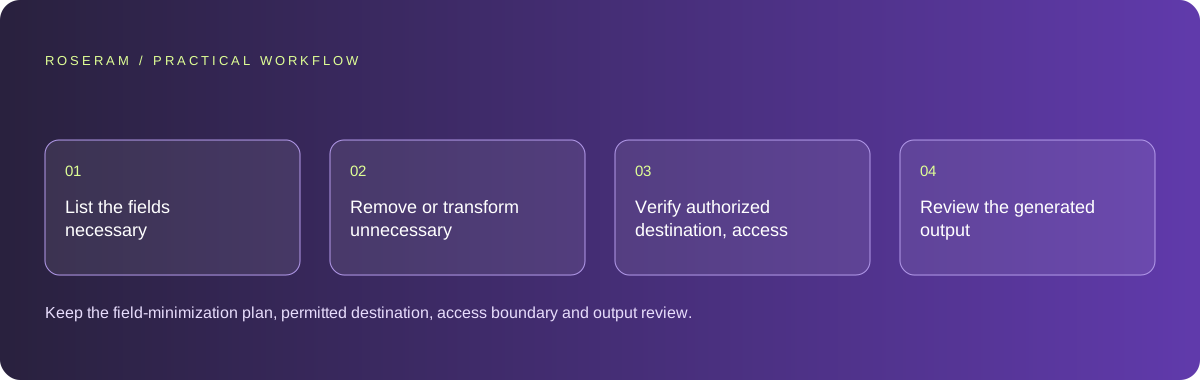
Use the sequence below as a task boundary, not as a claim that the example has been executed. Work with approved inputs and the project’s actual architecture. If a required integration or permission is unavailable, keep that stage visibly incomplete rather than generating a plausible substitute result.
- List the fields necessary to answer the actual question.
- Remove or transform unnecessary identifiers and sensitive content.
- Verify authorized destination, access settings and applicable retention requirements.
- Review the generated output for private details before wider use.
A detailed brief you can adapt for your agent
Replace the illustrative context with your approved facts and controlled inputs. Keep the stated boundaries when adapting the brief. The expected deliverable matters more than a particular tool name: ask for an explanation grounded in the inspected material and evidence for the requested outcome.
Design a minimized input for classifying these support issues. Identify fields required for the task and propose consistent redaction for the rest. Keep source mapping in the authorized system. Flag residual identification risks and output-review needs. Do not transmit the original export or certify legal compliance from the prompt alone.Failure modes that an attractive preview can hide
Replacing a name with an account number does not remove linkability if that number remains unique and known. Avoid uploading complete exports for convenience. Do not use invented compliance assurances from the model as approval. If required handling conditions are unavailable, use a different authorized method or keep the task within the approved environment.
Technical references: MDN: practical security implementation guides
Acceptance checks and the evidence to retain
Keep the field-minimization plan, permitted destination, access boundary and output review. Document limitations that remain after redaction rather than calling every transformed dataset anonymous.
| Controlled case | Expected evidence |
|---|---|
| Prompt only needs issue categories | Unnecessary payment and contact fields are excluded. |
| Output quotes a distinctive personal story | Review checks whether it is appropriate to distribute. |
| Destination configuration is unknown | The workflow pauses sharing until the required handling facts are established. |
Specific answers
Common questions
Is removing names enough?
Not always. Unique combinations, identifiers and distinctive narratives can still identify people.
Should the model decide whether sharing is allowed?
It can help identify questions, but the authorized data owner and applicable policy determine permission.
What is the practical completion criterion?
Keep the field-minimization plan, permitted destination, access boundary and output review. Document limitations that remain after redaction rather than calling every transformed dataset anonymous.
Sources and editorial method
These references support the indicated technical facts. Workflows, examples and decision tables are original Roseram analysis. Illustrative costs are not vendor prices. No search volume, organic difficulty, ranking result or product endorsement is implied.
- MDN: practical security implementation guides ↗
Web security implementation reference; task-specific threat models and review remain necessary.
Roseram offers AI software and may compete with tools discussed here. Sources checked 2026-10-11. Send a sourced correction.
Your next step
Keep a practical checklist.
Mark your progress. This checklist and helpfulness choice are saved on this device only; they are not public reviews.
0 of 5 complete
Share your experience in the community or submit a sourced correction. Public experiences remain separate from editorial claims.
Bring your next idea
Keep learning. Build with context.
Get Roseram model and workspace reopening updates. The guide remains available whether or not you subscribe.
Explore the workspace guide →