A worked example: where the task becomes difficult
A fictional storefront has a cart-total bug after quantity changes. The agent proposes a new styling system, state library and checkout layout alongside the arithmetic fix. Those additions obscure the relevant change and increase regression risk. Start by identifying the existing calculation owner, preserving the current dependencies and testing a quantity update against an approved expected total.
Decisions to make before implementation
Set boundaries based on responsibility rather than an arbitrary line count. A change may legitimately touch a function, its callers and a behavioral test. Keep formatting-only churn separate, and explain any necessary public contract modification. If the cause requires a broader patch, have the agent state why the original scope is insufficient before adding a replacement subsystem.
A practical sequence for the work
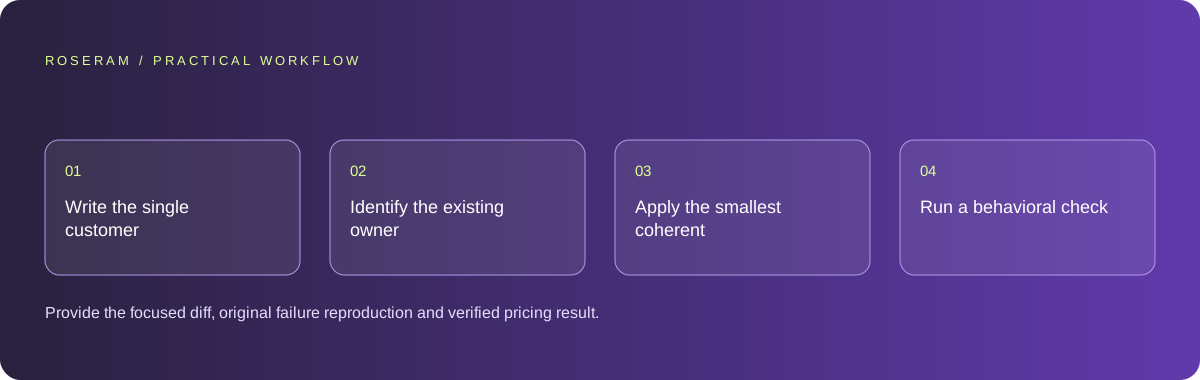
Use the sequence below as a task boundary, not as a claim that the example has been executed. Work with approved inputs and the project’s actual architecture. If a required integration or permission is unavailable, keep that stage visibly incomplete rather than generating a plausible substitute result.
- Write the single customer behavior that needs to change.
- Identify the existing owner and callers from inspected source.
- Apply the smallest coherent patch and inspect the diff for unrelated churn.
- Run a behavioral check that would fail before the repair and pass afterward.
A detailed brief you can adapt for your agent
Replace the illustrative context with your approved facts and controlled inputs. Keep the stated boundaries when adapting the brief. The expected deliverable matters more than a particular tool name: ask for an explanation grounded in the inspected material and evidence for the requested outcome.
Repair cart recalculation after quantity edits using the current state and pricing functions. Preserve styling, dependencies and checkout layout. Trace the calculation owner, change the supported cause and add one representative behavioral check. Explain every changed file. If a contract change is necessary, state why instead of silently redesigning the cart.Failure modes that an attractive preview can hide
Removing a failing assertion or returning a constant total makes a diff look small while destroying correctness. Review the test expectation and the business rule, not just the changed lines. An agent can also touch generated files unintentionally. Keep the source/build boundary visible and verify that dependency manifests have not changed without a reason.
Technical references: GitHub: getting useful results from coding tasks
Acceptance checks and the evidence to retain
Provide the focused diff, original failure reproduction and verified pricing result. Record postponed cleanup separately so it cannot be mistaken for required work on the cart bug.
| Controlled case | Expected evidence |
|---|---|
| Quantity increases from one to three | Total follows the approved item and discount rules. |
| Unrelated product detail is opened | Its existing rendering and navigation remain valid. |
| Diff adds a new state dependency | The agent provides a necessary scope justification or removes it. |
Specific answers
Common questions
Should I impose a maximum number of lines?
A responsibility boundary is usually more useful; necessary callers and tests may require additional lines.
Can tests be removed to keep a patch small?
Do not remove a meaningful failing test instead of correcting the behavior it protects.
What is the practical completion criterion?
Provide the focused diff, original failure reproduction and verified pricing result. Record postponed cleanup separately so it cannot be mistaken for required work on the cart bug.
Sources and editorial method
These references support the indicated technical facts. Workflows, examples and decision tables are original Roseram analysis. Illustrative costs are not vendor prices. No search volume, organic difficulty, ranking result or product endorsement is implied.
- GitHub: getting useful results from coding tasks ↗
Provider-specific reference for clear task scope and repository instructions; the worked workflows here are original analysis, not claims that every agent implements GitHub features.
Roseram offers AI software and may compete with tools discussed here. Sources checked 2026-10-11. Send a sourced correction.
Your next step
Keep a practical checklist.
Mark your progress. This checklist and helpfulness choice are saved on this device only; they are not public reviews.
0 of 5 complete
Share your experience in the community or submit a sourced correction. Public experiences remain separate from editorial claims.
Bring your next idea
Keep learning. Build with context.
Get Roseram model and workspace reopening updates. The guide remains available whether or not you subscribe.
Explore the workspace guide →