A worked example: where the task becomes difficult
A fictional frontend at a preview domain calls an API configured only for the production origin. The browser blocks access even though a command-line request succeeds. Record scheme, host and port for both sides, plus request method and headers. The preview may require an approved origin entry, but it should not inherit broad access to unrelated endpoints or credentials.
Decisions to make before implementation
Distinguish network failure, authentication failure and cross-origin policy. The server might process a request even when the browser cannot read its response, so blind retries can duplicate side effects. Decide whether cookies or authorization are involved and inspect the preflight where applicable. Prefer a same-origin backend route when that matches the architecture; do not invent an open relay to avoid understanding the receiving service.
A practical sequence for the work
Use the sequence below as a task boundary, not as a claim that the example has been executed. Work with approved inputs and the project’s actual architecture. If a required integration or permission is unavailable, keep that stage visibly incomplete rather than generating a plausible substitute result.
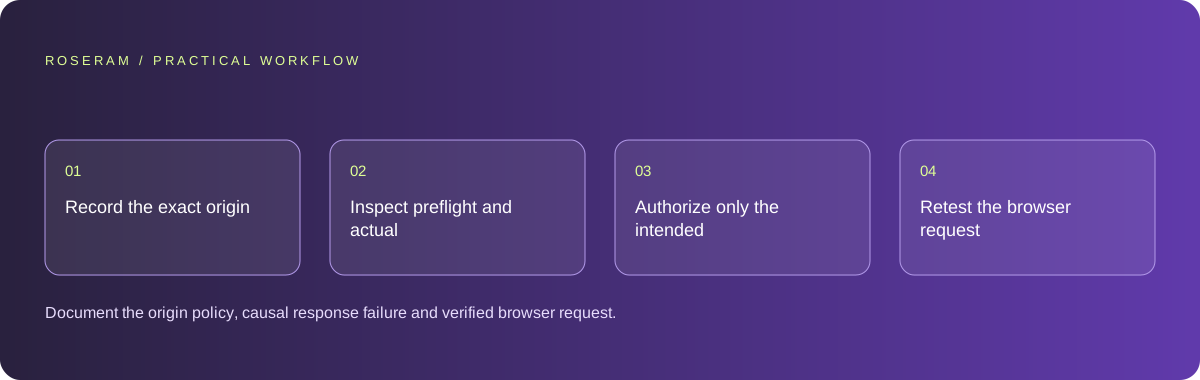
- Record the exact origin pair and the browser’s failing request.
- Inspect preflight and actual response headers alongside server logs.
- Authorize only the intended origins, methods and credentials at the owning service.
- Retest the browser request and check whether any earlier attempt created an operation.
A detailed brief you can adapt for your agent
Replace the illustrative context with your approved facts and controlled inputs. Keep the stated boundaries when adapting the brief. The expected deliverable matters more than a particular tool name: ask for an explanation grounded in the inspected material and evidence for the requested outcome.
Investigate the cross-origin failure using this origin pair and request trace. Check preflight, actual response and receiver logs. Configure the narrow intended policy at the receiving boundary. Preserve authentication and reject unapproved origins. Do not add an unrestricted proxy or disable browser security. Verify duplicate side effects before retrying writes.Failure modes that an attractive preview can hide
A wildcard policy is not a universal fix, especially for credentialed requests. Do not tell visitors to install a browser extension that bypasses protections. A missing CORS header on an error response can hide the underlying server failure; inspect the receiver before declaring that origin configuration is the only cause.
Technical references: MDN: Cross-Origin Resource Sharing
Acceptance checks and the evidence to retain
Document the origin policy, causal response failure and verified browser request. Keep authentication and authorization checks distinct from CORS configuration.
| Controlled case | Expected evidence |
|---|---|
| Approved preview origin makes a request | The intended operation and readable response succeed. |
| Unapproved origin attempts privileged access | The service enforces its access and origin policy. |
| First browser request was unreadable | Investigation checks for an already-created operation before retrying. |
Specific answers
Common questions
Why does a command-line request work?
Browser cross-origin enforcement differs from a direct client request; inspect the browser boundary.
Does a CORS error mean nothing happened on the server?
Not necessarily. Confirm server-side state before retrying an operation with side effects.
What is the practical completion criterion?
Document the origin policy, causal response failure and verified browser request. Keep authentication and authorization checks distinct from CORS configuration.
Sources and editorial method
These references support the indicated technical facts. Workflows, examples and decision tables are original Roseram analysis. Illustrative costs are not vendor prices. No search volume, organic difficulty, ranking result or product endorsement is implied.
- MDN: Cross-Origin Resource Sharing ↗
Browser cross-origin behavior and receiving-service policy; origin checks are distinct from resource authorization.
Roseram offers AI software and may compete with tools discussed here. Sources checked 2026-10-11. Send a sourced correction.
Your next step
Keep a practical checklist.
Mark your progress. This checklist and helpfulness choice are saved on this device only; they are not public reviews.
0 of 5 complete
Share your experience in the community or submit a sourced correction. Public experiences remain separate from editorial claims.
Bring your next idea
Keep learning. Build with context.
Get Roseram model and workspace reopening updates. The guide remains available whether or not you subscribe.
Explore the workspace guide →