A worked example: where the task becomes difficult
A fictional app reads an API URL during its build but the owner adds it only to the runtime environment afterward. Another developer places a private service key into a browser-exposed variable to make an integration work. Both can appear as configuration fixes, but the latter exposes authority to visitors. Trace the read location and required timing before changing variable prefixes or duplicating values.
Decisions to make before implementation
Create a configuration contract listing name, consumer, build/runtime timing and public/secret classification. Check environment differences between local, preview and production. Some values need a rebuild to enter generated browser assets. Never assume that a generic prefix works across frameworks. Give the agent variable names and intended roles; load actual secret values only through an appropriate protected configuration mechanism.
A practical sequence for the work
Use the sequence below as a task boundary, not as a claim that the example has been executed. Work with approved inputs and the project’s actual architecture. If a required integration or permission is unavailable, keep that stage visibly incomplete rather than generating a plausible substitute result.
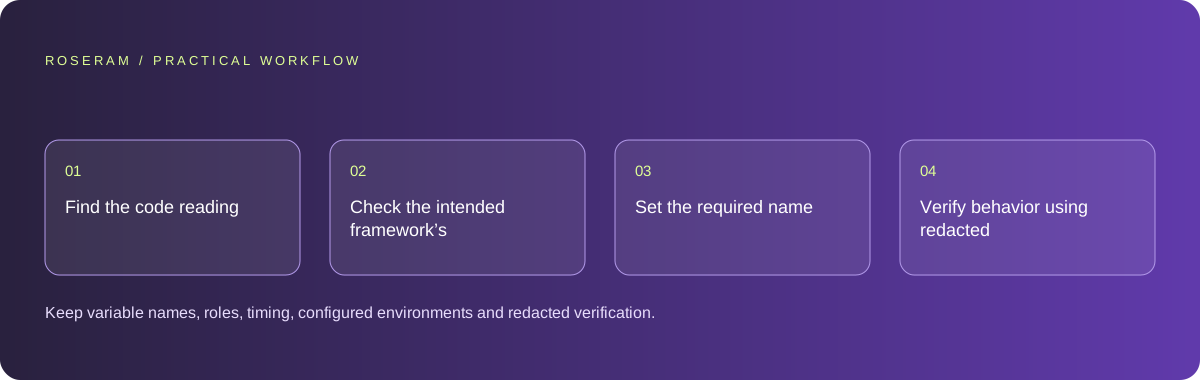
- Find the code reading the missing value and its execution environment.
- Check the intended framework’s configuration contract and deployment timing.
- Set the required name in the correct protected scope and rebuild when needed.
- Verify behavior using redacted presence checks and a controlled request.
A detailed brief you can adapt for your agent
Replace the illustrative context with your approved facts and controlled inputs. Keep the stated boundaries when adapting the brief. The expected deliverable matters more than a particular tool name: ask for an explanation grounded in the inspected material and evidence for the requested outcome.
Diagnose the missing configuration by tracing its consumer and build/runtime timing. Create a variable-name contract without printing values. Preserve the distinction between public endpoints and private service credentials. Apply the smallest scoped configuration change and verify a controlled request. If a credential was exposed, report rotation as required work.Failure modes that an attractive preview can hide
Logging the entire environment to find a typo can leak many unrelated credentials. Report presence and classification instead. Do not return a private key through a configuration endpoint. If a value is bundled publicly, removing it from the latest source is not enough to revoke prior exposure; rotate exposed credentials and review affected artifacts.
Technical references: GitHub: removing sensitive data
Acceptance checks and the evidence to retain
Keep variable names, roles, timing, configured environments and redacted verification. Do not store credential values in the support report or generated documentation.
| Controlled case | Expected evidence |
|---|---|
| Private credential is inspected from the browser | It is absent from page assets and public responses. |
| Build-time public API URL changes | A new build uses the intended URL rather than stale bundled configuration. |
| Required value is missing | The application fails clearly without inventing a substitute credential. |
Specific answers
Common questions
Can I expose a server key to fix a browser request?
No. Use a limited server integration rather than giving visitors privileged credentials.
Will changing a value immediately update browser assets?
That depends on when the framework consumes it; build-time values may require a new build.
What is the practical completion criterion?
Keep variable names, roles, timing, configured environments and redacted verification. Do not store credential values in the support report or generated documentation.
Sources and editorial method
These references support the indicated technical facts. Workflows, examples and decision tables are original Roseram analysis. Illustrative costs are not vendor prices. No search volume, organic difficulty, ranking result or product endorsement is implied.
- GitHub: removing sensitive data ↗
Revoking exposed credentials and the limits of deleting them from the current file.
Roseram offers AI software and may compete with tools discussed here. Sources checked 2026-10-11. Send a sourced correction.
Your next step
Keep a practical checklist.
Mark your progress. This checklist and helpfulness choice are saved on this device only; they are not public reviews.
0 of 5 complete
Share your experience in the community or submit a sourced correction. Public experiences remain separate from editorial claims.
Bring your next idea
Keep learning. Build with context.
Get Roseram model and workspace reopening updates. The guide remains available whether or not you subscribe.
Explore the workspace guide →