A worked example: where the task becomes difficult
A fictional dashboard navigates to /orders/42 from its home screen, but opening that URL directly fails on the static host. The client knows the route while the host does not. Another project has a genuine missing server endpoint at the same shape of path. Check the architecture and response before adding a catch-all rewrite; the same hosting rule cannot repair both cases.
Decisions to make before implementation
Map public pages, client routes, API routes and static assets separately. A fallback should not replace missing JavaScript or API responses with HTML. Preserve meaningful status codes for genuinely unavailable pages and private resources. If the app uses a base path, verify generated links and assets under that path. Deep-link behavior must work before authentication as well as after it.
A practical sequence for the work
Use the sequence below as a task boundary, not as a claim that the example has been executed. Work with approved inputs and the project’s actual architecture. If a required integration or permission is unavailable, keep that stage visibly incomplete rather than generating a plausible substitute result.
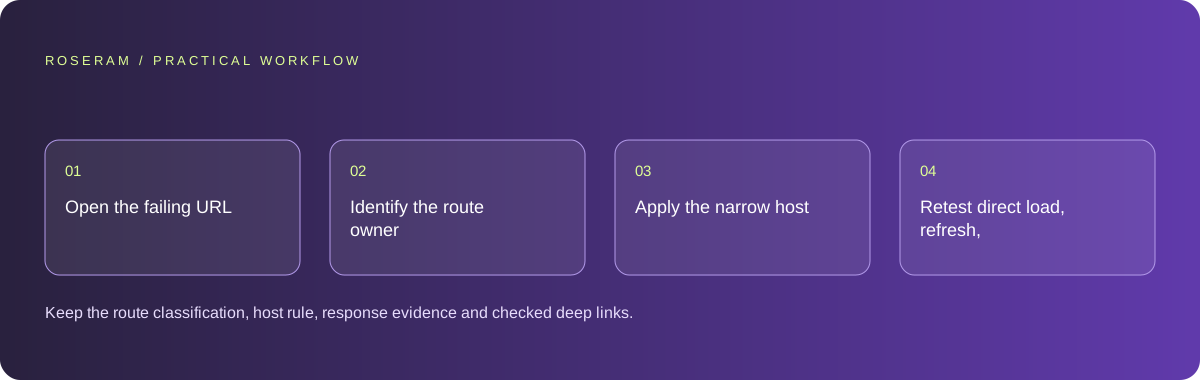
- Open the failing URL directly and inspect its status and content type.
- Identify the route owner and expected deployment output.
- Apply the narrow host or application routing fix appropriate to that architecture.
- Retest direct load, refresh, missing asset and unauthorized resource behavior.
A detailed brief you can adapt for your agent
Replace the illustrative context with your approved facts and controlled inputs. Keep the stated boundaries when adapting the brief. The expected deliverable matters more than a particular tool name: ask for an explanation grounded in the inspected material and evidence for the requested outcome.
Diagnose direct-load 404 for this deployed order route. Identify client, server, API and asset paths before changing rewrites. Apply only the required app fallback or route output fix. Preserve missing-resource and access behavior. Test direct load and refresh alongside a nonexistent asset and an unknown route.Failure modes that an attractive preview can hide
Rewriting every request to the homepage creates misleading success responses and can make script requests receive HTML. It also conceals absent APIs. Avoid using a visual “not found” page with a success status when the route is genuinely missing unless the architecture intentionally requires that behavior and search implications are understood.
Technical references: Chrome: console features reference
Acceptance checks and the evidence to retain
Keep the route classification, host rule, response evidence and checked deep links. A navigation click alone is insufficient evidence for direct URL support.
| Controlled case | Expected evidence |
|---|---|
| Valid order route is opened directly | The app reaches the intended order journey. |
| Missing JavaScript asset is requested | The host does not return the application HTML as a script. |
| Unknown public route is opened | The visitor receives an accurate missing-page response and useful navigation. |
Specific answers
Common questions
Why does clicking work but refreshing fail?
Client routing may know a path that the receiving host has not been configured to serve.
Should every missing request return the homepage?
No. APIs, assets and genuinely missing pages need their own accurate responses.
What is the practical completion criterion?
Keep the route classification, host rule, response evidence and checked deep links. A navigation click alone is insufficient evidence for direct URL support.
Sources and editorial method
These references support the indicated technical facts. Workflows, examples and decision tables are original Roseram analysis. Illustrative costs are not vendor prices. No search volume, organic difficulty, ranking result or product endorsement is implied.
- Chrome: console features reference ↗
Inspecting messages, stack traces and network errors.
Roseram offers AI software and may compete with tools discussed here. Sources checked 2026-10-11. Send a sourced correction.
Your next step
Keep a practical checklist.
Mark your progress. This checklist and helpfulness choice are saved on this device only; they are not public reviews.
0 of 5 complete
Share your experience in the community or submit a sourced correction. Public experiences remain separate from editorial claims.
Bring your next idea
Keep learning. Build with context.
Get Roseram model and workspace reopening updates. The guide remains available whether or not you subscribe.
Explore the workspace guide →