A worked example: where the task becomes difficult
A fictional trade association lists apprenticeships from member companies. Employers submit roles with closing dates, work locations and salary information where available. The association wants applicants to find current openings and reach the correct application path. It should not claim that AI has verified a company’s legitimacy merely because the listing was generated or the application button works.
Decisions to make before implementation
Choose whether applications stay with employers or enter a board-owned system. The latter creates private applicant records, access controls and retention work. Define moderation, employer corrections and how closed roles are handled. Use consistent units for salary ranges and distinguish unknown compensation from zero. A ranking algorithm must not silently imply that sponsored placements are the best opportunities.
A practical sequence for the work
Use the sequence below as a task boundary, not as a claim that the example has been executed. Work with approved inputs and the project’s actual architecture. If a required integration or permission is unavailable, keep that stage visibly incomplete rather than generating a plausible substitute result.
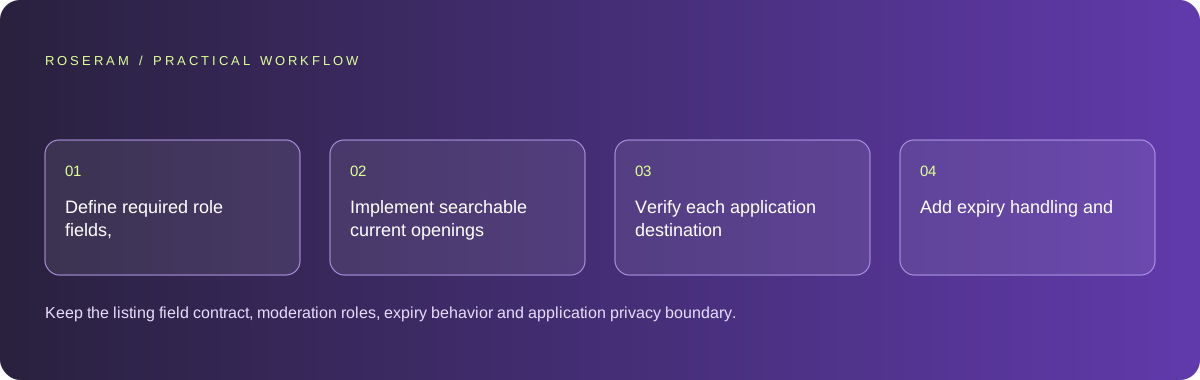
- Define required role fields, employer ownership and publication approval.
- Implement searchable current openings with clear location and work-arrangement filters.
- Verify each application destination or build a restricted receiving workflow.
- Add expiry handling and an employer correction process before scaling listings.
A detailed brief you can adapt for your agent
Replace the illustrative context with your approved facts and controlled inputs. Keep the stated boundaries when adapting the brief. The expected deliverable matters more than a particular tool name: ask for an explanation grounded in the inspected material and evidence for the requested outcome.
Build an apprenticeship board from controlled employer submissions. Keep publication approval separate from AI drafting. Implement role status, filters and the supplied application destinations. Clearly label sponsorship. Do not rank applicants or expose CVs publicly. Include expiry and invalid-destination checks and document who can approve employer changes.Failure modes that an attractive preview can hide
Generated boards may keep closed listings searchable as if they were active. Show the status clearly and guide visitors to current alternatives without inventing a replacement role. Do not collect CVs if the application simply redirects to an employer. If CV handling is required, restrict uploads and access and avoid using applicant documents as public content or training examples.
Technical references: MDN: sending form data
Acceptance checks and the evidence to retain
Keep the listing field contract, moderation roles, expiry behavior and application privacy boundary. Demonstrate a current listing journey and an expired listing recovery path.
| Controlled case | Expected evidence |
|---|---|
| Closing date passes | The role no longer appears as an active opening. |
| Applicant changes a record identifier | Another person’s application remains inaccessible. |
| Employer edits the application URL | The approved destination and affected listing update together. |
Specific answers
Common questions
Should AI generate missing salary figures?
No. Preserve unknown compensation or request an approved value from the employer.
Does a functioning application button prove a listing is legitimate?
No. Destination functionality and employer verification are separate checks.
What is the practical completion criterion?
Keep the listing field contract, moderation roles, expiry behavior and application privacy boundary. Demonstrate a current listing journey and an expired listing recovery path.
Sources and editorial method
These references support the indicated technical facts. Workflows, examples and decision tables are original Roseram analysis. Illustrative costs are not vendor prices. No search volume, organic difficulty, ranking result or product endorsement is implied.
- MDN: sending form data ↗
Form submission transports data to a receiving endpoint; downstream delivery is a separate implementation.
Roseram offers AI software and may compete with tools discussed here. Sources checked 2026-10-11. Send a sourced correction.
Your next step
Keep a practical checklist.
Mark your progress. This checklist and helpfulness choice are saved on this device only; they are not public reviews.
0 of 5 complete
Share your experience in the community or submit a sourced correction. Public experiences remain separate from editorial claims.
Bring your next idea
Keep learning. Build with context.
Get Roseram model and workspace reopening updates. The guide remains available whether or not you subscribe.
Explore the workspace guide →