A worked example: where the task becomes difficult
A fictional project tracker has owners, collaborators and viewers. The interface hides the delete button from viewers, but the delete endpoint only checks that someone is signed in. A viewer can call it directly. Build a permission table before testing and use fake projects owned by two separate accounts. Test the resource identifiers and operations outside the ordinary navigation path.
Decisions to make before implementation
Define the actor, resource ownership and operation separately. Access can change after invitations are revoked, so session state alone may not be enough. Check list filtering, record detail, updates, exports and file URLs. Denial should avoid leaking the private record through error text. Keep tests reversible and restrict destructive cases to explicitly controlled resources.
A practical sequence for the work
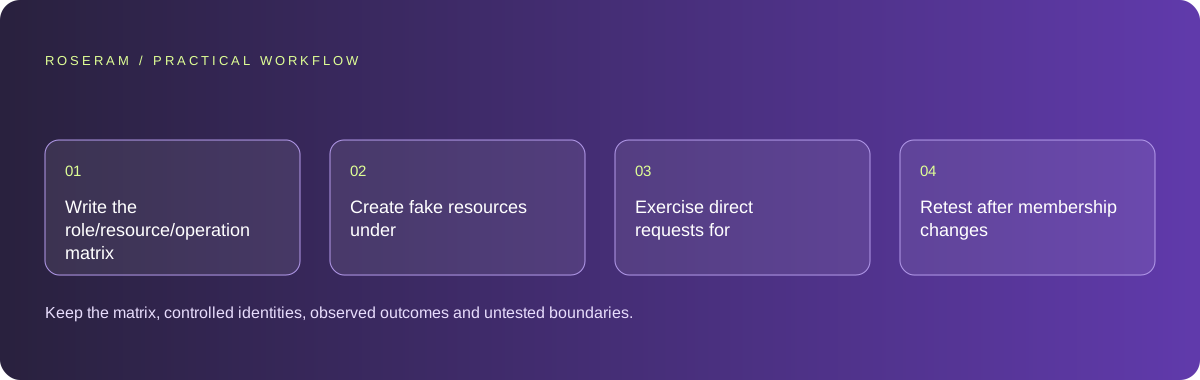
Use the sequence below as a task boundary, not as a claim that the example has been executed. Work with approved inputs and the project’s actual architecture. If a required integration or permission is unavailable, keep that stage visibly incomplete rather than generating a plausible substitute result.
- Write the role/resource/operation matrix from approved product rules.
- Create fake resources under two controlled identities.
- Exercise direct requests for permitted and denied operations.
- Retest after membership changes and inspect private-file access separately.
A detailed brief you can adapt for your agent
Replace the illustrative context with your approved facts and controlled inputs. Keep the stated boundaries when adapting the brief. The expected deliverable matters more than a particular tool name: ask for an explanation grounded in the inspected material and evidence for the requested outcome.
Verify the supplied permission matrix using two controlled accounts and fake projects. Test direct reads, writes, exports and downloads, not only button visibility. Include membership revocation. Preserve production data and do not broaden permissions as a workaround. Report each allowed or denied result with the tested resource and revision.Failure modes that an attractive preview can hide
Testing only the happy path as an administrator misses the core boundary. Also watch for bulk endpoints that omit checks used by single-record handlers. Do not test against another real customer’s account without authorization. Use controlled fixtures whose ownership is known and report unavailable test roles rather than pretending the matrix is complete.
Technical references: MDN: practical security implementation guides
Acceptance checks and the evidence to retain
Keep the matrix, controlled identities, observed outcomes and untested boundaries. Passing representative checks supports the access model but is not a complete security certification.
| Controlled case | Expected evidence |
|---|---|
| Viewer calls delete endpoint directly | The service rejects the operation under the role policy. |
| Account A requests Account B’s export | No private rows or file contents are disclosed. |
| Collaborator membership is removed | Subsequent operations follow the current membership policy. |
Specific answers
Common questions
Is authentication the same as authorization?
No. Knowing the identity does not establish permission for every resource or operation.
Can I test permissions only through the interface?
Include direct requests because hidden controls can leave receiving operations accessible.
What is the practical completion criterion?
Keep the matrix, controlled identities, observed outcomes and untested boundaries. Passing representative checks supports the access model but is not a complete security certification.
Sources and editorial method
These references support the indicated technical facts. Workflows, examples and decision tables are original Roseram analysis. Illustrative costs are not vendor prices. No search volume, organic difficulty, ranking result or product endorsement is implied.
- MDN: practical security implementation guides ↗
Web security implementation reference; task-specific threat models and review remain necessary.
Roseram offers AI software and may compete with tools discussed here. Sources checked 2026-10-11. Send a sourced correction.
Your next step
Keep a practical checklist.
Mark your progress. This checklist and helpfulness choice are saved on this device only; they are not public reviews.
0 of 5 complete
Share your experience in the community or submit a sourced correction. Public experiences remain separate from editorial claims.
Bring your next idea
Keep learning. Build with context.
Get Roseram model and workspace reopening updates. The guide remains available whether or not you subscribe.
Explore the workspace guide →