A worked example: where the task becomes difficult
A fictional workspace stores projects, billing references and collaboration memberships. Deleting an account may remove personal projects while shared organization work has different ownership. The generated “Delete everything” button does not answer those questions. Build a deletion map with the owner and relevant policy reviewers, then use controlled test accounts to rehearse the operation.
Decisions to make before implementation
Separate immediate access removal, asynchronous data cleanup and any required retention. Identify shared resources, external providers and backup treatment. Provide an explicit confirmation with the correct scope and an appropriate identity check. Do not invent a legal retention period or promise total erasure where provider backups and records have a documented lifecycle. Keep the process traceable without retaining unnecessary personal content.
A practical sequence for the work
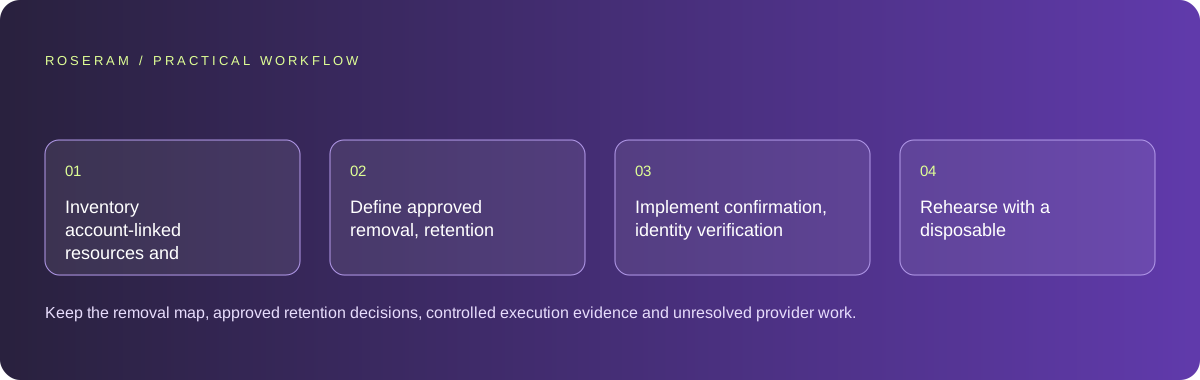
Use the sequence below as a task boundary, not as a claim that the example has been executed. Work with approved inputs and the project’s actual architecture. If a required integration or permission is unavailable, keep that stage visibly incomplete rather than generating a plausible substitute result.
- Inventory account-linked resources and shared ownership boundaries.
- Define approved removal, retention and provider coordination rules.
- Implement confirmation, identity verification and observable workflow state.
- Rehearse with a disposable controlled account and verify affected systems separately.
A detailed brief you can adapt for your agent
Replace the illustrative context with your approved facts and controlled inputs. Keep the stated boundaries when adapting the brief. The expected deliverable matters more than a particular tool name: ask for an explanation grounded in the inspected material and evidence for the requested outcome.
Design account removal from this approved data inventory. Separate personal projects, shared membership, billing references and provider records. Use explicit confirmation and trusted identity checks. Report asynchronous cleanup states honestly and do not invent retention rules. Implement and test only with an explicitly disposable controlled account.Failure modes that an attractive preview can hide
Deleting an authentication record first can leave orphaned data that no remaining workflow can associate with the request. Plan the order and recovery behavior. A broad cascading delete can destroy shared work. Do not test destructive removal on a real account merely to prove the feature; use explicitly disposable records and preserve approved recovery boundaries.
Technical references: MDN: practical security implementation guides
Acceptance checks and the evidence to retain
Keep the removal map, approved retention decisions, controlled execution evidence and unresolved provider work. A prepared workflow is distinct from a completed removal across every system.
| Controlled case | Expected evidence |
|---|---|
| User owns and shares projects | Deletion follows the approved personal/shared-resource policy. |
| External cleanup fails | The workflow records incomplete removal and a recoverable next step. |
| Wrong identity attempts deletion | The operation rejects unauthorized account removal. |
Specific answers
Common questions
Can the button promise instant deletion everywhere?
Only if the actual coordinated process supports that promise; describe asynchronous and retained records accurately.
Should shared projects always be deleted?
Follow explicit ownership rules rather than assuming every account-linked resource is personal.
What is the practical completion criterion?
Keep the removal map, approved retention decisions, controlled execution evidence and unresolved provider work. A prepared workflow is distinct from a completed removal across every system.
Sources and editorial method
These references support the indicated technical facts. Workflows, examples and decision tables are original Roseram analysis. Illustrative costs are not vendor prices. No search volume, organic difficulty, ranking result or product endorsement is implied.
- MDN: practical security implementation guides ↗
Web security implementation reference; task-specific threat models and review remain necessary.
Roseram offers AI software and may compete with tools discussed here. Sources checked 2026-10-11. Send a sourced correction.
Your next step
Keep a practical checklist.
Mark your progress. This checklist and helpfulness choice are saved on this device only; they are not public reviews.
0 of 5 complete
Share your experience in the community or submit a sourced correction. Public experiences remain separate from editorial claims.
Bring your next idea
Keep learning. Build with context.
Get Roseram model and workspace reopening updates. The guide remains available whether or not you subscribe.
Explore the workspace guide →