What stands out?
- Publisher-described database, application and dashboard workflows.
- Hosted and self-managed deployment options.
- Plan-dependent views, allowances and governance capabilities.

THE BUYER’S RESEARCH DESK
Baserow SCAM Review: compare cloud pricing, self-hosting, permissions, automations, Kuma AI, plugin risks and a practical database-to-application pilot.
By Roseram Editorial. An AI-assisted desk review of the cited publisher material. Roseram sells the workspace promoted on this page. No hands-on test, fraud verdict, or customer rating is claimed. Editorial review checked 2026-10-30.
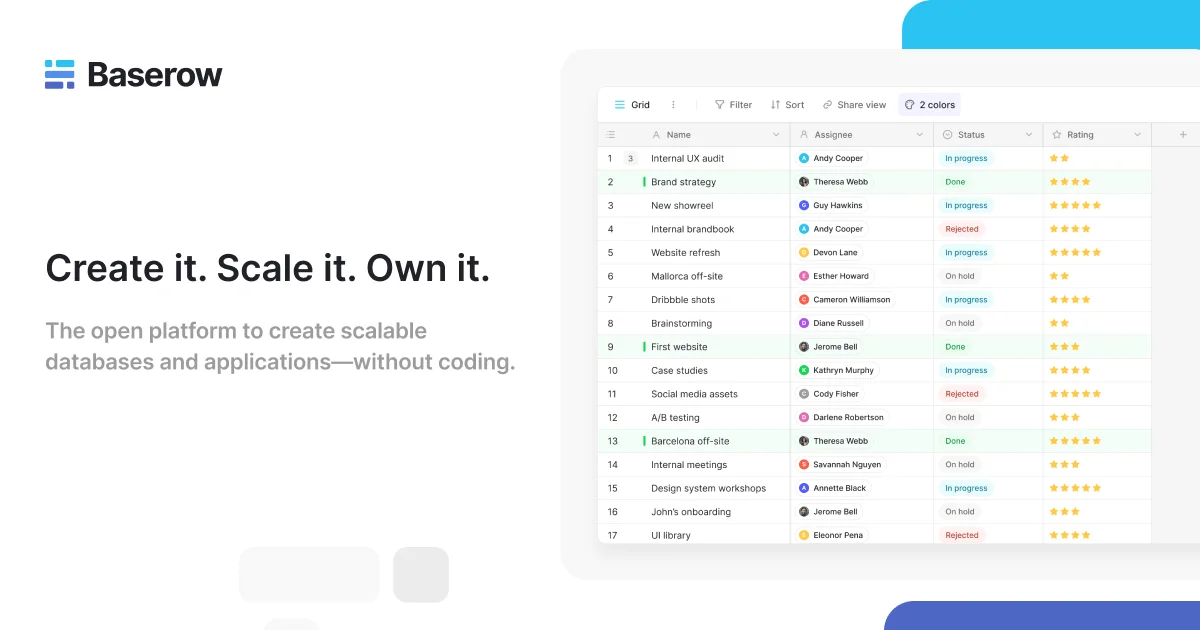
Publisher-declared imagery, with original sources. Images show the publisher’s presentation, not a Roseram product test.
PRODUCT OVERVIEW
Baserow combines database-oriented collaboration, application building and deployment choices. This source-led review examines cloud seat pricing, self-hosting responsibilities, record design, access controls, automation failure cases, plugin trust and a practical migration pilot.
Not Provided means the review does not contain a verified value. No hands-on rating or price has been inferred.
CAPABILITIES & REQUIREMENTS
Capabilities described in the cited material, with the questions to resolve before choosing a plan.
| Described capability | What to verify |
|---|---|
| Publisher-described database, application and dashboard workflows. | Confirm the applicable plan, limits and current availability with the publisher. |
| Hosted and self-managed deployment options. | Confirm the applicable plan, limits and current availability with the publisher. |
| Plan-dependent views, allowances and governance capabilities. | Confirm the applicable plan, limits and current availability with the publisher. |
| Documented plugin extension model with explicit self-hosting cautions. | Confirm the applicable plan, limits and current availability with the publisher. |
WORKFLOWS & FIT
Explore the workflows addressed in the article. These are editorial topics, not verified customer outcomes.
Baserow is a publisher-described database and application platform with hosted and self-hosted deployment options. Its website presents tables, visual views, applications, dashboards, automations and an AI assistant. The purchase question is whether these parts can support a particular operating process with acceptable governance and maintenance.
Read this section IN THE ANALYSISBaserow presents application building and dashboards on top of its data. Start with the decision a user needs to make, such as which service requests are overdue or which assets lack an owner. Define the calculation and source fields before designing the display. A dashboard can look polished while silently excluding incomplete records, double-counting linked rows or treating an empty date as an on-time item.
Read this section IN THE ANALYSISA sensible Baserow pilot is one bounded register or approval process with a named owner, a clear access model and a recovery test. Define success as an observable result: an operator can find the right record, complete a valid update, detect an invalid one and recover a previous state. Record the effort needed to administer the system alongside the time saved in the visible workflow.
Read this sectionBaserow combines database-oriented collaboration, application building and deployment choices. This source-led review examines cloud seat pricing, self-hosting responsibilities, record design, access controls, automation failure cases, plugin trust and a practical migration pilot.
The name used here is Baserow. The catalog points readers to baserow.io. The source links below show where this product was found. Discovery on a directory is a starting point for research. It does not show that the directory tested the product, approved the seller, or promised a result.
This desk review does not establish that Baserow is a scam or certify the business as safe. The cited publisher material describes an offer that can be evaluated against your requirements. Before paying, verify the seller, the current terms, any cancellation rules and the capabilities that matter to your use case.
The discussion below separates publisher claims from suggested buyer checks; it does not report hands-on testing or an independent security audit.
Start with the seller and the exact offer. Check that the checkout belongs to the company you intend to pay. Read the renewal and cancellation rules. Save the plan details and your receipt. If a claim matters to your decision, ask for evidence tied to that claim instead of treating a logo, a launch badge, or a referral offer as proof.
Baserow is a publisher-described database and application platform with hosted and self-hosted deployment options. Its website presents tables, visual views, applications, dashboards, automations and an AI assistant. The purchase question is whether these parts can support a particular operating process with acceptable governance and maintenance.
A spreadsheet-like interface can make initial adoption approachable, but the design of the underlying information still determines whether the finished application is dependable.
This is a desk review of the linked publisher material, not a report from an installed instance, paid account or benchmark. The SCAM Review label introduces a due-diligence question; the cited pages do not establish fraud or independently certify the service. The source captures are dated 28 October 2026. Check the official offer before purchasing because deployment choices, feature availability and plan allowances can change.
Roseram has a commercial interest in the custom-building workflow promoted below.
Begin by naming the process you want to replace. For an equipment register, that could mean receiving an asset, assigning an owner, recording a service event and retiring the item. Write down who owns each transition and which fields establish that the work actually happened. A successful demonstration should follow one complete record through those transitions, including a correction.
Filling a table with convincing sample rows is a weaker demonstration than showing that an authorized person can reliably complete the real handoff.
The publisher lists multiple ways to visualize information, including grid, form and gallery views, with further views assigned to paid plans. Views answer different questions about the same underlying records. They should not become separate, conflicting versions of the business. In an equipment register, a calendar view might help schedule servicing while a gallery helps identify an asset.
Both should refer to the same asset identity and current status, rather than require someone to reconcile two lists manually.
Before importing existing spreadsheets, examine duplicate identifiers, missing owners and inconsistent categories. Decide whether a blank value means unknown, not applicable or not yet collected. Those meanings matter when an automation later selects records. A test import should include an intentionally repeated identifier and an incomplete row, so that the team can inspect what is rejected, accepted or flagged for review.
Do not assume that import success means the original data have become accurate.
Relationships also deserve an explicit decision. A customer, order and delivery may need separate records because their lifecycles differ. Flattening them into one wide table can duplicate contact information and make corrections inconsistent. Conversely, an elaborate relational model may create unnecessary friction for a small team. Ask a future operator to complete a routine update and explain what they believe each linked field means.
Confusion at this stage is a design finding to resolve before expanding access.
Baserow's documentation describes several installation routes, while its pricing distinguishes cloud and self-hosted choices. These are different operating responsibilities. Running your own instance can provide infrastructure control, but someone must own upgrades, monitoring, backups, secrets, incident response and capacity.
An organization should not count a self-hosted installation as cheaper until it has priced that work and identified a person who can perform a restore when the usual administrator is unavailable.
A useful evaluation separates the application owner from the infrastructure owner. The first knows which records and workflows matter; the second knows how the service is deployed and recovered. Ask both to review the same small project. Document where files are stored, how notifications leave the system, which network services are necessary and what happens if a dependency becomes unavailable.
A deployment diagram can reveal obligations that are absent from a simple per-user subscription comparison.
For a hosted service, ask about the arrangements that apply to the actual subscription rather than transferring assumptions from self-hosting. For a self-managed service, rehearse an upgrade and restore with disposable data before moving business records. Preserve a copy of configuration alongside the database and relevant uploaded files.
The useful outcome is an operational procedure another administrator can follow, with a measurable recovery objective, not merely a container that starts successfully on the original author's machine.
The captured cloud pricing shows Free at $0, Premium at $10 per user per month when billed yearly or $12 monthly, and Advanced at $18 yearly-billed or $22 monthly. Enterprise is quoted on request. The displayed plan comparison also associates allowances with rows, storage and automation activity.
Treat those as a dated description of the selected cloud billing view, not as a complete quote for every deployment, contract or combination of features.
Translate seat pricing into the people who need to perform work. Suppose a small operation has four editors, occasional reviewers and outside requesters. Ask which of those roles count as paid users under the chosen offer and how application users are treated. The bill should be calculated from the publisher's definitions, not from a casual headcount.
Annual monthly-equivalent figures also describe a different commitment from a monthly subscription; compare the amount due and cancellation conditions before selecting the lower displayed number.
Then estimate the dimensions that may force a change of plan. Record creation, attached images, automation runs and retention requirements can grow at different rates. A service business might add few customer records but many job photographs. An integration can create repeated activity without adding many rows.
Ask how an exhausted allowance is surfaced, whether new work is blocked, and what purchase or cleanup options exist. This review does not infer unlimited capacity or automatic overage treatment where the offer has not established it.
The pricing comparison describes role-based permissions and audit logs among paid capabilities. Those labels are a starting point for a demonstration, not proof that a particular access model is enforced. Write an access table for the planned application: who can read personal details, edit status, change the schema, export records and invite another member.
The table should distinguish an administrator from a routine operator and, where relevant, a customer-facing application user.
Create non-sensitive sample records and ask the vendor or trial administrator to demonstrate each role. Test a direct record link as well as the intended view. A filtered screen may improve usability without being an authorization boundary. Try an export, attachment download and shared link from the restricted account, then remove its access and check what remains available.
These are proposed buyer checks; Roseram did not perform them against Baserow and does not claim to have found a vulnerability.
Audit history is useful only if it answers the questions an operator will actually ask after an error. Can the team determine what changed, who changed it and whether the relevant record can be restored? Establish how long that information is retained and who can access it.
If an investigation depends on a paid feature, include that plan requirement in the purchase decision rather than discovering it after a mistaken bulk update or an employee departure.
The publisher presents visual automations and integrations, including HTTP, email and webhooks. For an approval workflow, sketch the trigger, eligibility condition, action and completion record before enabling anything. Decide whether the automation operates on a new event, the current state of a record or both.
A rule that works once on a demonstration row can still behave incorrectly when someone edits the same record again or an upstream system repeats a request.
Use a pilot that includes a duplicate event, a rejected request and a temporary downstream failure. Specify the expected behavior in advance: whether the action should be skipped, queued, retried or referred to an operator. Check how failures are visible and how someone resumes a record without repeating a completed external action.
For email or another customer-facing integration, review the recipient and message with internal test addresses before considering live activation.
Automation cost is another reason to test exceptions. A rule that repeatedly reacts to its own update can create unnecessary work or usage. Ask how loops are controlled and how an administrator can stop a problematic workflow quickly. Keep an owner, purpose and rollback note beside each automation.
A smaller set of understandable rules is often easier to maintain than an impressive diagram whose original designer is the only person who knows why every branch exists.
Baserow presents application building and dashboards on top of its data. Start with the decision a user needs to make, such as which service requests are overdue or which assets lack an owner. Define the calculation and source fields before designing the display. A dashboard can look polished while silently excluding incomplete records, double-counting linked rows or treating an empty date as an on-time item.
Include a known expected total in the pilot so the team can check the calculation.
Application navigation should also be tested as a complete task. Ask a person who did not create the model to find a record, update the relevant field and explain how they know the change was saved. Check keyboard use, narrow screens, long labels and validation messages. A customer portal requires particular care because the displayed data, allowed actions and identity checks must fit the audience.
The existence of an application builder does not establish that a finished portal meets accessibility or privacy requirements.
Maintain a distinction between an attractive status summary and an authoritative operational record. Decide which screen is used when figures disagree, how stale data are indicated and how a correction appears in subsequent reports. Export a small report and compare it with the underlying records.
If management relies on a dashboard for a recurring decision, its definition and owner belong in the operating documentation rather than solely in the original builder's memory.
The homepage describes Kuma and other AI-related capabilities. Evaluate any generated structure as a proposal that requires review. Check whether the proposed fields, relationships and access rules match the requirements you wrote before generation. A plausible schema can still model the wrong business process.
Use a deliberately ambiguous request and observe whether the workflow asks for clarification or creates assumptions that the operator might mistake for settled requirements.
The plugin documentation is more specific about a separate risk: it describes plugins as experimental, available for self-hosted installations and able to access internals. That makes plugin selection an operational trust decision. Ask who maintains a proposed plugin, which version is compatible, what it can access and how it can be removed.
A recognizable project name or a convenient installation command should not substitute for reviewing the code's provenance and the effect on the deployment.
The publisher advises backups before plugin use. A practical buyer check is to restore the pilot environment without the plugin and verify that essential records and workflows remain understandable. Keep custom extensions in version control where appropriate, with installation notes and a named maintainer. The open-source option may make customization possible; it does not make that customization maintenance-free or automatically supported by the publisher.
Budget for compatibility work before treating an extension as a permanent business dependency.
The ability to move information is part of the product evaluation, not an administrative task for later. Choose a small set of records with linked relationships, attachments and unusual characters. Export the set using the functions available on the proposed plan and check what another system would need to reconstruct it.
A file that contains visible cell values may omit relationships, permissions, automation definitions or the context that makes a status meaningful to your team.
Record the steps needed to recreate the essential process outside the initial environment. This is not a prediction that Baserow will fail; it is a continuity exercise for any business system. Identify which parts can be moved directly and which would need redesign.
The answer may still favor the product, but the decision will include an honest switching cost instead of assuming that all forms of portability are equivalent.
Before importing real records, agree how errors from the original spreadsheets will be handled. Keep a mapping of source columns to the new model and retain a read-only copy of the source during the migration window. Ask operators to reconcile a sample of completed work, not just the total number of imported rows.
Only increase the scope after the team can explain discrepancies and repeat the procedure without relying on undocumented manual corrections.
A sensible Baserow pilot is one bounded register or approval process with a named owner, a clear access model and a recovery test. Define success as an observable result: an operator can find the right record, complete a valid update, detect an invalid one and recover a previous state. Record the effort needed to administer the system alongside the time saved in the visible workflow.
That creates a useful comparison with the tools the team already has.
If the requirement is an original interface around a narrower business process, the Roseram workspace offers another starting point for scoping a custom project. For example, brief an equipment-intake portal with requester questions, an owner review queue and a service history screen. Ask about the data model, identity, integrations and approval rules before requesting a preview.
This is a development direction, not a claim that Roseram reproduces Baserow's database engine, hosting arrangements or enterprise governance features.
Choose the approach that leaves your team with a process it can operate and explain. Baserow may fit when a data-oriented platform and its documented deployment options match that process. A custom application may fit when a distinct interface and tightly scoped interactions matter more than a broad table-oriented platform. In either case, retain the original requirements, dated offer and pilot findings.
A purchase should follow demonstrated suitability, rather than a headline about flexibility or an untested assumption that the most comprehensive feature list must be the best choice.
The useful question is whether Baserow helps you build, connect, or run a useful piece of software. Turn the product description into a short list of tasks you can check. For each task, define the input, the finished result, and the person who accepts it. Keep a note of the steps that still need manual work.
A feature can be available yet fail to fit the way your team works.
Look closely at source access, integration limits, runtime costs, and recovery after an error. Ask which plan includes the feature, what limit applies, and whether another paid service is required. Separate a current feature from a roadmap item. If you only have a directory description, confirm the detail on the publisher's own site before choosing a plan.
Use the pricing evidence shown below as a starting point. Match the amount to its currency, billing period, and unit. A per-user price, a usage charge, an annual commitment, and a one-time payment describe different bills. Check the number of people or tasks you expect, then include any required add-ons. Do not treat an affiliate commission as the price a customer pays.
Estimate the full cost of using Baserow for a month of real work. Include setup, time spent learning the tool, fixing mistakes, moving data, and paying connected services. Compare that total with the value of the finished work. A low starting price can still be expensive for your workload, while a higher plan may be useful only if you actually need its added capacity.
| Plan | Price | Billing context |
|---|---|---|
| Free | $0 | Cloud free tier; allowances apply |
| Premium | $10 / user / month | Monthly equivalent billed yearly; $12 on monthly billing |
| Advanced | $18 / user / month | Monthly equivalent billed yearly; $22 on monthly billing |
| Enterprise | On request | Obtain a scoped quote |
Cloud figures captured 28 October 2026. Annual monthly equivalents differ from monthly subscriptions. Verify current seat definitions, allowances and deployment-specific terms before purchasing.
Check official pricingA useful first test is to build one small feature, test an invalid input, inspect the result, and save an export you can reopen. Write the expected result before opening the product. Use information you are allowed to share. Save the original input and the output so someone else can repeat the check.
This is a proposed test for buyers; it is not a claim that Roseram ran it or measured a success rate.
Count completed tasks and corrections, rather than clicks or attractive screenshots. Try a normal case, a missing-information case, and a request to change the result. Note the time, the cost, and the help you needed. If you cannot obtain a trial, ask for a demonstration using an example you provide. Decide which unanswered questions would stop a purchase before discussing a longer contract.
One risk to test is a working demo that becomes hard to maintain or move. Look for a clear explanation of what happens when a limit is reached or an action fails. Ask whether you can stop work safely, recover a previous version, and get a useful answer from support. Marketing can describe the intended outcome while leaving the recovery steps unclear.
Those steps matter when real people depend on the result.
Check who owns the account, the domain, the saved data, and any work you create. Find out which exports are available on your plan and what access remains after cancellation. Keep a copy of the terms that apply when you buy. A useful exit plan reduces disruption if your needs change or the product stops fitting the job.
None of these checks by itself establishes fraud; together they help you make a better purchase.
Consider Baserow when the sourced features match a job you already need to finish and you can check the outcome. Start with a small scope. Expand only after you understand the result, the cost, and the effort needed to keep it working. If your main requirements are still unclear, write them down before comparing subscription tiers.
Compare services that solve the same job. Use the same example, the same acceptance checks, and the same cost period for each one. A specialist product may fit one part of your work while a broader workspace helps with another. Choose based on the job you can demonstrate, rather than a promise that one tool will do everything for everyone.
Compare the job first: can each candidate help you build, connect, or run a useful piece of software? Use one written brief, the same expected outcome and the same billing period. Include required integrations, the cost of revisions and the work needed to move your data. The linked reviews below are further research, not a claim that every product is an equivalent replacement.
Keep Baserow's purchase decision separate from Roseram's promotion on this page. Roseram may be relevant when your task is to create and revise a software project, but it is not a substitute for every specialist service. Ask each provider to demonstrate the requirement that matters to you before committing.
The listing has not been rechecked for this article. A directory listing is a discovery source, not a product test or endorsement.
4 readable publisher pages were captured for this review. These establish what the publisher says about its offer; they do not independently prove performance or customer outcomes. This is desk research. No hands-on evaluation, independent peer review, or customer interview is claimed.
No attributable customer testimonial has been verified for this page. Ask for a customer reference with a similar use case and read the original feedback in context before deciding.
Start with comparable workflows. These source-led reviews explain their own pricing and limitations.

Self-hosted AI application building
The listing named AINIRO's Magic Cloud points to Hyperlambda material describing a self-hosted AI application builder. Establish that current identity before applying an older product description. The useful evaluation follows a generated application from a written requirement into inspectable behavior, with particular attention to who controls the runtime and what the generated work is permitted to do.

Data integration and developer tools
Airbyte advertises reusable data connectors, managed and capacity-based plans, hybrid deployment and Python-oriented ingestion through PyAirbyte. This review examines connector fit, replication versus agent actions, deployment boundaries, sync freshness, incremental recovery and cost planning using saved publisher pages.

GraphQL development and API testing clients
Altair GraphQL Client advertises queries, mutations, subscriptions and schema tooling across several client modes. This source-led review examines environment selection, authorization boundaries, scripts, collections, optional cloud state, response interpretation and integration responsibilities.
Open a question for the answer and its research limitations.
No. Budget for infrastructure, upgrades, backups, monitoring and a person responsible for recovery. The review does not treat the deployment option as a maintenance-free service.
The captured plugin documentation describes experimental plugins for self-hosted installations and cautions about their access and trust. Confirm current support before adopting an extension.
Use one bounded register or approval process to check record design, permissions, failed automations, exports and a recovery procedure. These are suggested tests, not measured results.
This review does not establish that Baserow is fraudulent. The SCAM Review title introduces a buyer due-diligence question, not a fraud finding. Follow the cited sources, check the exact publisher identity and evaluate the specific offer before paying.
The dated USD plan comparison in this review was observed on 2026-10-28. Prices, billing periods, usage limits and eligibility can change. Confirm the complete offer on the linked official pricing page before checkout.
No hands-on test is claimed. This is an editorial desk review of the cited material. The buyer checklist describes a test you can run, rather than a result Roseram has measured.
Yes. Roseram publishes this page and promotes its own paid AI workspace. Compare each product against your requirements; a Roseram promotion is not evidence that another product is unsuitable.
FOLLOW THE SOURCE
Publisher pages explain the offer. Directory records explain where it was found. Neither is a performance test or an official endorsement of this review.
