What stands out?
- Publisher-described accounts, contacts, leads, deals and activity records.
- Plan-specific pipelines, custom objects, reports and administration.
- Read and write MCP operations subject to permissions.

THE BUYER’S RESEARCH DESK
Anvil CRM SCAM Review: assess shared records, pipelines, reports, permission-bound MCP access, audit and recovery, Standard versus Pro, billing and trial boundaries.
By Roseram Editorial. An AI-assisted desk review of the cited publisher material. Roseram sells the workspace promoted on this page. No hands-on test, fraud verdict, or customer rating is claimed. Editorial review checked 2026-10-29.
Publisher-declared imagery, with original sources. Images show the publisher’s presentation, not a Roseram product test.
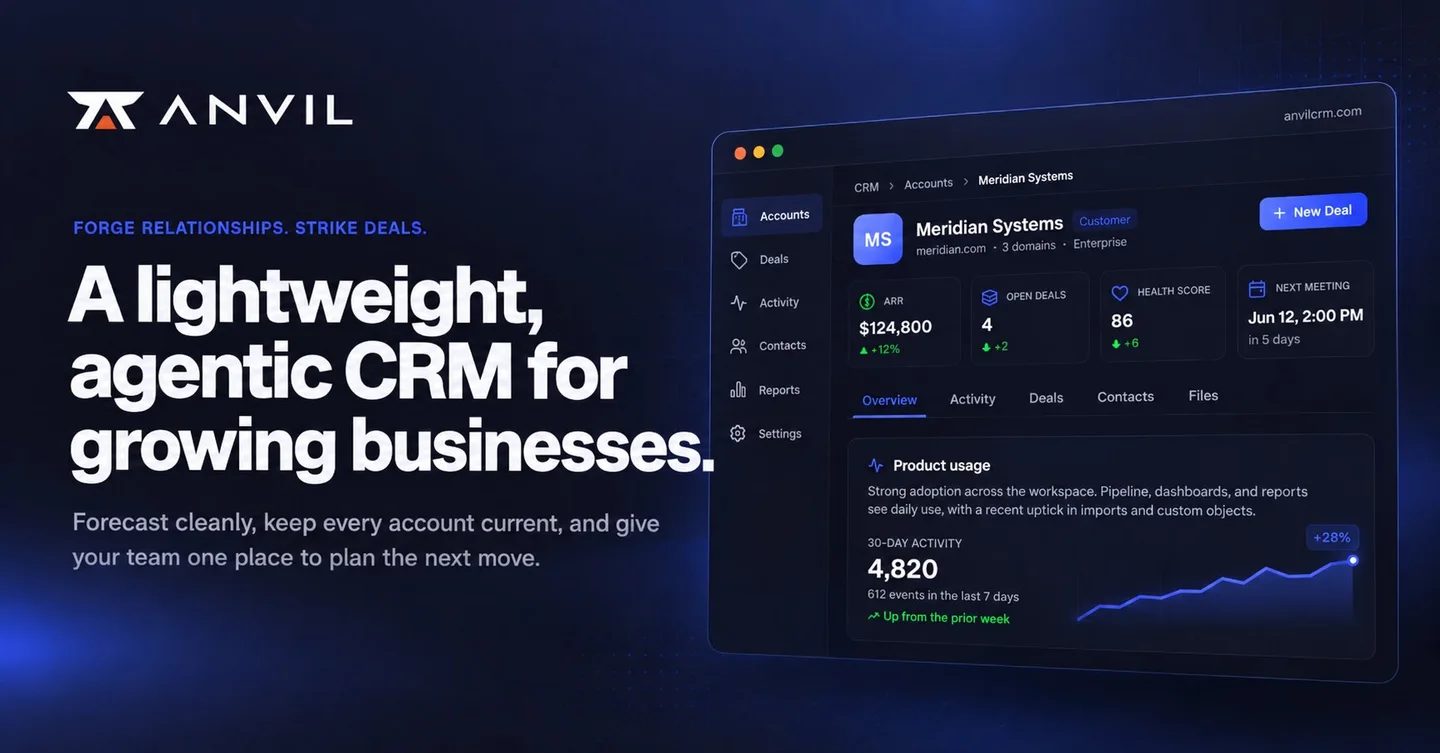
PRODUCT OVERVIEW
Anvil CRM describes shared customer records, pipelines, reports and MCP access. This review examines demo persistence, relationship integrity, permissions, automation, recovery, plan limits, per-user billing and five-user trial qualifications.
Not Provided means the review does not contain a verified value. No hands-on rating or price has been inferred.
CAPABILITIES & REQUIREMENTS
Capabilities described in the cited material, with the questions to resolve before choosing a plan.
| Described capability | What to verify |
|---|---|
| Publisher-described accounts, contacts, leads, deals and activity records. | Confirm the applicable plan, limits and current availability with the publisher. |
| Plan-specific pipelines, custom objects, reports and administration. | Confirm the applicable plan, limits and current availability with the publisher. |
| Read and write MCP operations subject to permissions. | Confirm the applicable plan, limits and current availability with the publisher. |
| Explicit no-card trial, membership and downgrade qualifications. | Confirm the applicable plan, limits and current availability with the publisher. |
WORKFLOWS & FIT
Explore the workflows addressed in the article. These are editorial topics, not verified customer outcomes.
The homepage advertises a fourteen-day, no-card trial and no automatic charge when it expires without a subscription. Its FAQ adds important detail: the trial includes up to five users, subscribing early with up to five preserves remaining free time, and six or more users starts billing immediately.
Read this section IN THE ANALYSISAnvil CRM is relevant to teams seeking a relatively focused relationship workspace with clear plan boundaries and optional agent access. Compare alternatives using the same records, roles, imports and workflow exceptions. Inspect persistence and authorization rather than selecting solely from a polished demonstration. A shared CRM can reduce fragmentation without automatically making all data accurate or every recommended next step appropriate.
Read this sectionAnvil CRM describes shared customer records, pipelines, reports and MCP access. This review examines demo persistence, relationship integrity, permissions, automation, recovery, plan limits, per-user billing and five-user trial qualifications.
The name used here is Anvil CRM. The catalog points readers to anvilcrm.com. The source links below show where this product was found. Discovery on a directory is a starting point for research. It does not show that the directory tested the product, approved the seller, or promised a result.
This desk review does not establish that Anvil CRM is a scam or certify the business as safe. The cited publisher material describes an offer that can be evaluated against your requirements. Before paying, verify the seller, the current terms, any cancellation rules and the capabilities that matter to your use case.
The discussion below separates publisher claims from suggested buyer checks; it does not report hands-on testing or an independent security audit.
Start with the seller and the exact offer. Check that the checkout belongs to the company you intend to pay. Read the renewal and cancellation rules. Save the plan details and your receipt. If a claim matters to your decision, ask for evidence tied to that claim instead of treating a logo, a launch badge, or a referral offer as proof.
Anvil CRM presents a lightweight relationship-management workspace for accounts, contacts, leads, deals and related activity. Its captured homepage emphasizes current account context, reports, pipelines and access through compatible AI tools. These are related but different jobs.
A timeline can show recent activity without establishing that the underlying data is complete, and an AI-assisted update can be convenient while still requiring appropriate permission and a correct destination. A useful evaluation needs both the shared data model and the actions performed on it.
This Anvil CRM SCAM Review is an AI-assisted desk review of saved publisher homepage and company material. No account was created, customer record imported, agent connected or subscription purchased. The title is a search question rather than a finding of fraud. Roseram offers commercial development tools, so that context is disclosed.
Demonstration records and reported outcomes remain identified as publisher material rather than converted into independent customer evidence or hands-on test results.
The homepage says its interactive demonstrations use representative data and do not save changes. That is important when interpreting what the visitor sees. A draggable deal and responsive chart can illustrate a workflow without establishing backend persistence, an audit record or the behavior of a real multi-user workspace.
The sample account names, activity and financial figures should not be treated as disclosures about actual customer businesses merely because the interface looks live.
Use the demo to identify questions for a real evaluation, then verify saving, reloading and authorized access with permitted test data. Keep a demo interaction separate from evidence that a production record was changed correctly. This review did not interact with the demonstration or a live account. It does not claim the illustrated pipeline is a measured business outcome.
The publisher's explicit demo label provides a useful limitation that should remain visible rather than disappearing when an interface screenshot is used as evidence.
Anvil lists accounts, contacts, leads, deals and products alongside tasks, meetings, calls and notes. The goal is to keep customer knowledge connected rather than fragmented across private spreadsheets. That proposition depends on the relationships being correct. A note attached to a similarly named account or a duplicate contact can create a misleading history even when the interface is orderly.
The captured page does not establish the exact duplicate-detection, merge or matching rules for imported records.
Prepare a small representative data set and check how identities, ownership and relationships are represented. Confirm which record is authoritative and what happens when an existing item is updated rather than recreated. This review did not inspect a schema or import a contact. It does not infer automatic reconciliation or universal deduplication.
The practical acceptance question is whether the actual team's records remain traceable and correctly associated, not simply whether the product offers object categories with familiar CRM names.
The publisher describes attaching activities, notes, tickets and CRM changes to the relevant account and emphasizes current information. It also advertises email and calendar connections and updates through other tools. A stream that looks active does not establish that every relevant system is connected or that each event appears without delay.
The captured pages do not supply a complete integration matrix, synchronization contract or event-retention policy for every source.
Identify the sources needed for the actual account view and demonstrate how a permitted change reaches the workspace. Inspect timestamps and distinguish the time an event occurred from the time it was recorded. This review did not connect a mail account, calendar or messaging service. It does not promise real-time completeness or invent a refresh interval.
A shared timeline can support team coordination while still requiring explicit decisions about which systems and events count as the relevant customer context.
The homepage describes stage changes triggering tasks, reminders and handoffs. That can reduce routine coordination when a sales process has clear rules, but moving a card is not the same as meeting the business condition for a stage. An automatic task can also be wrong if a deal moved by mistake or an exception needs another owner.
The captured material does not document every trigger, retry, approval or reversal behavior.
Define the stage criteria and intended next action before enabling an automation. Test a normal transition, a correction and an exception using authorized sample records. Keep the action's result separate from the fact that the stage changed. This review did not move a live deal or run an automation. It does not claim autonomous closing or guaranteed removal of administrative work.
The product's workflow promise needs a demonstration tied to the team's actual process rather than an inference that every pipeline stage can safely trigger the same playbook.
The captured pricing describes Standard with one sales pipeline, one lead pipeline and ten custom fields per standard object, along with basic dashboards and import/export. Pro adds multiple pipelines, custom objects, additional fields, advanced reporting, custom roles, granular permissions and other controls. These are material differences for a team whose process goes beyond a simple pipeline.
A trial exposing Pro capabilities does not establish that the same configuration remains fully editable under Standard.
Map required objects, fields and access rules to the actual plan before building a large evaluation configuration. Identify which limits affect the intended process instead of selecting by the lowest displayed price alone. This review did not reach a plan boundary or downgrade a workspace. It does not infer a custom-field total or object allowance that the capture does not state.
The useful comparison is a concrete configuration requirement matched to a documented entitlement, including what happens to existing data when the plan changes.
The FAQ describes an MCP server through which compatible assistants can read, create, update and delete several CRM record types, subject to permissions. This is broader than a read-only reporting connection. A natural-language request can lead to an actual data change, so it needs an appropriate identity, scope and review process.
Naming compatible tools is not proof that a particular account or organization has authorized the connection or that every requested operation should be permitted.
Test the intended access path with non-sensitive data and identities that have deliberately different permissions. Confirm that the same record boundary applies through the agent and through the ordinary interface. This review did not connect an assistant, invoke a tool or inspect an authorization token. It does not invent a default approval rule or certify scope enforcement.
The relevant evaluation distinguishes technical availability, the user's authority and the correctness of the specific action performed on the intended customer record.
The captured Pro description lists audit and deleted-record recovery, while the company page points toward a separate security explanation covering isolation, permissions, scopes, auditing and revocation. That reference is not a completed audit in this review. An audit trail, a recovery function and a full backup service answer different questions.
A record that can be restored may still need its relationships checked, and an event appearing in history does not establish every detail required by a particular governance process.
Demonstrate an authorized edit, deletion and recovery with sample data, then inspect the resulting record and the evidence of who acted. Obtain the actual retention and coverage rules if those controls are material. This review has not opened the separate security page or exercised a recovery operation. It does not infer indefinite retention, comprehensive rollback or a certification.
The feature names identify worthwhile acceptance tests, while their suitability depends on the actual documented lifecycle and the organization's requirements.
Anvil describes reports built from current CRM data, saved views, dashboards and exportable figures. Its demonstration includes pipeline and forecast metrics. A report can calculate accurately from incomplete or misclassified records, so visible totals should not be confused with independently verified commercial outcomes. The captured pages do not supply every definition for win rate, forecast inclusion or the time window behind a particular chart.
This review has not recalculated a report or reconciled it with source records.
Choose a known sample set and check filters, status treatment and totals against an expected result. Keep a saved report's definition with any figures shared outside the immediate team. Separate a forecast from recognized revenue and a demonstration value from an actual customer result. The review does not recommend a financial action or assign predictive accuracy to the system.
The practical value of reporting depends on transparent definitions and reviewed inputs, not merely the existence of charts or server-side aggregation claims.
The publisher says both Standard and Pro include CRM import and export. Those capabilities can support bringing in an existing customer list and moving information elsewhere. They do not establish that every relationship, activity, attachment or custom object survives every format. The saved page does not provide a complete file specification or migration guarantee.
A successful row count can conceal duplicate identities or missing associations that matter to the team's customer history.
Test a small authorized sample with the structures the business needs and compare the resulting records, owners and relationships. Inspect an export in the intended receiving tool rather than assuming that downloading a file completes portability. This review did not transfer any personal or customer information. It does not infer permission to contact imported people or to expand their marketing preferences.
Data movement and authorization for later use remain separate decisions, even when the software makes importing technically straightforward.
The captured offer displays Standard and Pro monthly prices for a single user and says each workspace has one plan with a common per-user rate. It also describes annual billing upfront and an enterprise discussion for larger teams. These are saved offers, not verified current checkout prices.
A per-user figure should be evaluated alongside the actual number of billable members and the billing period rather than read as a flat price for the whole organization.
Request or inspect the actual offer for the intended membership and clarify how additions, removals and period changes affect charges. Keep enterprise customization separate from public plan entitlements. This review has not received an enterprise quote or changed membership. It does not invent a proration rule, refund entitlement or unlimited-seat provision.
The useful commercial comparison is the actual workspace and user configuration, including the features required, rather than a headline price detached from its billing basis.
The homepage advertises a fourteen-day, no-card trial and no automatic charge when it expires without a subscription. Its FAQ adds important detail: the trial includes up to five users, subscribing early with up to five preserves remaining free time, and six or more users starts billing immediately.
These conditions should be kept together rather than reducing the offer to an unqualified statement that every team size can use the same unpaid period.
Confirm the membership and subscription state before inviting a larger team or entering payment information. Keep the trial deadline and chosen plan visible to the administrator. This review did not start a trial or test the user-count transition. It does not imply that a no-card signup causes an automatic charge.
The practical point is that the captured offer has a documented capacity boundary, so an evaluation involving six or more people needs its actual billing terms understood rather than assumed from the simpler headline.
The captured FAQ says there is no free tier, that data is retained for at least thirty days after an unsubscribed trial expires, and that Standard preserves existing Pro data for viewing while applying Standard limits. These are different states: retained data is not necessarily an indefinitely usable workspace, and viewable Pro data is not the same as retaining every Pro editing capability.
The capture does not establish all later deletion, export or reactivation conditions.
Plan the evaluation so the team can decide or preserve needed information before relying on an unverified post-expiry workflow. Confirm the actual downgrade behavior for the configuration created during the trial. This review did not let an account expire or inspect retained records. It does not invent a permanent archive or claim that information is immediately erased.
The useful distinction is between a stated minimum retention period, limited viewing and the paid capabilities required to keep operating the chosen process.
The homepage includes reported results about time saved, relationships managed and active opportunities, with an explicit statement that outcomes vary by team and workflow. The company page describes the founders' earlier CRM frustrations as part of its operating story. These are publisher-provided statements rather than independent measurements in this review.
A prior company's scale does not establish a measured advantage for Anvil, and a customer-outcome card does not identify every baseline or cost involved.
Evaluate a representative process and record review time, missing information, correction effort and the usefulness of the resulting next action. If a published result is material, request appropriately scoped evidence instead of assuming it transfers to another organization. No customer was contacted or testimonial invented here. The review does not claim hours saved or forecast improvement for its own use.
It keeps reported outcomes in context and distinguishes a clear product principle from proof that a particular team will obtain the same result.
Anvil CRM is relevant to teams seeking a relatively focused relationship workspace with clear plan boundaries and optional agent access. Compare alternatives using the same records, roles, imports and workflow exceptions. Inspect persistence and authorization rather than selecting solely from a polished demonstration. A shared CRM can reduce fragmentation without automatically making all data accurate or every recommended next step appropriate.
The actual adoption decision needs a checked workflow and a commercial offer matched to the team's configuration.
For readers building a custom internal application or a specialized customer workflow, the Roseram workspace is a separate development option to assess. It is not presented as an equivalent preconfigured CRM or a verified replacement for Anvil. The saved sources establish a concrete product with unusually detailed trial and downgrade statements, alongside controls that need demonstration.
They do not establish fraudulent conduct or guaranteed sales improvement. The next useful evidence is an authorized sample workspace with inspected records, reports, permissions and billing state.
The useful question is whether Anvil CRM helps you build, connect, or run a useful piece of software. Turn the product description into a short list of tasks you can check. For each task, define the input, the finished result, and the person who accepts it. Keep a note of the steps that still need manual work.
A feature can be available yet fail to fit the way your team works.
Look closely at source access, integration limits, runtime costs, and recovery after an error. Ask which plan includes the feature, what limit applies, and whether another paid service is required. Separate a current feature from a roadmap item. If you only have a directory description, confirm the detail on the publisher's own site before choosing a plan.
Use the pricing evidence shown below as a starting point. Match the amount to its currency, billing period, and unit. A per-user price, a usage charge, an annual commitment, and a one-time payment describe different bills. Check the number of people or tasks you expect, then include any required add-ons. Do not treat an affiliate commission as the price a customer pays.
Estimate the full cost of using Anvil CRM for a month of real work. Include setup, time spent learning the tool, fixing mistakes, moving data, and paying connected services. Compare that total with the value of the finished work. A low starting price can still be expensive for your workload, while a higher plan may be useful only if you actually need its added capacity.
These are captured publisher excerpts, not a normalized quote. Check the linked page for the full plan, limits, currency, and billing terms.
A useful first test is to build one small feature, test an invalid input, inspect the result, and save an export you can reopen. Write the expected result before opening the product. Use information you are allowed to share. Save the original input and the output so someone else can repeat the check.
This is a proposed test for buyers; it is not a claim that Roseram ran it or measured a success rate.
Count completed tasks and corrections, rather than clicks or attractive screenshots. Try a normal case, a missing-information case, and a request to change the result. Note the time, the cost, and the help you needed. If you cannot obtain a trial, ask for a demonstration using an example you provide. Decide which unanswered questions would stop a purchase before discussing a longer contract.
One risk to test is a working demo that becomes hard to maintain or move. Look for a clear explanation of what happens when a limit is reached or an action fails. Ask whether you can stop work safely, recover a previous version, and get a useful answer from support. Marketing can describe the intended outcome while leaving the recovery steps unclear.
Those steps matter when real people depend on the result.
Check who owns the account, the domain, the saved data, and any work you create. Find out which exports are available on your plan and what access remains after cancellation. Keep a copy of the terms that apply when you buy. A useful exit plan reduces disruption if your needs change or the product stops fitting the job.
None of these checks by itself establishes fraud; together they help you make a better purchase.
Consider Anvil CRM when the sourced features match a job you already need to finish and you can check the outcome. Start with a small scope. Expand only after you understand the result, the cost, and the effort needed to keep it working. If your main requirements are still unclear, write them down before comparing subscription tiers.
Compare services that solve the same job. Use the same example, the same acceptance checks, and the same cost period for each one. A specialist product may fit one part of your work while a broader workspace helps with another. Choose based on the job you can demonstrate, rather than a promise that one tool will do everything for everyone.
Compare the job first: can each candidate help you build, connect, or run a useful piece of software? Use one written brief, the same expected outcome and the same billing period. Include required integrations, the cost of revisions and the work needed to move your data. The linked reviews below are further research, not a claim that every product is an equivalent replacement.
Keep Anvil CRM's purchase decision separate from Roseram's promotion on this page. Roseram may be relevant when your task is to create and revise a software project, but it is not a substitute for every specialist service. Ask each provider to demonstrate the requirement that matters to you before committing.
The listing has not been rechecked for this article. A directory listing is a discovery source, not a product test or endorsement.
2 readable publisher pages were captured for this review. These establish what the publisher says about its offer; they do not independently prove performance or customer outcomes. This is desk research. No hands-on evaluation, independent peer review, or customer interview is claimed.
No attributable customer testimonial has been verified for this page. Ask for a customer reference with a similar use case and read the original feedback in context before deciding.
Start with comparable workflows. These source-led reviews explain their own pricing and limitations.

Product management and customer analytics
AIOProductOS advertises a shared customer record connecting revenue, feedback, tasks and code, with analytics modules and AI teammates. This review examines identity matching, observational attribution, flat-tier limits, trial access and credential-handling questions using saved publisher pages.

Backend platforms and application infrastructure
Appwrite describes integrated backend services, Cloud and self-hosted deployment and agent access. This desk review examines service boundaries, live-project permissions, CORS setup, database billing, free-plan freezes, overages and recovery responsibilities.

Shared 2FA Management
2Faktor is a specialized authentication platform built to store, organize, and share two-factor authentication tokens across teams and guest collaborators. Developed as a standalone alternative to bundling one-time passcodes inside standard password vaults, the service provides web access alongside iOS and Android mobile apps. It features folder-based token organization, granular access permissions, one-click code copying, and client-side end-to-end encryption. Buyers evaluating the tool must carefully verify its security architecture, billing mechanics, and administrative governance against their specific operational workflows and third-party risk management standards.
Open a question for the answer and its research limitations.
No. The publisher explicitly says demo changes are not saved and its company page identifies representative data.
No. The FAQ describes read, create, update and delete operations subject to permissions. Demonstrate the intended authorization boundary.
No. The captured FAQ limits the trial to five users and says six or more starts billing immediately when subscribing.
No. The saved page says no free tier and describes retention for at least thirty days after expiry. No expiry or deletion behavior was tested here.
This review does not establish that Anvil CRM is fraudulent. The SCAM Review title introduces a buyer due-diligence question, not a fraud finding. Follow the cited sources, check the exact publisher identity and evaluate the specific offer before paying.
A complete current customer price has not been verified for this review. Check the publisher’s pricing page for the currency, billing period, usage limits and renewal terms. Directory prices and referral commissions do not establish the amount a customer will pay.
No hands-on test is claimed. This is an editorial desk review of the cited material. The buyer checklist describes a test you can run, rather than a result Roseram has measured.
Yes. Roseram publishes this page and promotes its own paid AI workspace. Compare each product against your requirements; a Roseram promotion is not evidence that another product is unsuitable.
FOLLOW THE SOURCE
Publisher pages explain the offer. Directory records explain where it was found. Neither is a performance test or an official endorsement of this review.
