A worked example: where the task becomes difficult
A fictional app offers image generation and a public enquiry form. The image endpoint consumes paid credits; the form can trigger notifications. A single blanket limit for every route may block normal page navigation while leaving costly retries poorly controlled. Map each operation’s cost, actor and expected frequency, then choose limits and recovery behavior that fit the workflow.
Decisions to make before implementation
Distinguish burst control, daily budget and concurrent-job limits. Use trusted identity where available and consider anonymous access separately. A per-instance memory counter may not enforce a global policy across deployed workers. Preserve request identity so retries of the same accepted job do not charge repeatedly. Report limits clearly without exposing private account balances or internal enforcement details.
A practical sequence for the work
Use the sequence below as a task boundary, not as a claim that the example has been executed. Work with approved inputs and the project’s actual architecture. If a required integration or permission is unavailable, keep that stage visibly incomplete rather than generating a plausible substitute result.
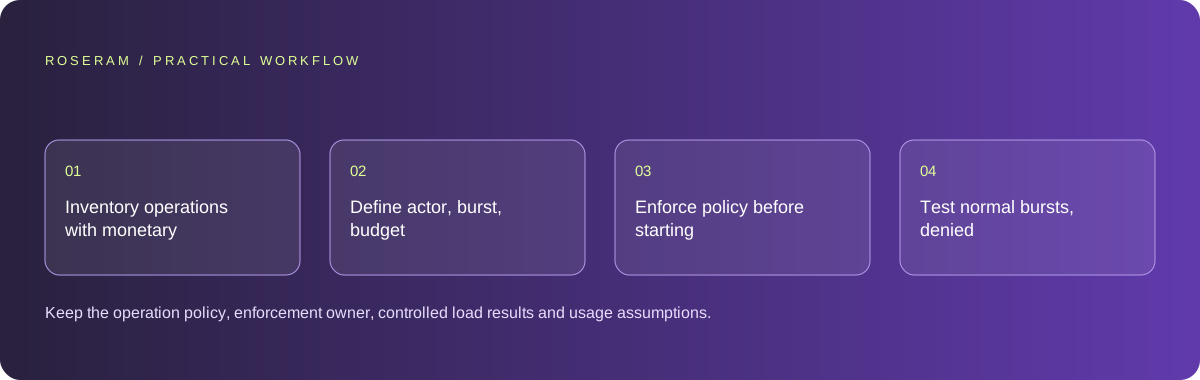
- Inventory operations with monetary or downstream side effects.
- Define actor, burst, budget and concurrency rules from actual usage needs.
- Enforce policy before starting expensive work and preserve accepted job identity.
- Test normal bursts, denied requests and safe retry after uncertain responses.
A detailed brief you can adapt for your agent
Replace the illustrative context with your approved facts and controlled inputs. Keep the stated boundaries when adapting the brief. The expected deliverable matters more than a particular tool name: ask for an explanation grounded in the inspected material and evidence for the requested outcome.
Design limits for image generation and enquiry delivery using these expected workloads. Separate burst, budget and concurrency. Enforce before expensive actions using the current identity and storage architecture. Include duplicate-job handling and clear denied outcomes. Do not rely only on browser controls or log full private prompts.Failure modes that an attractive preview can hide
A client-side counter is easy to bypass, and an IP-only policy can group unrelated users behind a shared network. Avoid pretending either is a complete abuse solution. Unbounded model retries can consume the very budget the limit was intended to protect. Keep observability aggregate and redacted, and investigate unusual behavior without dumping complete prompts.
Technical references: MDN: practical security implementation guides
Acceptance checks and the evidence to retain
Keep the operation policy, enforcement owner, controlled load results and usage assumptions. State whether limits are global or instance-local and what abuse patterns remain unaddressed.
| Controlled case | Expected evidence |
|---|---|
| Caller bypasses the page and sends repeated requests | Authoritative limits still apply. |
| Accepted job is retried after a lost response | The selected job-identity policy avoids duplicate expensive work. |
| Normal user reaches a limit | They receive a clear bounded outcome and a permitted recovery path. |
Specific answers
Common questions
Can disabling the submit button prevent API abuse?
It helps ordinary interaction but does not stop direct requests.
Will one limit fit every endpoint?
Different costs and customer tasks often require different policies.
What is the practical completion criterion?
Keep the operation policy, enforcement owner, controlled load results and usage assumptions. State whether limits are global or instance-local and what abuse patterns remain unaddressed.
Sources and editorial method
These references support the indicated technical facts. Workflows, examples and decision tables are original Roseram analysis. Illustrative costs are not vendor prices. No search volume, organic difficulty, ranking result or product endorsement is implied.
- MDN: practical security implementation guides ↗
Web security implementation reference; task-specific threat models and review remain necessary.
Roseram offers AI software and may compete with tools discussed here. Sources checked 2026-10-11. Send a sourced correction.
Your next step
Keep a practical checklist.
Mark your progress. This checklist and helpfulness choice are saved on this device only; they are not public reviews.
0 of 5 complete
Share your experience in the community or submit a sourced correction. Public experiences remain separate from editorial claims.
Bring your next idea
Keep learning. Build with context.
Get Roseram model and workspace reopening updates. The guide remains available whether or not you subscribe.
Explore the workspace guide →